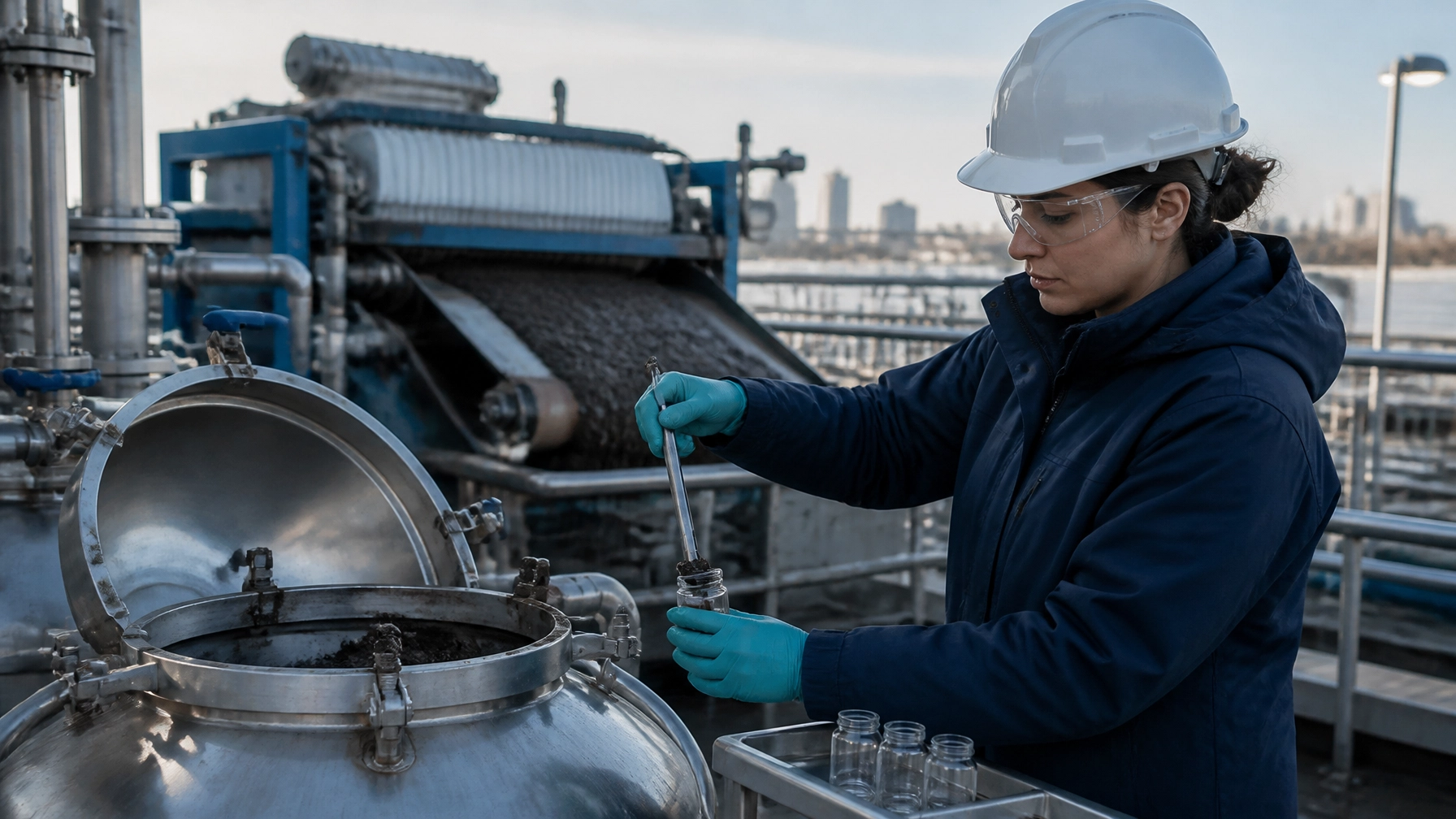
As of August 2026, New York’s PFAS framework for biosolids is no longer limited to wastewater treatment plant residuals. NYSDEC now requires a broader data and management approach covering biosolids sources, commercial biosolids-derived products, land application, and: through separate proposed rules: landfill leachate.
The practical message for municipalities, wastewater utilities, agricultural operators, product manufacturers, and landfill owners is straightforward: PFAS characterization must become part of routine material management, not an afterthought when a permit or customer raises a question.
Two NYSDEC policies drive the biosolids requirements:
- DMM-7: PFAS controls for recycled biosolids.
- DMM-7a: PFAS sampling and reporting for biosolids-derived products, including commercial products and products imported into New York.
A separate 2026 Part 360/363 proposal addresses PFAS treatment in landfill leachate before discharge to a water resource recovery facility or the environment.
“This Program Policy establishes interim PFOA and PFOS sampling criteria for biosolids that are recycled in New York State.” : NYSDEC DMM-7
What DMM-7 Requires for Recycled Biosolids
DMM-7 applies to facilities permitted under 6 NYCRR Subparts 361-2 and 361-3 that accept biosolids for recycling or beneficial use. That includes biosolids used for land application and facilities that produce certain biosolids-derived products.
The policy requires facilities to sample each biosolids source: meaning each water resource recovery facility supplying the material: and submit analytical results to NYSDEC.
The initial sampling requirement was established when DMM-7 was issued in 2023. Ongoing sampling frequency is determined by NYSDEC based on:
- The quantity of biosolids recycled.
- Potential industrial PFAS sources entering the wastewater treatment plant.
- Previous analytical results.
- The facility’s operating and source-control history.
Sampling must follow NYSDEC’s April 2023 PFAS Sampling, Analysis, and Assessment guidance. Personnel collecting samples must have PFAS-specific training acceptable to the Division of Materials Management.
DMM-7 identifies Draft EPA Method 1633 as the required analytical method unless NYSDEC approves an alternative. The method evaluates a broad PFAS suite. Facilities should not treat the policy as a PFOA-and-PFOS-only testing program, even though the interim action thresholds are based on those two compounds.
The DMM-7 policy also allows NYSDEC to request additional testing, including Synthetic Precipitation Leaching Procedure analysis, when the dry-weight results do not provide enough information to evaluate recycling risk.
The DMM-7 PFAS Thresholds
The most important technical point is that the thresholds apply to each compound individually. They are not a combined PFOS-plus-PFOA number.
Results are reported on a dry-weight basis in micrograms per kilogram, which is equivalent to parts per billion.
| PFOS or PFOA concentration in biosolids | NYSDEC interim action |
|---|---|
| 20 ppb or less | No additional PFAS-specific action required under DMM-7 |
| Greater than 20 ppb but less than 50 ppb | Additional sampling required; NYSDEC may restrict recycling if levels are not reduced below 20 ppb after one year |
| 50 ppb or greater | Recycling is prohibited until the concentration is reduced below 20 ppb |
These values are interim management criteria. They are not presented as a complete risk assessment or a permanent statewide standard. NYSDEC is using them to identify biosolids affected by industrial PFAS sources, require source reduction where appropriate, and generate data for future rulemaking.
For a wastewater utility, a result above 20 ppb should trigger more than another laboratory order. It should trigger a source investigation.
Potential source-control steps include:
- Reviewing industrial user permits and pretreatment records.
- Identifying facilities using fluorinated surfactants, coatings, plating chemistry, or specialty process materials.
- Evaluating incoming wastewater and industrial discharge points.
- Separating known industrial contributors from predominantly domestic flows.
- Coordinating corrective actions with the wastewater utility, industrial users, and NYSDEC.

DMM-7a Brings Commercial Biosolids Products Into the Program
DMM-7a, adopted by NYSDEC on June 10, 2026, expands the program from source biosolids to finished biosolids-derived products.
Covered products may include:
- Biosolids-derived compost.
- Heat-dried pellets.
- Soil amendments.
- Other commercial soil products made from biosolids.
- Comparable products manufactured outside New York and distributed into the state.
The policy applies to permitted New York facilities producing these products and to facilities or entities authorized to distribute biosolids products from out-of-state sources.
Under DMM-7a, covered facilities must sample and analyze finished biosolids products for PFAS and report the results to NYSDEC. The 2026 stakeholder materials describe an initial sampling window of up to 90 days after issuance for covered facilities, with ongoing sampling frequency tied to production volume and other facility-specific factors.
Testing is expected to use a broad PFAS suite consistent with Draft EPA Method 1633. DMM-7a materials also identify the use of a New York State Department of Health-certified laboratory for product testing.
That distinction matters. DMM-7 included temporary flexibility because certified PFAS laboratory methods were not yet available under the applicable solid waste regulations. Facilities should not assume that the same laboratory provisions automatically apply to commercial product testing under DMM-7a.
What DMM-7a Does Not Yet Do
DMM-7a is primarily a sampling, reporting, and data-development policy. It does not currently establish a complete PFAS-based product-use restriction system for every commercial biosolids product.
In practical terms:
- Finished products must be characterized.
- Results must be reported.
- NYSDEC is building a statewide dataset.
- Future regulations may establish product concentration limits, operating conditions, or distribution restrictions.
The absence of a current product prohibition does not eliminate project risk. Product manufacturers, distributors, and agricultural users should maintain full records for each batch, source, laboratory, analytical method, and destination.
That documentation will matter when customers, municipalities, lenders, regulators, or future rules require proof of product quality.
Land Application Restrictions Still Apply
PFAS results are only one part of the land-application decision. Biosolids and biosolids-derived products must also comply with existing Part 360 and Part 361 requirements, permit conditions, site limitations, and crop-use restrictions.
NYSDEC’s current land application guidance addresses conditions such as:
- Groundwater depth.
- Depth to bedrock.
- Slope limitations.
- Flood hazard areas.
- Hydraulic loading.
- Setbacks and access controls.
- Public access restrictions.
- Crop harvesting and grazing intervals.
- Application rates and incorporation requirements.
DMM-7 adds another screening layer. A biosolids source at or above 50 ppb for PFOA or PFOS cannot continue recycling under the policy until concentrations fall below 20 ppb. A source between 20 and 50 ppb remains subject to additional sampling and potential future restrictions.
Agricultural operators should also track proposed changes to Class B biosolids management and pending legislation, including proposed restrictions on land application. Those proposals are not the same as current enforceable requirements. However, they demonstrate the direction of travel: New York is moving toward tighter controls on PFAS-bearing materials applied to agricultural and other land.
Before approving a field, owners and operators should confirm:
- The current permit status of the biosolids source.
- Recent PFAS results for PFOA and PFOS.
- The analytical method and laboratory qualifications.
- Background soil conditions.
- Groundwater and bedrock depth.
- Slope, drainage, floodplain, and setback conditions.
- Crop, grazing, and public-access restrictions.
- Required NYSDEC notifications and records.

Landfill Leachate Is a Separate: but Connected: Issue
DMM-7 and DMM-7a focus on biosolids and biosolids-derived products. They do not themselves create the proposed PFAS treatment requirements for landfill leachate.
That issue is moving through a separate NYSDEC rulemaking for 6 NYCRR Parts 360 and 363. The proposed framework would affect active municipal solid waste landfills and active construction and demolition debris landfills with leachate collection systems.
The proposal would require landfill leachate to be treated before it is:
- Sent to a water resource recovery facility.
- Discharged under a SPDES permit.
- Released to another authorized environmental pathway.
Treatment could occur at the landfill or at an off-site permitted facility. The treatment location would need authorization under the Part 360 series as a leachate treatment facility.
NYSDEC is taking a performance-based approach rather than requiring one specific technology. A project may need a treatment train involving technologies such as:
- Equalization and pretreatment.
- Granular activated carbon.
- Reverse osmosis.
- Concentrate management.
- Additional polishing or destruction technologies.
- Proper disposal of spent media and treatment residuals.
The exact treatment configuration depends on leachate chemistry, discharge requirements, flow, PFAS concentrations, residual management, and permit conditions. The proposed rules are designed to require contaminant removal performance rather than allow the receiving WRRF to absorb the PFAS burden.
This creates a direct connection between biosolids and landfill planning. If high-PFAS biosolids can no longer be recycled through land application, more material may move toward disposal. That can increase landfill loading and, in turn, PFAS concentrations in leachate.
Landfills and municipalities should review the NYSDEC proposed Part 360/363 leachate rulemaking now rather than waiting for a WRRF to revise its acceptance conditions.

A Practical 2026 Compliance Plan
For municipalities, agricultural projects, biosolids processors, and landfill operators, the next steps are operational:
-
Inventory every biosolids source and product stream.
Identify where material originates, how it is processed, and where it goes. -
Confirm the applicable policy and permit.
DMM-7 and DMM-7a do not replace Part 360, Part 361, SPDES, pretreatment, or facility-specific permit obligations. -
Build a defensible sampling plan.
Address sampling locations, personnel training, equipment, contamination control, laboratory qualifications, method selection, detection limits, and chain of custody. -
Use results to investigate sources.
Elevated results require more than reporting. They require coordination with industrial users and regulators. -
Evaluate land application sites before material is scheduled.
Confirm soil, groundwater, slope, floodplain, crop, access, and permit constraints. -
Plan for non-land-application contingencies.
If a source exceeds DMM-7 criteria, identify treatment, storage, disposal, or alternative management routes before the material is generated. -
Model leachate impacts.
Landfills should assess flow, PFAS loading, treatment capacity, residuals, and potential WRRF acceptance changes.
Envicon Group helps clients connect the laboratory result to the decision that follows. Our team supports environmental sampling, regulatory coordination, soil and groundwater management, compliance permitting, field oversight, and real-time project reporting across New York and New Jersey. We work directly with owners, utilities, contractors, attorneys, regulators, and public agencies because collaboration is not a buzzword: it’s how projects move.
The Takeaway
NYSDEC’s 2026 overhaul creates a more connected PFAS management system:
- DMM-7 controls recycled biosolids through PFOA and PFOS action tiers.
- DMM-7a extends sampling and reporting to commercial biosolids-derived products.
- Part 361 land-application requirements remain in force alongside PFAS controls.
- Proposed Parts 360 and 363 would require PFAS-focused treatment of landfill leachate before discharge.
The firms that succeed will not wait for a failed sample, rejected load, or revised WRRF acceptance letter. They will build source tracking, sampling, regulatory review, and contingency planning into the operating model now.
PFAS compliance is not just about testing material. It is about keeping the next decision clear.
Ready to Plan Your PFAS Compliance Strategy?
- Call Envicon Group now at (917) 764-2171
- Book a free consultation
- Use the Environmental Risk Screener

Leave a Reply