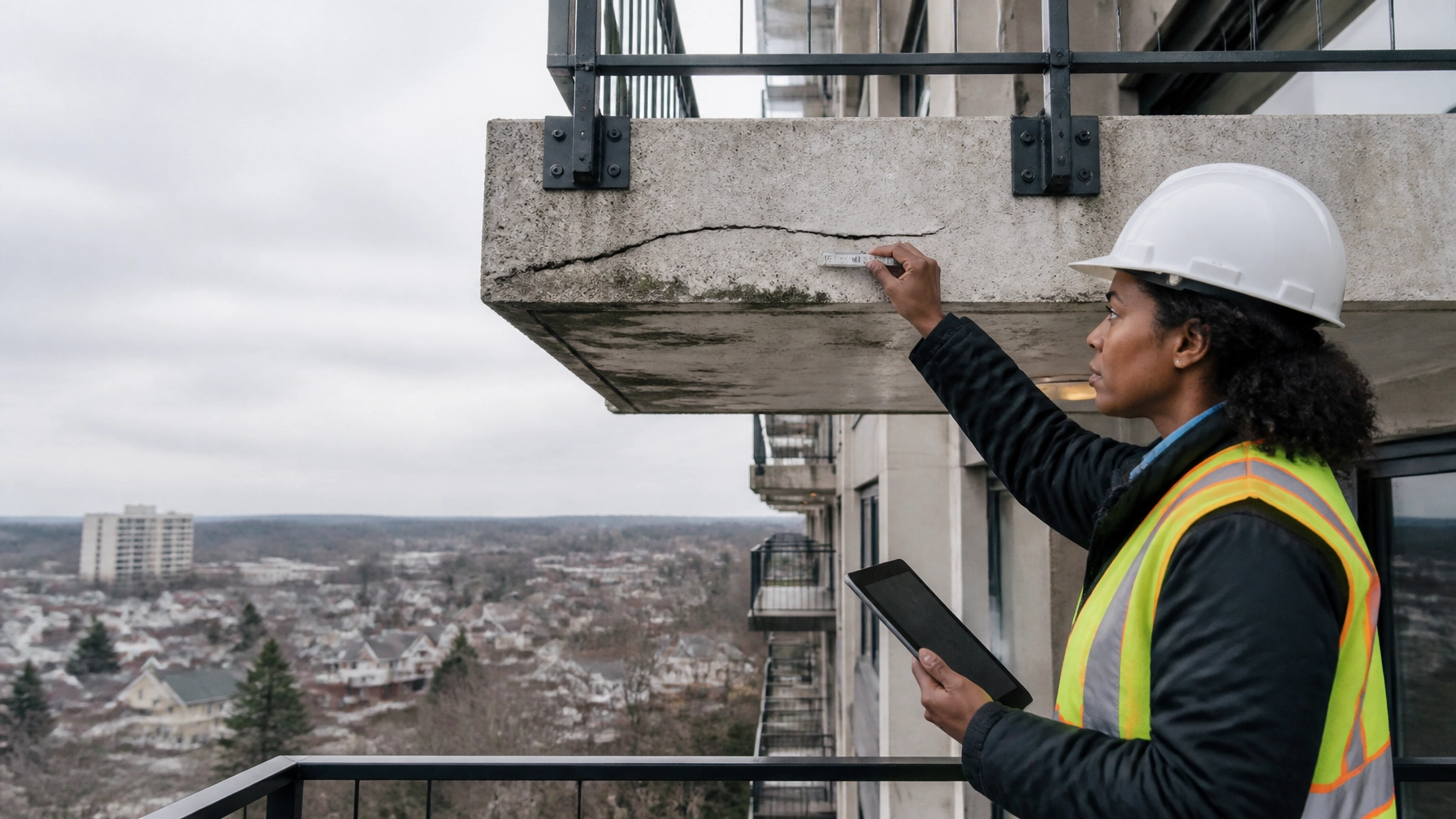
New Jersey condominium boards face two separate compliance obligations: structural integrity inspections for certain buildings and capital reserve studies for planned real estate developments.
The requirements are connected, but they aren’t interchangeable. A reserve study doesn’t replace a structural inspection. A structural inspection doesn’t create a 30-year reserve funding plan.
This distinction matters for condominium associations in Jersey City, Hoboken, Newark, Bergen County, Essex County, and throughout New Jersey.
It also matters because the law places responsibility on the association and its executive board to act, document decisions, and address identified corrective maintenance.
First, a correction on the law’s citation
Senate Bill 2760 is commonly associated with New Jersey’s Residential Structural Integrity Law. However, the controlling enactment is P.L. 2023, c.214, signed on January 8, 2024.
The law is sometimes incorrectly described as P.L. 2024, c.7. Based on the New Jersey Department of Community Affairs and New Jersey Legislature materials, condominium boards should reference P.L. 2023, c.214, codified in part at N.J.S.A. 52:27D-132.2 through 52:27D-132.5.
The official statute is available through the New Jersey Legislature. The New Jersey DCA also provides a Structural Integrity and Capital Reserve FAQ.
This article provides general information, not legal advice. Boards should confirm current requirements with association counsel and a qualified New Jersey-licensed engineer.
Which condominium buildings are covered?
The Structural Integrity Law applies to a “covered building.” In general, that means a residential condominium or cooperative building with a primary load-bearing system made of:
- Concrete
- Masonry
- Steel
- Heavy timber
- A hybrid structural system
- A building with a podium deck
The law excludes certain frame-built structures, single-family dwellings, primarily rental buildings, and buildings where concrete, masonry, steel, or heavy timber elements do not form part of the primary load-bearing path.
Building height alone does not determine whether a condominium is covered. A low-rise condominium may still fall within the law if its primary load-bearing system meets the statutory definition.
The evaluation focuses on the structural path that transfers building loads to the foundation. That includes columns, beams, bracing, the foundation, and connected or attached balconies.

New Jersey structural integrity inspection deadlines
The inspection deadline depends on the building’s certificate of occupancy date.
Buildings receiving a certificate of occupancy after January 8, 2024
For a new covered condominium building, the initial post-occupancy structural inspection must occur by the earlier of:
- Fifteen years after the certificate of occupancy date; or
- Sixty days after observable damage to the primary load-bearing system.
That means a condominium with a certificate of occupancy dated June 1, 2025 generally reaches its 15-year inspection milestone on June 1, 2040, unless damage requires an earlier inspection.
Buildings with a certificate of occupancy before January 8, 2024
The law includes transition deadlines for existing buildings:
- If the certificate of occupancy was issued less than 15 years before January 8, 2024, the initial inspection must occur within one year after the building reaches 15 years from its certificate of occupancy date.
- If the certificate of occupancy was issued 15 or more years before January 8, 2024, the initial inspection was due within two years after the law’s effective date, no later than January 8, 2026.
- If observable damage is identified, the inspection must occur within 60 days, regardless of the building’s age or normal inspection cycle.
As of 2026, a covered condominium with a pre-January 8, 2009 certificate of occupancy may already be past the initial inspection deadline if the association has not completed the required evaluation.
The CO date must be verified
Boards should not rely on a property manager’s estimated construction date. The relevant date is the certificate of occupancy issued under New Jersey’s Uniform Construction Code process.
A practical compliance review should confirm:
- The original or applicable certificate of occupancy.
- Whether the building has been converted to condominium or cooperative ownership.
- The primary structural system and any podium or balcony conditions.
- Whether prior structural reports exist.
- Whether repairs, alterations, or observable damage changed the inspection schedule.
Envicon helps owners and associations organize technical records, site observations, regulatory documentation, and action items through a field-first process supported by digital project management solutions.
What does a condominium structural inspection include?
A condominium structural inspection under New Jersey law is not a general property-condition walk-through.
The inspection evaluates the building components that form the primary load-bearing system. Depending on site conditions, the scope may include:
- Foundations and structural slabs
- Columns, beams, and bearing walls
- Podium decks and transfer slabs
- Structural steel and bracing
- Concrete balconies and balcony connections
- Masonry structural elements
- Visible deterioration, cracking, spalling, corrosion, displacement, or water-related damage
- Evidence of progressive deterioration
- Conditions that require corrective maintenance
The licensed New Jersey engineer must prepare a written report describing the condition of the primary load-bearing system. The report must identify required maintenance or repairs, establish the timing of the next inspection, and follow an ASCE structural condition assessment protocol or a similar protocol from a nationally recognized structural engineering organization.
The report must also be provided to the applicable municipal appointing authority, construction official, and enforcing agency. Residents may request access to written reports issued under the law.
A structural engineer may recommend additional testing when visual observations do not adequately define the condition. That may include concrete sounding, cover measurements, corrosion assessment, selective exposure, water-intrusion review, or coordination with civil and geotechnical professionals.
Recurring inspections: don’t treat the first report as the finish line
The first condominium structural inspection creates an ongoing compliance obligation.
The inspecting engineer must establish a reasonable date for the next inspection. The statutory schedule generally provides:
- No more than 10 years between inspections during the first 20 years following the certificate of occupancy.
- No more than five years between inspections after the building is more than 20 years old.
- A new inspection within 60 days when observable damage to the primary load-bearing system is identified.
The engineer may recommend a shorter interval based on deterioration, water exposure, coastal conditions, construction defects, past repairs, deferred maintenance, or other risk factors.
For a condominium in Hudson County or along the New Jersey waterfront, exposure to wind-driven rain, freeze-thaw cycles, salt, and persistent moisture can influence the practical inspection schedule even when the statutory maximum has not been reached.
Reserve studies are a separate requirement
P.L. 2023, c.214 also amended New Jersey requirements for capital reserve studies. These requirements apply more broadly than the structural inspection provisions.
A planned real estate development association, including many condominium, cooperative, and HOA communities, must undertake and fund a capital reserve study to evaluate the repair and replacement needs of common-area capital assets.
A compliant reserve study should address:
- Current reserve fund balances
- Anticipated association income and expenses
- The physical condition of common-area components
- Repair and replacement costs
- Costs for future reserve studies and updates
- Periodic structural inspection costs
- Corrective maintenance costs
- A proposed 30-year reserve funding plan
The study must be performed or overseen by a Community Associations Institute-credentialed reserve specialist, a New Jersey-licensed engineer, or a New Jersey-licensed architect. It must be reviewed and conducted at least once every five years for covered buildings.
Associations with less than $25,000 in total common-area capital assets may qualify for an exemption from the reserve-study provision. Boards should document how that determination was made rather than assume the exemption applies.

How structural inspections and reserve studies work together
A reserve study should include the anticipated costs of periodic structural inspections and corrective maintenance. That allows the board to plan for known obligations instead of treating every structural issue as an emergency assessment.
The correct sequence is usually:
- Determine whether the building is a covered building.
- Verify the certificate of occupancy date.
- Confirm the initial structural inspection deadline.
- Retain a qualified New Jersey-licensed engineer.
- Complete the primary load-bearing system evaluation.
- Document corrective maintenance and permitting needs.
- Update the capital reserve study and 30-year funding plan.
- Track repairs, reports, filings, and the next inspection date.
This is where many boards lose time. The engineer identifies a repair, but the association has no clear scope, budget, permit pathway, contractor coordination plan, or recordkeeping system.
Envicon’s approach is built around closing that gap. We coordinate technical findings with civil engineering, construction oversight, regulatory documentation, and project controls so the board receives more than a report, it receives a path to action.
Reducing board liability through disciplined documentation
The New Jersey DCA states that it does not oversee the business decisions of owner-controlled associations regarding reserve accounts, assessments, or funding choices. The association and its board retain responsibility for making informed decisions.
That does not mean a board must predict every future repair. It does mean the board should be able to show that it:
- Identified the applicable legal requirements.
- Retained properly qualified professionals.
- Reviewed the structural inspection and reserve study.
- Communicated material findings to unit owners.
- Budgeted for corrective maintenance.
- Obtained permits and repair plans where required.
- Followed through on urgent conditions.
- Maintained complete project records.
A board should also avoid treating a clean report as permission to defer visible damage. If residents, property managers, contractors, or board members observe cracking, spalling, exposed reinforcement, balcony movement, water intrusion, or other potentially structural conditions, the observation should be documented and evaluated promptly.

A practical compliance checklist for New Jersey condominium boards
Use this checklist as a starting point:
- Locate the certificate of occupancy.
- Confirm whether the building is concrete, masonry, steel, heavy timber, hybrid, or podium construction.
- Determine whether the building is a covered building under P.L. 2023, c.214.
- Check whether the initial structural inspection deadline has passed.
- Ask for prior structural reports, repair records, warranties, and permits.
- Retain a New Jersey-licensed engineer qualified in structural assessment.
- Confirm that the report follows ASCE or a similar nationally recognized protocol.
- Establish the next inspection date in the association’s compliance calendar.
- Obtain or update the five-year reserve study.
- Include structural inspection and corrective maintenance costs in the 30-year funding plan.
- Preserve reports and supporting records for unit owners, counsel, insurers, and regulators.
The bottom line
The New Jersey condo inspection law is not just a periodic engineering requirement. It is a management system for identifying structural risk, funding necessary work, and protecting the long-term value of a community.
For boards searching for a structural integrity inspection in NJ, a condominium structural inspection in New Jersey, or guidance on NJ condo inspection law, the first step is to establish the building’s coverage and deadline from the certificate of occupancy: not from assumptions.
Envicon Group brings licensed professional coordination, field-level oversight, clear documentation, and local New Jersey project experience to complex property conditions. We solve environmental and engineering challenges with precision, speed, and trust.
Take the next step

Leave a Reply