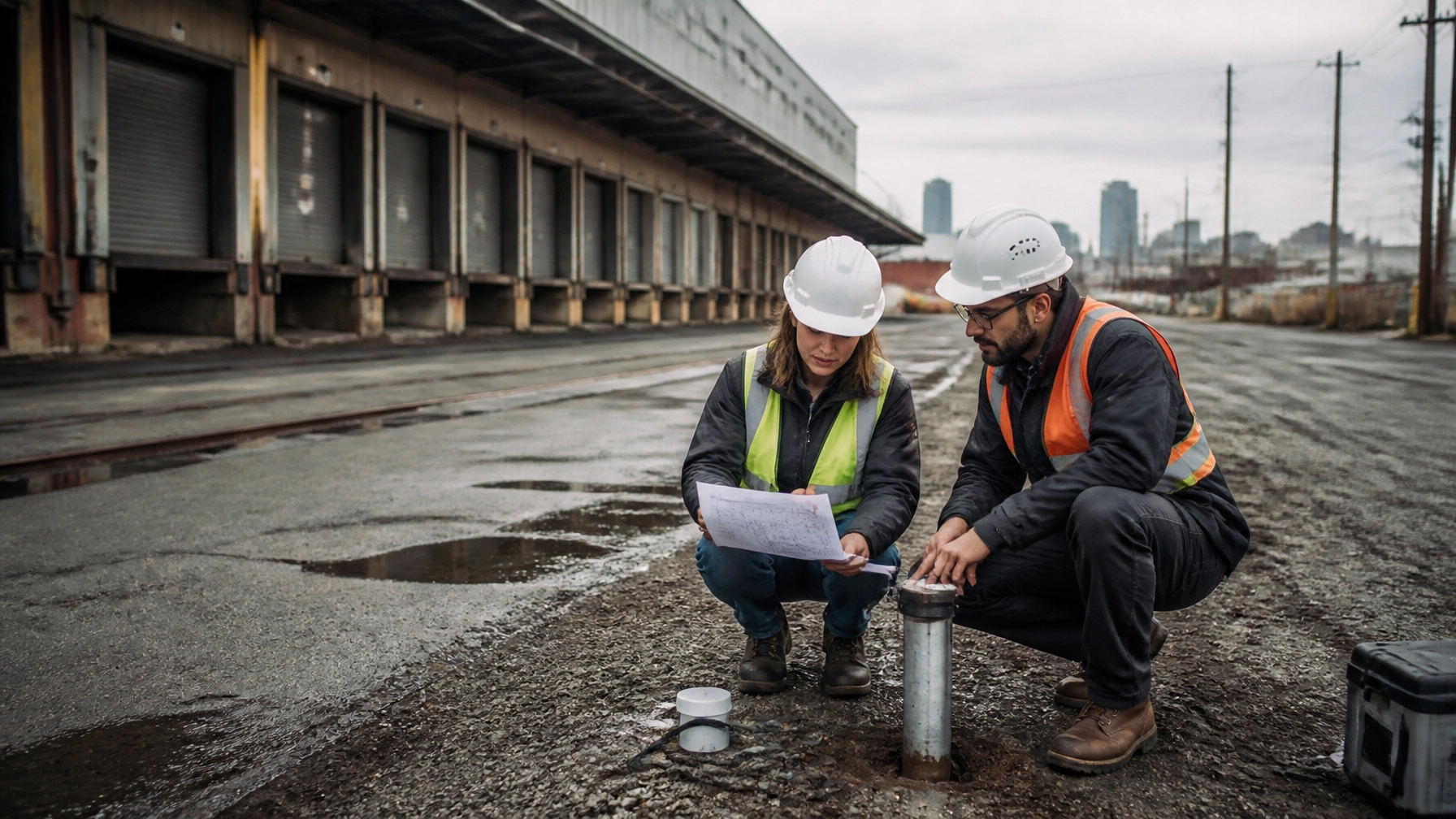
A warehouse acquisition in Newark, Jersey City, Hoboken, Bayonne, Bergen County, or Essex County is not just a building transaction. The property may carry environmental obligations tied to former manufacturing, fuel storage, rail activity, waterfront filling, industrial waste, or regulated operations.
That is why NJ environmental due diligence for warehouse acquisition must go beyond a generic report. The right process connects the lender’s Phase I requirements with NJDEP obligations, purchase agreement protections, construction planning, and post-closing responsibility.
A warehouse can look clean and still have:
- A former underground storage tank beneath a loading yard
- Historic fill containing petroleum, metals, PAHs, or other contaminants
- Soil vapor concerns beneath a slab
- An ISRA trigger that requires LSRP involvement
- Stormwater permits or compliance obligations
- Asbestos and lead risks inside an older structure
- Geotechnical conditions that change the redevelopment budget
The goal is not to collect reports. The goal is to identify risk early enough to price it, allocate it, and keep the acquisition moving.
Start with an ASTM E1527-21 Phase I ESA
The first step for most warehouse acquisitions is an ASTM E1527-21 Phase I Environmental Site Assessment.
ASTM E1527-21 is recognized by the U.S. Environmental Protection Agency as a method that can satisfy the federal All Appropriate Inquiries rule under 40 CFR Part 312. EPA states that, after the transition period, ASTM E1527-21 became the recognized ASTM standard for commercial and industrial property AAI evaluations.
A lender-ready Phase I should include:
- Historical aerial photographs, Sanborn maps, city directories, and topographic records
- Federal, state, and local environmental database searches
- Site reconnaissance and interviews with owners, operators, and occupants
- Review of adjoining properties and potential off-site sources
- Identification of Recognized Environmental Conditions, Historical RECs, and Controlled RECs
- Review of activity and use limitations, environmental liens, and institutional controls
- Clear recommendations for additional investigation
Some AAI components must be completed or updated within 180 days before acquisition. The report also needs to be completed within the applicable one-year period before closing.
A Phase I does not include subsurface sampling. It also does not replace asbestos, lead, geotechnical, stormwater, building condition, or regulatory transfer reviews. Those scopes should be added when the property history or transaction requires them.
When a Phase II ESA becomes necessary
A Phase II ESA is appropriate when the Phase I identifies a REC or when other transaction facts create a reason to investigate below grade.
Common triggers at New Jersey warehouses include:
- Current or former USTs
- Stained soil, floor drains, or chemical storage
- Former manufacturing, plating, printing, dry-cleaning, or bulk storage
- Historic fill or undocumented imported soil
- Regulatory files showing spills, violations, or unresolved cases
- Soil vapor or groundwater contamination near occupied buildings
- Lender requirements for quantified environmental exposure
- Planned excavation, expansion, grading, or utility work
- A purchase price that depends on a defensible cleanup estimate
A targeted Phase II should answer a business question. For example:
- Is the suspected UST leaking?
- Is historic fill present beneath the proposed addition?
- Does groundwater contamination extend beyond the property?
- Is there a complete vapor intrusion pathway?
- What will soil disposal cost during construction?
- Does the site require an LSRP-led remediation path?
Envicon places borings and monitoring points against the identified Areas of Concern. That produces more useful information than scattering samples across a site without a decision framework.
USTs can change the closing timeline
A former fuel tank is one of the most common acquisition risks at industrial properties.
The diligence team should review:
- NJDEP UST registration records
- Tank size, contents, age, and service history
- Closure, removal, or abandonment documentation
- Piping locations and dispenser areas
- Historical spill reports and remediation files
- Soil and groundwater data from prior work
- Whether the tank is located below a building, dock, or paved yard
New Jersey UST closure work must follow applicable NJDEP requirements, including proper system closure, documentation, field observations, and environmental sampling where required. NJDEP provides UST compliance materials through its official UST program resources.
Do not treat an old closure certificate as proof that the property has no environmental exposure. The certificate may establish that a tank was closed, but it may not resolve contamination outside the excavation or beneath adjacent structures.

Historic fill is a transaction issue and a construction issue
Historic fill is common in low-lying and formerly industrial areas of Hudson County, including parts of Jersey City, Hoboken, Bayonne, and nearby waterfront districts.
It may contain:
- Ash and cinders
- Brick and concrete
- Petroleum-related compounds
- PAHs
- Lead and other metals
- Construction debris
- Site-specific contaminants tied to prior operations
NJDEP guidance treats historic fill as a condition that requires careful investigation and management. The NJDEP Preliminary Assessment guidance directs investigators to examine whether fill was placed to raise grade or support prior development. Historic fill mapping can help identify risk, but it should not replace field confirmation.
For an acquisition, historic fill affects more than environmental liability. It can affect:
- Excavation and disposal costs
- Soil reuse options
- Foundation design
- Utility trenching
- Stormwater construction
- Vapor and groundwater evaluation
- Cap or engineering control requirements

PFAS, dioxin, and vapor require a site-specific screen
PFAS should not be added to every analytical program automatically. It should be considered when the property history supports it.
Potential PFAS indicators include:
- Aqueous film-forming foam use
- Firefighting training or emergency response areas
- Plating or metal-finishing operations
- Specialty chemical manufacturing
- Bulk terminals and certain industrial processing operations
Review current NJDEP PFAS information and guidance when the property history indicates a credible source.
Dioxin analysis may be appropriate where historical operations involved combustion, chemical manufacturing, pesticide or herbicide production, waste handling, or other activities that could generate dioxin-like compounds. It is not a default warehouse test. The decision should follow the historical record and the identified Areas of Concern.
Vapor intrusion should be evaluated when volatile contaminants are present in soil or groundwater near an occupied building. NJDEP’s Vapor Intrusion Technical Guidance addresses building surveys, soil gas, sub-slab, indoor air, and mitigation decisions.
Warehouse acquisition diligence matrix
| Diligence area | Primary question | Typical trigger | Transaction output |
|---|---|---|---|
| ASTM E1527-21 Phase I | What environmental conditions are reasonably apparent? | Every commercial acquisition | Lender-ready REC opinion |
| Phase II ESA | Is contamination present and what is the exposure? | REC, UST, fill, spill, lender request | Sampling results and cost path |
| UST review | Was fuel or another regulated substance released? | Current or former tanks | Closure and remediation strategy |
| Historic fill | What is beneath the pavement or slab? | Waterfront, low-lying, industrial history | Soil management and cap planning |
| PFAS and dioxin | Do site operations support targeted analysis? | AFFF, plating, combustion, chemical history | Site-specific analyte plan |
| Vapor | Could soil or groundwater affect indoor air? | VOCs, chlorinated solvents, petroleum | VI pathway determination |
| Asbestos and lead | Can renovation or demolition proceed safely? | Older warehouse construction | Survey and abatement scope |
| Geotechnical | Can the planned redevelopment be built as designed? | Addition, heavy storage, new foundations | Subsurface design data |
| Stormwater | Are permits, SWPPP obligations, or drainage upgrades required? | Disturbance, expansion, redevelopment | Compliance and civil scope |
| ISRA and LSRP | Does the transaction trigger New Jersey obligations? | Qualifying industrial establishment and trigger | Applicability review and regulatory path |
Add ISRA and LSRP review before signing
A warehouse may fall under New Jersey’s Industrial Site Recovery Act depending on the property’s operations, industrial classification, and transaction facts. Do not assume that a standard Phase I answers the ISRA question.
The acquisition team should determine:
- Whether the property is an ISRA industrial establishment.
- Whether the transfer or operational change creates a triggering event.
- Whether an LSRP must be retained.
- Whether a General Information Notice or other NJDEP filing applies.
- Whether the seller has an existing remediation case.
- Whether a Response Action Outcome, alternate compliance option, remediation certification, or pre-purchase arrangement is appropriate.
- Whether financial assurance or post-closing remediation obligations will continue.
Envicon’s NJ LSRP services connect the investigation, NJDEP communication, remedial planning, and case-closure path. The official NJDEP ISRA guidance should be reviewed with environmental counsel and the project LSRP before closing.
Protect the buyer in the purchase agreement
Environmental diligence should change the purchase agreement when risk remains unresolved.
Common protections include:
- A defined environmental investigation period
- Buyer access for borings, tank review, and sampling
- Seller delivery of all prior reports and regulatory correspondence
- Representations about tanks, spills, hazardous materials, and permits
- A right to terminate or renegotiate based on defined findings
- Escrow or holdback for identified remediation
- Clear allocation of pre-closing and post-closing obligations
- Cooperation requirements for NJDEP filings and site access
- Indemnity language that matches the actual environmental risk
- A schedule for removing tanks, managing soil, or maintaining controls
The environmental consultant should communicate directly with counsel, the lender, the broker, and the acquisition team. A report that reaches the buyer after the agreement is signed has limited leverage.
A practical closing schedule
For a straightforward warehouse acquisition, plan the work in this order:
- Days 1 to 2: Confirm address, site access, lender scope, closing date, prior reports, and purchase agreement deadlines.
- Week 1: Begin records review, database research, interviews, and site reconnaissance.
- Weeks 2 to 3: Deliver the ASTM E1527-21 Phase I and identify Phase II, UST, vapor, or regulatory needs.
- Weeks 3 to 6: Complete targeted Phase II work, laboratory analysis, and cost evaluation if required.
- In parallel: Review ISRA applicability, LSRP status, asbestos, geotechnical, stormwater, and construction implications.
- Before closing: Finalize lender reliance, purchase agreement protections, remediation responsibility, and post-closing obligations.
Envicon’s Jersey City environmental consulting team serves Hudson County and nearby markets, including Newark, Hoboken, Bayonne, Bergen County, and Essex County. The advantage is direct coordination. One senior team can connect the Phase I, Phase II, LSRP, soil, vapor, civil, and construction decisions instead of sending the buyer through separate departments.
Frequently asked questions
What is the first environmental report needed for a New Jersey warehouse acquisition?
Most transactions begin with an ASTM E1527-21 Phase I ESA. A separate NJDEP Preliminary Assessment or LSRP review may also be needed when the site has industrial history, known contamination, or an ISRA concern.
Does every warehouse acquisition require a Phase II ESA?
No. A Phase II is generally triggered by a REC, UST concern, historic fill, known spill, vapor concern, lender requirement, or planned work that will disturb potentially impacted soil.
Is historic fill automatically a reason to cancel a warehouse purchase?
No. Historic fill is a condition that must be characterized and managed. The financial impact depends on contaminant concentrations, fill thickness, planned excavation, disposal requirements, cap conditions, and regulatory obligations.
Can a Phase I ESA identify asbestos, lead, or structural defects?
Not as a full building survey. Those conditions require separate scopes. Coordinate asbestos, lead, property condition, geotechnical, and structural inspections with the environmental diligence schedule.
When should an LSRP be involved?
Engage an LSRP as soon as ISRA applicability, known contamination, an active NJDEP case, or a required remediation path becomes possible. Waiting until the closing date can limit the available options.
How much does warehouse environmental due diligence cost?
The cost depends on acreage, historical operations, site access, suspected tanks, laboratory scope, urgency, and lender requirements. Use Envicon’s cost estimator for an initial project range, then request a fixed scope.
The takeaway
A New Jersey warehouse acquisition should not be managed as a Phase I report exercise. The transaction team needs a connected workflow that addresses ASTM E1527-21, Phase II triggers, USTs, historic fill, vapor, PFAS and dioxin where applicable, asbestos, geotechnical conditions, stormwater, ISRA, LSRP obligations, lender requirements, and purchase agreement protections.
The right diligence process gives you more than a list of findings. It gives you a price, a schedule, a responsible party, and a path to closing.
Ready to evaluate a warehouse acquisition?
- Call Envicon at (917) 764-2171
- Get a free quote
- Estimate your project cost
- Review Phase I ESA services

Leave a Reply