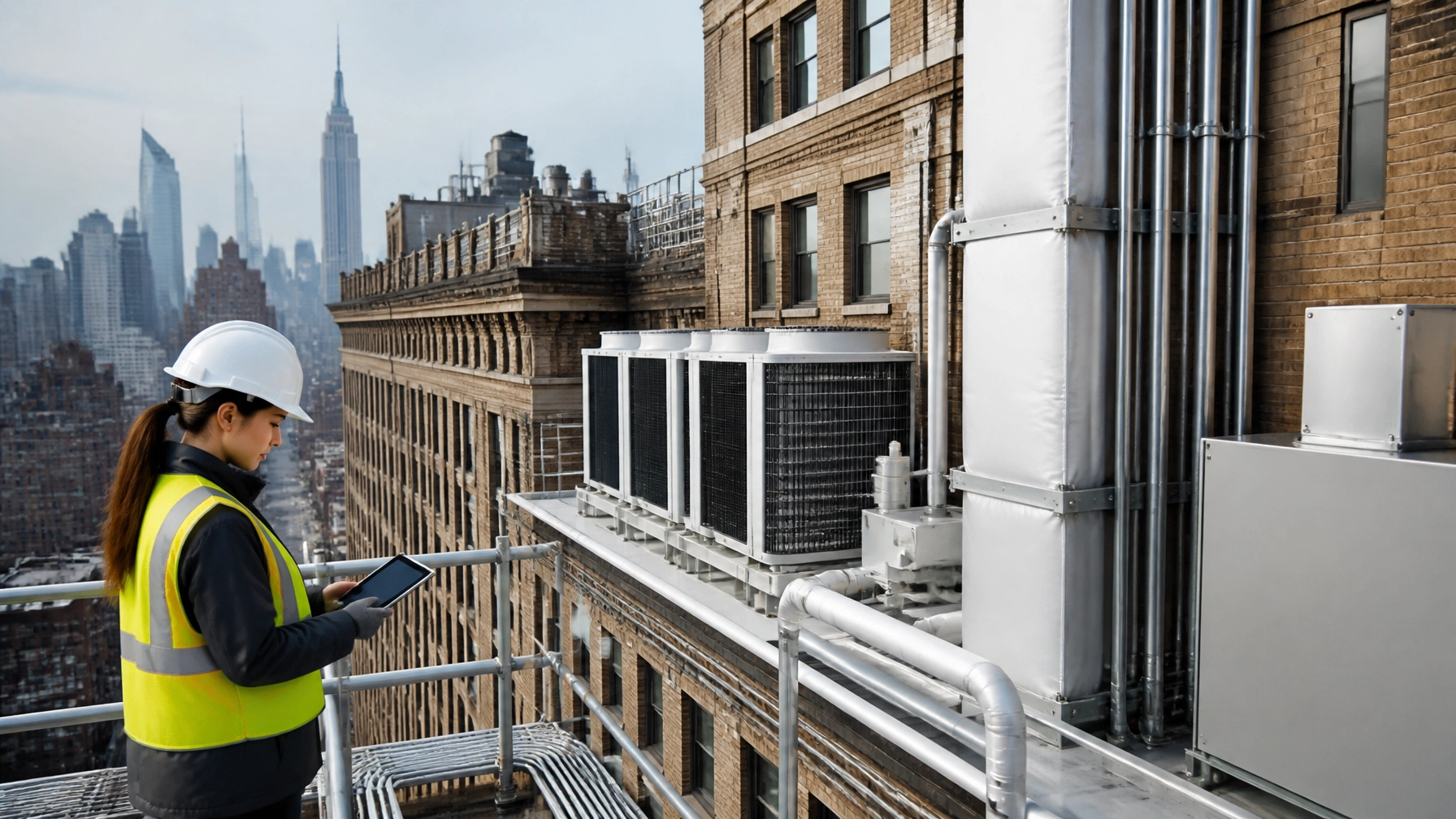
For covered buildings in Manhattan, Brooklyn, Queens, the Bronx, and Staten Island, NYC Local Law 97 compliance in 2026 is not just a reporting exercise. It is a building improvement and construction coordination issue.
Local Law 97 sets greenhouse gas emissions limits for most buildings above 25,000 gross square feet. Owners must report annual emissions, address excess emissions, and plan for increasingly demanding compliance periods. The work needed to reduce emissions can also trigger asbestos surveys, lead-related controls, roof and structural reviews, electrical upgrades, stormwater planning, soil disturbance controls, air monitoring, and construction oversight.
The right compliance strategy connects those scopes before construction begins.
What NYC Local Law 97 requires in 2026
Local Law 97 generally applies to:
- A single building exceeding 25,000 gross square feet
- Multiple buildings on the same tax lot exceeding 50,000 gross square feet in total
- Multiple condominium buildings governed by the same board of managers exceeding 50,000 gross square feet in total
The law establishes emissions limits based on building characteristics, occupancy or property type, floor area, and reported energy use. Owners should confirm the applicable limit through current NYC Department of Buildings emissions guidance and the applicable provisions of Article 320.
For the 2026 reporting cycle:
- The standard report deadline was May 1, 2026.
- DOB provided an automatic grace period through June 30, 2026.
- Owners who applied for an extension by June 30 could receive an extended filing deadline of August 29, 2026.
- The 2026 filing covers calendar-year 2025 emissions.
- The extension affected filing timing. It did not change the building’s emissions limit or eliminate excess emissions exposure.
As of September 2026, those 2026 deadlines have passed. Owners should not assume that the same extension structure will apply to a future reporting cycle. Review the latest DOB LL97 processing guidance before relying on any deadline, grace period, or extension.
“The deadline to submit this year’s LL97 compliance report is May 1, 2026, with an automatic 60-day grace period through June 30, 2026.”
Source: NYC Department of Buildings LL97 Processing FAQs
Emissions limits and penalty exposure
The first LL97 compliance period covers calendar years 2024 through 2029. The building must remain at or below its applicable annual emissions limit for each year.
If reported emissions exceed the limit, the civil penalty is generally calculated at:
Excess metric tons of CO₂e × $268
There is also a separate reporting penalty framework for failing to submit a required report. DOB guidance identifies a potential penalty of $0.50 per square foot per month for a covered building that does not file.
These penalties make a late compliance review expensive. They also show why a retrofit plan should begin with verified building data, not a generic equipment list.
A useful review should confirm:
- Covered building status
- Gross floor area and tax lot information
- Energy use by fuel and utility source
- Portfolio Manager data quality
- Property type and applicable emissions limit
- Existing mechanical, electrical, and envelope conditions
- Required energy conservation measures
- Potential emissions reductions from each measure
- Construction, environmental, and permitting constraints
Why LL97 retrofits can trigger environmental review
A decarbonization project may involve boilers, heat pumps, refrigerant systems, electrical service, roof work, façade penetrations, insulation, solar equipment, generator changes, and site utility work.
Each scope can create a separate compliance question.
Asbestos and lead
Older NYC buildings may contain asbestos-containing materials in:
- Pipe insulation and fittings
- Boiler and mechanical room components
- Roofing materials
- Flooring and mastics
- Window caulk
- Fireproofing
- Wall and ceiling materials
- Electrical equipment and service penetrations
Local Law 97 does not itself create a universal asbestos survey requirement. However, the retrofit work may disturb regulated materials. NYC renovation work must be evaluated under New York State Industrial Code Rule 56 and applicable NYC Department of Environmental Protection requirements.
Depending on the scope, the project may require a DEP-certified asbestos investigator, an ACP-5 asbestos assessment, or full asbestos project procedures. DOB permit requirements may also require ACP documentation before the permit is issued. Review the official NYC DOB asbestos abatement requirements and DEP asbestos forms.
Lead-based paint and lead-containing coatings can also affect disturbance controls, worker protection, waste handling, and air monitoring. A retrofit team should identify these risks before demolition or coring begins.

Roof and structural conditions
Rooftop heat pumps, electrical equipment, solar arrays, screening, and new mechanical supports add weight and wind exposure. A roof that can support existing equipment may not support the proposed retrofit without reinforcement.
The review should consider:
- Existing roof condition and remaining service life
- Structural capacity and equipment loading
- Curb, dunnage, and support conditions
- Waterproofing penetrations
- Fall protection and access
- Drainage and ponding
- Wind uplift and equipment anchorage
- Temporary construction loads
A roof replacement or equipment installation can also expose hidden materials and create sequencing issues. Structural, environmental, and construction teams need to review the same drawings before procurement.
Electrical and utility work
Building electrification often requires major electrical upgrades. That may include new service equipment, transformers, switchgear, feeders, distribution panels, and utility coordination.
Electrical work can affect:
- Asbestos-containing components
- Lead-containing coatings
- Fire-rated assemblies
- Existing utility corridors
- Basement and subgrade conditions
- Emergency power systems
- Tenant operations
- Construction sequencing
For a large building, the electrical scope may be the schedule driver. It should not be treated as a late design detail.
Stormwater and soil disturbance
Roof work, new equipment pads, service upgrades, trenching, and utility relocations can disturb soil or alter drainage. In Brooklyn, Queens, the Bronx, and Staten Island, even a constrained urban project may encounter historic fill, undocumented utility lines, contaminated soil, or regulated discharge conditions.
The project may require:
- Soil management procedures
- Excavated material characterization
- Disposal or reuse documentation
- Erosion and sediment controls
- Stormwater pollution prevention measures
- Dewatering review
- Utility coordination
- Air monitoring during excavation
- Restoration of paved or landscaped areas
This is where an LL97 retrofit becomes a broader environmental construction project. A building owner should understand the site conditions before issuing a construction package.
Construction oversight closes the gap between design and compliance
A retrofit plan can look complete on paper and still fail in the field. Equipment substitutions, unplanned demolition, utility conflicts, contaminated soil, water infiltration, or incomplete asbestos documentation can stop work.
Field oversight should verify:
- Work follows the approved environmental and construction plans
- Required air monitoring occurs during disturbance
- Contractors use the correct controls and exclusion zones
- Waste and soil move with proper documentation
- Changes receive technical review before implementation
- Roof and structural work matches the approved design
- Stormwater controls remain functional
- Closeout records support DOB and owner documentation
Envicon provides construction oversight and environmental monitoring for projects where regulatory compliance and field execution must stay aligned.
Our approach is direct. We coordinate with owners, architects, engineers, contractors, attorneys, and agency reviewers. We do not hand you a report and leave you to interpret the consequences.
LL97 is not the same as an E-designation or ordinary building code
These requirements often get mixed together.
Local Law 97
LL97 regulates building greenhouse gas emissions and annual reporting for covered buildings. It focuses on energy use, emissions limits, reporting, and compliance pathways.
NYC OER E-designation
An E-designation is an environmental requirement attached to certain properties through the NYC zoning and land use process. It may address issues such as hazardous materials, air quality, or noise. An E-designation is not automatically created because a building must comply with LL97.
Envicon’s NYC E-designation services address a different regulatory pathway. The project team must determine whether both programs apply.
Ordinary building code compliance
DOB construction permits, structural requirements, electrical rules, fire protection, plumbing, energy code provisions, and zoning requirements remain separate obligations. LL97 compliance does not replace them.
A successful retrofit coordinates all three layers instead of treating one as a substitute for the others.
NYC Local Law 97 retrofit compliance checklist
Use this checklist before finalizing a 2026 retrofit scope:
- Confirm whether the building is covered under Article 320
- Verify gross floor area, tax lot, and property type data
- Confirm the applicable emissions limit
- Review 2025 energy and emissions data
- Confirm the status of the 2026 LL97 filing
- Check whether any extension was properly requested and approved
- Identify measures required to reduce emissions
- Review roof capacity and structural conditions
- Evaluate asbestos and lead risks before disturbance
- Determine whether an ACP-5 or full asbestos project process applies
- Review electrical service and utility upgrade requirements
- Evaluate soil disturbance, historic fill, and groundwater conditions
- Plan air monitoring and environmental controls
- Coordinate stormwater and erosion controls
- Assign field-level construction oversight
- Maintain records for DOB, contractors, lenders, and future reporting
How Envicon helps keep the retrofit moving
Envicon combines environmental assessment, compliance permitting, civil engineering coordination, and construction oversight for complex NYC projects.
Our environmental assessment services help identify asbestos, lead, soil, groundwater, vapor, and other site conditions before they become construction surprises. Our compliance and permitting team helps connect technical findings to agency requirements and permit documentation.
We work across Manhattan, Brooklyn, Queens, the Bronx, and Staten Island. The goal is not to create another report. The goal is to create a clear, defensible path from emissions planning to completed construction.
Frequently asked questions
Does Local Law 97 require an asbestos survey?
Not by itself. LL97 regulates building emissions and reporting. However, retrofit work may disturb asbestos-containing materials and trigger Rule 56, NYC DEP, ACP-5, or full asbestos project requirements. The affected work area should be evaluated before construction.
What was the 2026 LL97 reporting extension?
For the 2026 reporting cycle covering 2025 emissions, DOB provided an automatic grace period through June 30, 2026. Owners who applied by June 30 could receive an extension to August 29, 2026. The extension changed filing timing, not emissions limits or excess emissions penalties.
Can a building use renewable energy credits for LL97 compliance?
Qualifying renewable energy credits may be available for certain LL97 compliance purposes, subject to the law, implementing rules, documentation requirements, and current DOB guidance. Owners should verify eligibility, delivery location, compliance year, limits, and double-counting restrictions before relying on RECs.
Is an E-designation the same as LL97 compliance?
No. An E-designation is a separate NYC environmental requirement connected to zoning or land use actions. LL97 addresses building emissions and reporting. A property may have one, both, or neither.
When should an owner bring in an environmental consultant?
Bring the environmental consultant in during planning and design, before demolition, procurement, or permit submission. Early review allows the team to identify asbestos, lead, soil, stormwater, air monitoring, and construction sequencing requirements before they affect cost and schedule.
The takeaway
NYC Local Law 97 compliance in 2026 is a building performance issue, but the solution is often built in the field.
Emissions reductions may require roof work, structural review, electrical upgrades, asbestos documentation, lead controls, stormwater planning, soil management, air monitoring, and construction oversight. Treating those issues as separate late-stage tasks creates avoidable delays.
Treat them as one coordinated project from the beginning.
Call Envicon now at (917) 764-2171 to discuss your building retrofit and environmental review.
Use the project risk screener to identify potential environmental and construction issues.
Review Envicon’s compliance and permitting services.

Leave a Reply