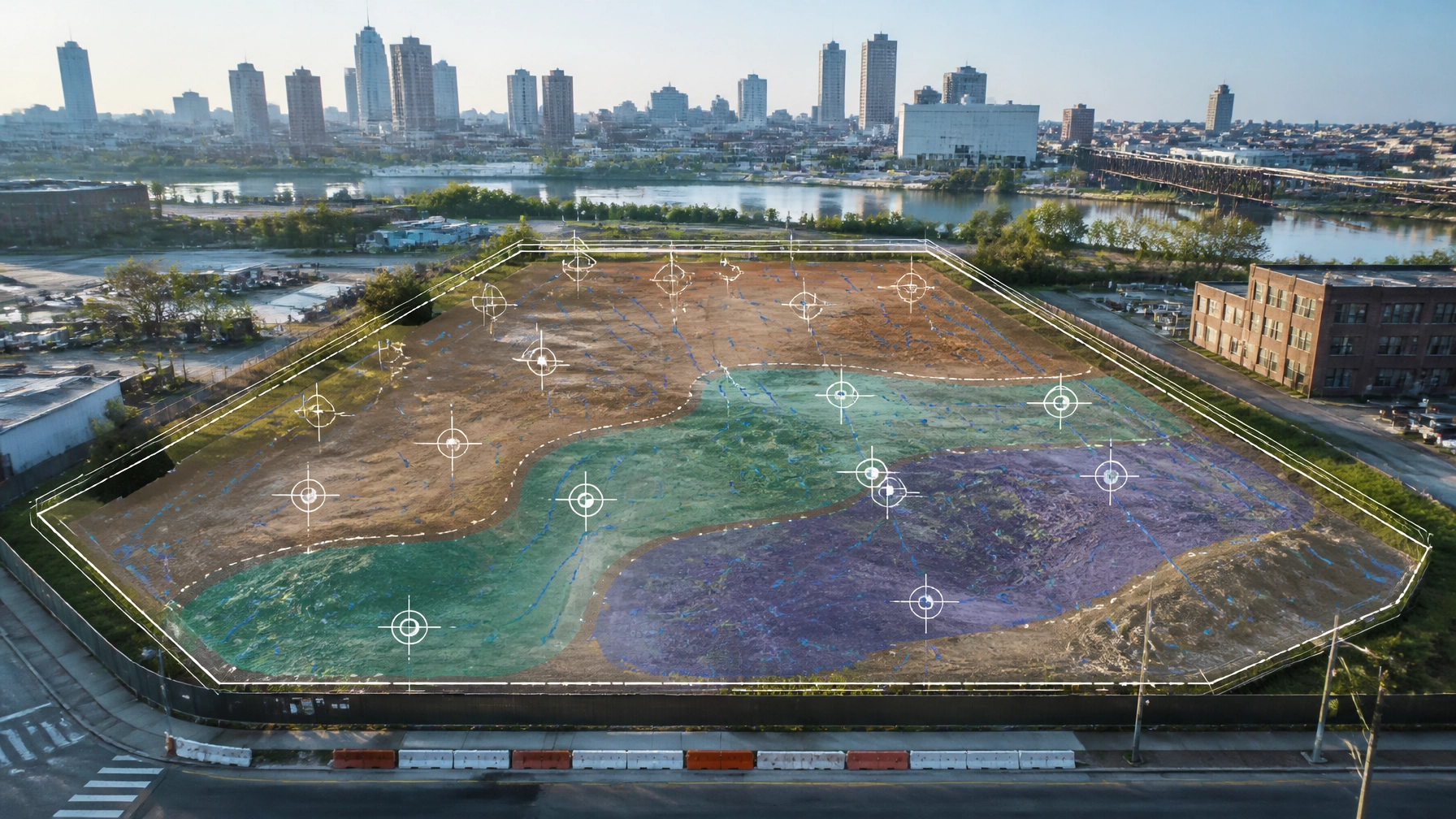
If you are developing a property in Jersey City or Newark, you aren't just buying dirt; you are likely buying decades of industrial history. In these urban hubs, "Historic Fill" is the default setting. It is the ash, coal, cinders, and demolition debris used to raise elevations and build out the waterfront over the last century.
For many developers, historic fill sounds like a budget-killing surprise. But it shouldn't be. Under current NJDEP Historic Fill Material Technical Guidance, historic fill is a manageable, predictable site condition. The difference between a project that stays on schedule and one that gets buried in change orders is how your consultant handles the "assumption" versus "characterization" of that fill.
At Envicon, we don’t sell you 200-page reports that leave you guessing. We give you a cleared path. Here is how we manage NJDEP Historic Fill to protect your project’s bottom line.
What Exactly Is Historic Fill?
NJDEP defines historic fill as non-indigenous material: meaning it didn't occur there naturally: that was contaminated before it was placed on your site. This is critical. If the contamination came from a leaking tank or a chemical spill after the fill was placed, the rules change.
Common components include:
- Incinerator ash and coal cinders.
- Demolition debris (brick, concrete, wood).
- Dredge spoils.
- Foundry sand.
Under the NJDEP Technical Requirements for Site Remediation (N.J.A.C. 7:26E), historic fill is an Area of Concern (AOC). It must be investigated, but the guidance provides two very different paths for how that investigation happens.

The Cost Trap: Excessive Sampling
Large national firms often fall into a "defensive sampling" trap. They write a scope to sample every acre, testing for every possible contaminant under the sun. They’ll tell you they are being "thorough," but what they are really doing is protecting themselves while you pay for lab fees and mobilization costs that don't actually move your project forward.
The NJDEP Historic Fill Guidance offers a more efficient alternative: The Presumptive Remedy.
Strategy A: Assume Contamination (The Envicon Favorite)
You have the right to assume the fill exceeds NJDEP soil standards. Instead of spending weeks and tens of thousands of dollars on analytical lab testing to prove exactly what is in the dirt, we simply delineate the physical extent of the fill (how deep it goes and where it stops).
By assuming contamination, you bypass the need for extensive chemical characterization. Your remediation strategy then moves straight to a "Cap and Deed Notice." For a developer in Newark or Jersey City, your building slab, parking lot, or two feet of clean soil already acts as a cap. We turn the "cleanup" into a "design element."
Strategy B: Prove It’s Clean
If you believe your fill might actually be clean: perhaps it’s mostly crushed stone or clean dredge: you can sample it (usually 2 samples per acre). If it passes, you avoid the long-term deed notice. However, in urban Jersey City or Newark, this is a gamble. If the samples fail, you’ve spent the money on the lab and you still have to build the cap.
We help you run the math on day one. If the project is a warehouse or a multi-family mid-rise where 90% of the site will be covered by a slab or asphalt anyway, the "Assume" strategy is almost always the winner.
Managing Groundwater: Stop Chasing Ghosts
One of the biggest budget blowouts occurs when a consultant tries to "delineate" groundwater contamination coming from historic fill. Because these fill layers cover entire neighborhoods in Hudson and Essex Counties, the groundwater is often regionally impacted.
NJDEP guidance allows your Licensed Site Remediation Professional (LSRP) to establish a Classification Exception Area (CEA). This is an institutional control that acknowledges the groundwater is not potable but doesn't require you to pump, treat, or chase the plume off-property.
Many "big-box" firms will suggest multiple rounds of quarterly monitoring to see if the levels "stabilize." At Envicon, if the site fits the criteria, we move straight to the CEA. We don't chase ghosts; we secure the Response Action Outcome (RAO) and let you get to your closing.

The Jersey City/Newark Context: Using the Maps
Before we even step foot on your site, we use NJ Geological Survey (NJGS) historic fill maps to predict what we’re going to find. In the Ironbound section of Newark or the waterfront in Jersey City, the presence of fill is virtually guaranteed.
When we sit down with you during due diligence, we don't just point to a map and say "there's a risk." We incorporate that risk into your Site Development Playbook. We coordinate with your architects and civil engineers early on to ensure the "capping" requirements for the historic fill are integrated into the grading and drainage plans.
"Collaboration is not a buzzword: it's how we work. When we align the remediation with the construction schedule, we remove the surprises that stall projects." : Envicon Team
Why Envicon Is Built Different
When you hire a national firm, the person writing your report is often a junior staffer in a different time zone who has never seen your site. They follow a cookie-cutter playbook that treats a Newark brownfield the same as a greenfield in Ohio.
Envicon brings 20 years of direct agency relationships with the NJDEP. We know the reviewers. We know the local soil strata. And most importantly, we know that every week of delay costs you carrying costs and lender patience.
- No Bloated Reports: We produce clean documentation that holds up under regulatory scrutiny and moves you to the next step.
- Direct Access: You deal with the principals. The engineer who answers the phone is the same person who designed your remedial strategy.
- Transparent Pricing: We focus on making complex projects simpler, with no surprise change orders for "additional sampling" that wasn't necessary.

Summary: A Checklist for Developers
If you are looking at a site in an urban NJ market, use this checklist to keep your historic fill costs in check:
- Review NJGS Maps Early: Know if you're in a fill zone before you sign the PSA.
- Opt for the Presumptive Remedy: Unless you have a very specific reason to believe the fill is clean, assume it's contaminated and save the lab fees.
- Design Your Cap: Use your building and parking lot as the remedy.
- LSRP Engagement: Ensure your LSRP is looking for a "Path to Closure" (RAO), not just a "Path to more Sampling."
- Groundwater CEA: Don't attempt to treat regional groundwater issues caused by historic fill. Use the institutional controls provided by the NJDEP.
Your project shouldn't be stalled by a report sitting in someone’s queue. We specialize in turning environmentally challenged sites into clean, buildable, and compliant assets. We don’t just deliver services; we help transform underused properties into thriving assets.
If you’re ready to clear the path for your next project, let’s talk.
Take the Next Step
If you want straight answers before you commit more time or money to a site, start here:

Leave a Reply