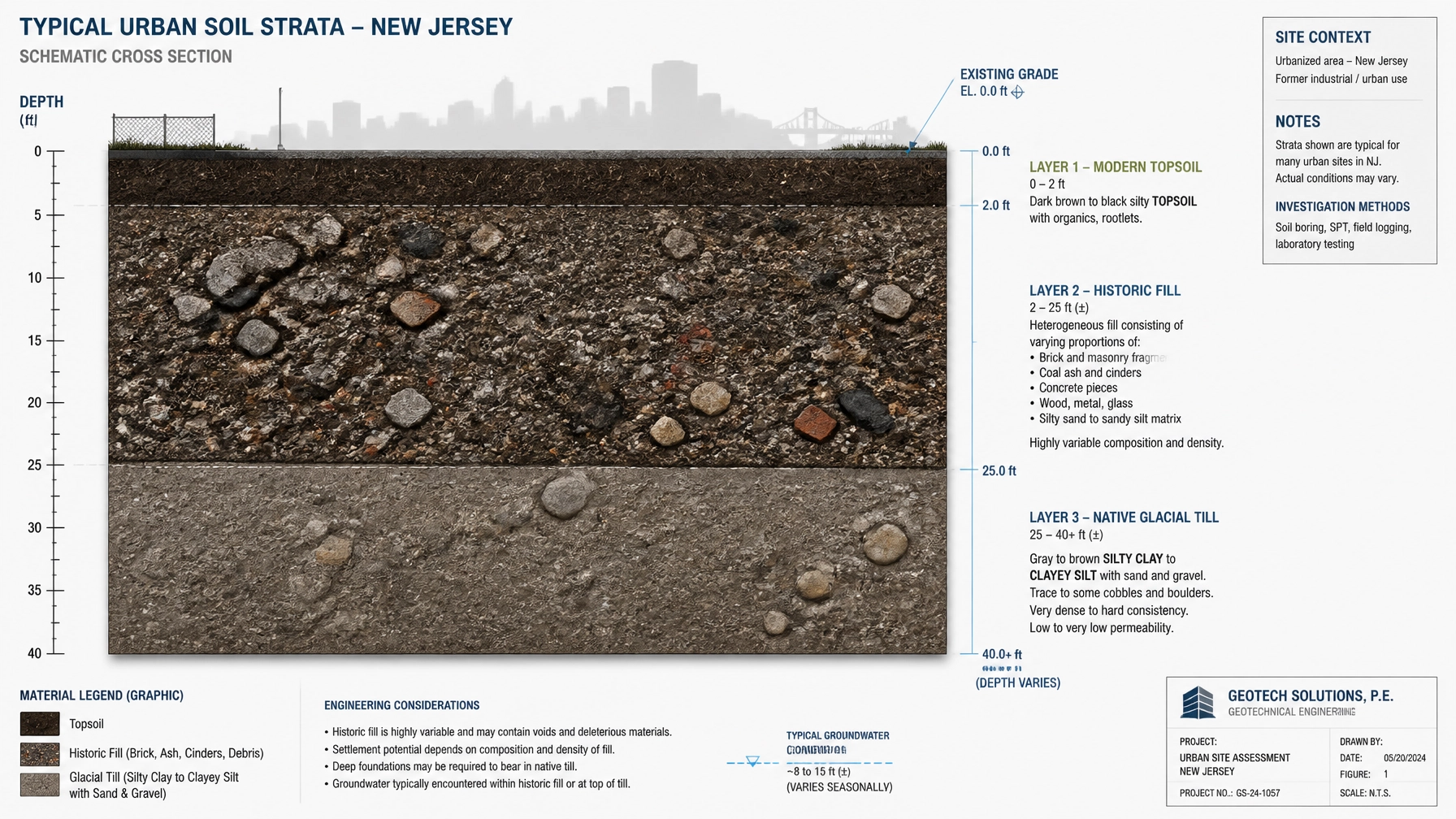
If you’re developing in Jersey City, Newark, or along the Raritan, you aren’t just moving dirt, you’re managing history. In the world of New Jersey real estate, "dirt" is a loaded term. Usually, it refers to historic fill material, a legacy of centuries of industrial growth, swamp reclamation, and urban expansion.
But here is the problem: what one person calls "reclaiming land," the New Jersey Department of Environmental Protection (NJDEP) calls a "regulated Area of Concern (AOC)."
At Envicon Group, we see developers get stuck in the "big-firm loop" every week. A large national consultant comes in, identifies historic fill, and immediately recommends a massive "dig and haul" operation or a bloated, multi-year sampling plan that treats the entire site like a hazardous waste dump. They write reports for their own liability protection, not for your project's progress.
We do things differently. We lean into the NJDEP historic fill guidance with a technical precision that separates the "fill" from the "spills," saving our clients hundreds of thousands in unnecessary remediation costs.
What is Historic Fill Material? (The NJDEP Definition)
Before you can solve the problem, you have to define it according to the book. According to the NJDEP Historic Fill Material Technical Guidance, historic fill is "non-indigenous material, deposited to raise the topographic elevation of the site."
We’re talking about more than just relocated soil. It’s a cocktail of:
- Construction debris and dredged spoils.
- Incinerator residue, coal ash, and cinders.
- Broken brick, block, and timber.
The regulatory nuance here is critical: for material to be classified as historic fill, it must have been contaminated prior to being placed on your site. It is a "non-site related" contamination. If the contamination came from a leaking tank or an industrial process on your property, it’s no longer just fill, it’s a discharge.
Remediating historic fill NJ requires knowing exactly where that line is drawn. If your consultant can’t tell the difference, you’re going to pay for it.

Navigating the Technical Requirements: NJAC 7:26E
The rules aren't suggestions; they are codified in NJAC 7:26E, the Technical Requirements for Site Remediation. Specifically, sections 3.12 and 4.7 lay out the roadmap for the historic fill site investigation and the subsequent remedial investigation.
The Preliminary Assessment (PA)
Your path starts with a Preliminary Assessment. This is where we review aerial photographs, Sanborn Fire Insurance Maps, and NJGS historic fill maps to identify if your site likely contains these materials. At Envicon, we don't just look at the maps; we use GIS-integrated historical data to predict exactly where the fill depth changes.
Confirming the Presence of Historic Fill
You can’t just guess. NJDEP procedures to demonstrate presence of historic fill require physical evidence. We use:
- Test Pits and Trenches: Often the most cost-effective way to see the stratigraphy.
- Soil Borings: To hit the vertical extent.
- Photo Documentation: We provide high-resolution visual logs that prove to the NJDEP, and your Licensed Site Remediation Professional (LSRP), that the material meets the technical definition.
3D Modeling vs. The "Fishing Expedition"
Most firms treat a site like a grid, poking holes at random intervals and hoping for the best. This "fishing expedition" approach leads to conservative, expensive remediation plans because the consultant doesn't actually understand the subsurface volume.
At Envicon, we utilize 3D plume modeling and high-resolution site characterization. By integrating our civil engineering services with environmental data, we map the historic fill horizontal and vertical extent investigation in a 3D digital environment.
Why does this matter? Because if we can prove that a "hot spot" is isolated and not part of the site-wide fill, or conversely, that the fill is consistent and manageable under a standard cap, we change the financial math of the project. We move you from "uncertain liability" to "manageable construction cost."

The LSRP’s Role in Historic Fill Remediation
In New Jersey, the LSRP is the gatekeeper. They have the authority to "sign off" on the remediation, but they also carry the professional liability.
Big-box firms often have LSRPs who are buried under corporate bureaucracy. They are incentivized to be ultra-conservative, recommending more samples, more reports, and more "digging and hauling."
At Envicon, our LSRPs are field-first. We sit at the table with you from day one. We know the NJDEP reviewers by name, and we understand how to apply the historic fill technical guidance to achieve a Response Action Outcome (RAO) without bankrupting the developer.
Remediation Strategies: Capping and Institutional Controls
You rarely "clean up" historic fill in the traditional sense. It’s too massive. Instead, the standard remedy involves engineering and institutional controls for historic fill njdep.
1. Engineering Controls (The Cap)
You "remediate" by breaking the pathway between the contamination and the people. This usually means a historic fill cap design using:
- Clean Soil Caps: Typically 1-2 feet of certified clean fill over a warning layer (orange geofabric).
- Hardscaping: Asphalt parking lots or concrete building slabs serve as excellent engineering controls.
- Stormwater Integration: This is where our civil team shines. We design grading and drainage that works with the cap, ensuring that your stormwater management doesn't puncture the remedial layers unnecessarily.
2. Institutional Controls (The Deed Notice)
Since the fill remains on-site, the NJDEP requires a Deed Notice. This is a document filed with the county that tells future owners, "Hey, there is historic fill here, and you have to maintain the cap." This is often paired with a Groundwater Classification Exception Area (CEA) if the fill has impacted the shallow aquifer (which, in NJ urban areas, it almost always has).
3. Long-Term Compliance
Once the cap is in place and the RAO is issued, you enter the "monitoring" phase. This involves a Remedial Action Permit (RAP) and a biennial certification every two years. We manage this through our real-time digital solutions, so you never miss a filing deadline with the state.

Why Envicon? The Technology Edge
We don't sell reports. We sell cleared paths.
When you hire a national firm, your project status is hidden in a monthly PDF that was out of date the day it was emailed. Envicon provides real-time project reporting dashboards.
If we are in the field doing a historic fill investigation, you can see the boring logs, the PID readings, and the site map updates as they happen. If a lender flags a report, we don't put it in a "queue." We resolve it.
We’ve spent 20 years building relationships with the NJDEP and local agencies. We know that in the NJ/NY market, speed is a function of technical accuracy. If your report is clean, data-driven, and follows the NJDEP historic fill guidance to the letter, it moves through the system. If it’s bloated and defensive, it sits.
Summary: Your Historic Fill Action Plan
If you’re sitting on a site with suspected historic fill, here is your playbook:
- Don't assume "Dig and Haul": It is usually the most expensive and least necessary option.
- Verify the Source: Ensure your consultant is distinguishing between historic fill and site-sourced discharges.
- Demand 3D Modeling: Don't settle for 2D maps that lead to 1D thinking. Know your volumes.
- Design the Cap Early: Integrate your remedial cap with your civil site plan to avoid "re-mobilization" costs.
- Leverage Technology: Use real-time data to keep your lenders and partners informed.
Ready to clear the path for your next project? At Envicon Group, we don’t just deliver reports: we deliver outcomes. Contact us today to discuss your site’s specific challenges.

Leave a Reply