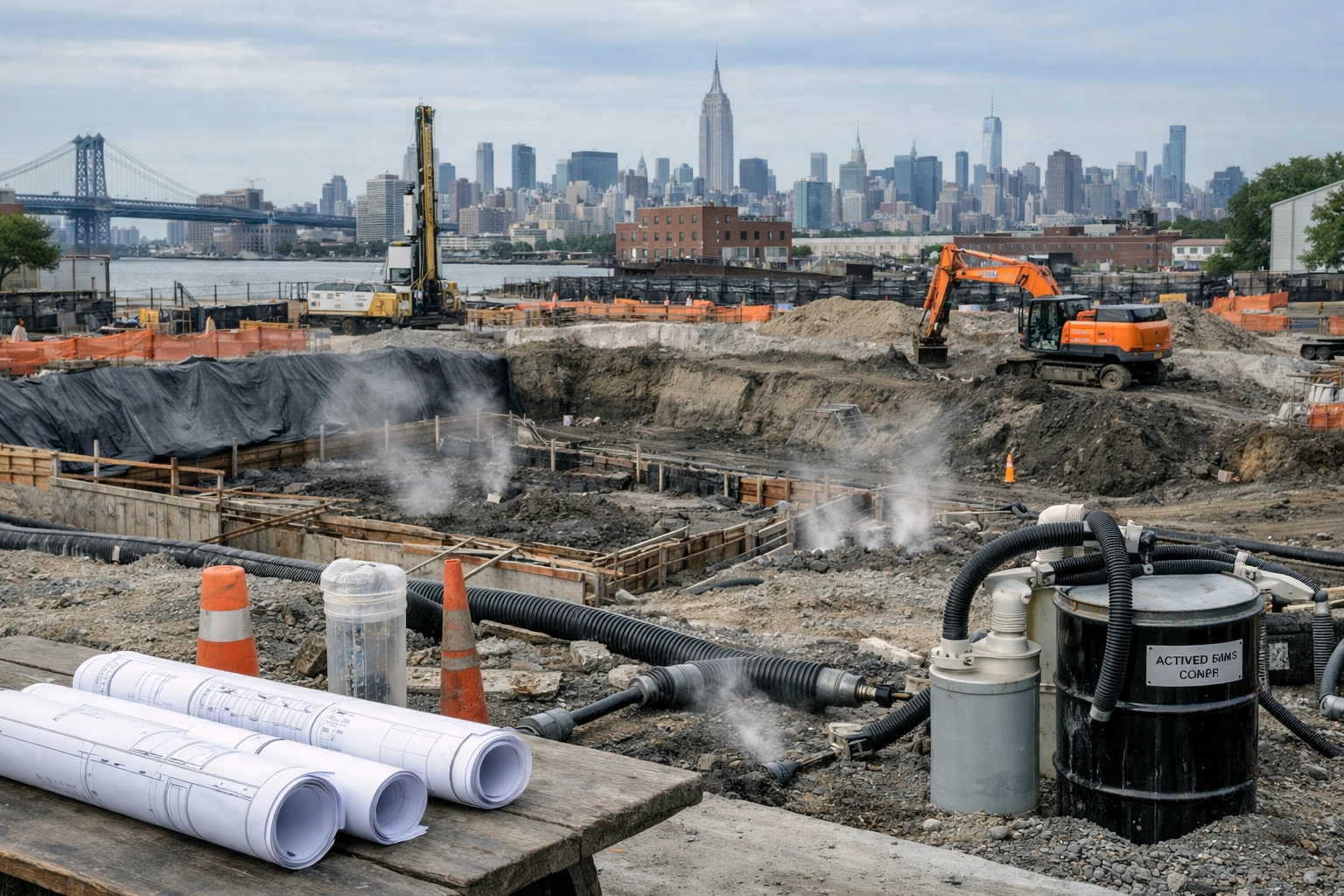
If you’ve ever tried to break ground on a contaminated lot in the five boroughs, you know the drill. You’ve got the Office of Environmental Remediation (OER) on one side and the Department of Buildings (DOB) on the other. In the middle? Your project timeline, and it’s usually getting squeezed.
At Envicon, we’ve seen too many developers treat environmental remediation and building code compliance as two separate hurdles. That’s a mistake that costs real time and real money. In NYC, if your Remedial Action Plan (RAP) doesn’t line up with your foundation design and the NYC Construction Codes, your project can stall before it gains momentum.
The secret to moving fast in this city isn't just knowing the rules; it’s knowing how to make NYC OER brownfield cleanup requirements and building code review work together from the start.
The E-Designation: More Than Just a Warning Label
Most brownfield redevelopment projects in NYC start with an E-Designation. It’s a flag on a tax lot indicating potential hazardous materials, noise, or air quality issues tied to redevelopment review. NYC OER outlines the process through its E-Designation program and Voluntary Cleanup Program resources (NYC OER).
The most common question we get is: How do you satisfy an E-Designation in NYC and keep the DOB review moving?
The short answer: You don't just "remove" it; you satisfy it through investigation, cleanup planning, and documented closure. To get DOB approvals moving, OER needs to approve the remedial pathway first. That’s where NYC OER brownfield cleanup and building code coordination becomes critical. If your architect is designing a cellar that requires deeper excavation, but your sampling and disposal assumptions stop short, you can lose weeks before permit review is back on track.

Why OER and DOB Coordination Fails (and How We Fix It)
The disconnect usually happens because the environmental team and the structural team are speaking different languages. The OER cares about soil vapor, heavy metals, and "clean" backfill. The DOB cares about structural stability, fire safety, and egress.
Here is where the friction occurs:
- Vapor Barriers vs. Foundation Waterproofing: You need both. But if the specific vapor barrier required by your OER-approved RAP doesn’t meet the DOB’s building code for waterproofing or structural integrity, you’re back to the drawing board.
- Soil Disposal vs. Support of Excavation (SOE): If you have to dig deeper to reach "clean" soil for the OER, your SOE plans (which the DOB must approve) might need a total redesign to prevent the neighboring building from shifting.
- Ventilation Systems: Sub-slab Depressurization Systems (SSDS) are common in OER cleanups. These systems need to be integrated into the building’s mechanical and electrical plans. If they aren't in the initial DOB filing, expect a long "disapproved" notice in your future.
At Envicon, we bridge this gap by performing a unified design review before a single document is filed. We look at your architectural plans and your remedial requirements simultaneously.
The Remedial Action Plan (RAP): Your Project’s North Star
Your RAP isn’t just a document for OER; it’s a construction roadmap. To maximize efficiency, the RAP needs to reflect NYC building code coordination for brownfield redevelopment from day one.
For example, if we know your project is in a high-water-table area, which is common in parts of Brooklyn and Queens, we don’t just suggest a standard vapor barrier. We look for a system that supports the remedial goals and fits the realities of foundation waterproofing, slab design, and mechanical routing under the applicable NYC Construction Codes (NYC Buildings).
“The fastest NYC cleanup projects are usually the ones where remediation planning and building design start as one conversation, not two.” — Jason Pancoast, CEO of Envicon Group

Navigating the NTP and NOS Milestones
The workflow for NYC OER brownfield cleanup, E-Designation compliance, and DOB coordination follows a specific rhythm. Understanding that rhythm is the difference between a project that flows and one that stalls.
- Phase I & II ESA: Identify the likely environmental issues and the data gaps.
- Remedial Investigation Report (RIR): Submit site findings to OER.
- Remedial Action Plan (RAP) & CHASP: Show OER how the cleanup and site controls will work during construction.
- Notice to Proceed (NTP): OER confirms the project can move into the approved implementation phase tied to permit progress.
- Notice of Satisfaction (NOS): After the cleanup is completed and documented, OER issues the closure milestone needed for the project’s final path forward.
If you’re trying to understand how to satisfy an E-Designation in NYC without delaying permits, the key is planning for the end at the beginning. OER’s program structure makes that clear, and DOB code compliance needs to stay aligned throughout the project (NYC OER Cleanup Programs).

The Technical Synergy: Vapor Barriers and SSDS
Let’s talk specifics. In many NYC brownfield cleanups, the primary concern is soil vapor: volatile organic compounds, or VOCs, moving from the ground into the building.
To satisfy OER, you may need a Sub-Slab Depressurization System (SSDS) or another approved control. To keep the project moving, that system also needs to fit the broader building design, including vent routing, power, access, and long-term operation. This is exactly where NYC OER cleanup requirements and building code coordination can either protect your schedule or wreck it.
We’ve seen projects where the SSDS layout looked fine on paper, but later conflicted with plumbing, utilities, or slab penetrations because the disciplines were not coordinated early. By integrating geotechnical expertise with environmental oversight, we catch those clashes before concrete is poured.
“Cleanup strategy has to fit the building you’re actually constructing. If it doesn’t, revisions show up late and cost you twice.” — Envicon

Why Envicon Beats the "Big Consultant" Approach
If you go with a massive, multi-national consulting firm, you’re often just another file in a cabinet. They follow a template. They don't know the specific quirks of the OER project managers or the nuances of the DOB’s Hub Self-Service system.
The Envicon Approach is Different:
- Agility over Bureaucracy: We respond in hours, not weeks. When a DOB examiner has a question about your vapor barrier on a Tuesday afternoon, we have the answer by Tuesday evening.
- Technical Integration: We don't just do "environmental." We understand the civil and geotechnical realities of NYC soil.
- Strategic Vision: We don't just follow the OER’s lead; we negotiate. We find the most cost-effective remedial measures that still meet the "protection of public health" standard.
- Accountability: We stay with the project from the first soil boring to the final Notice of Satisfaction.
When you work with us, you’re not just hiring a consultant; you’re gaining an advocate who understands that every day your project is stuck in the OER/DOB loop is a day you’re losing money.

Actionable Takeaways for Developers
If you are planning a project with an E-Designation or participating in the NYC Voluntary Cleanup Program (VCP), keep these points in mind:
- File Early: Get your RIR and RAP to the OER as soon as your schematic designs are ready. Don't wait for final construction documents.
- Coordinate the Trades: Ensure your MEP (Mechanical, Electrical, Plumbing) engineer and your environmental consultant are on the same page regarding vapor barriers and venting.
- Budget for Oversight: OER requires a Qualified Environmental Professional (QEP) to be on-site during all soil disturbance. This isn't optional.
- Focus on the NOS: Don't just aim for the NTP to start construction. Have a plan for the final reporting (Remedial Closure Report) so you don't get stuck at the end of the project without a CO.
Summary: Building a Visionary NYC
NYC is a city of layers: historical, structural, and regulatory. Navigating a NYC OER brownfield cleanup requires more than just technical knowledge; it requires the ability to see the "big picture" of a project’s lifecycle.
By coordinating OER requirements with NYC Building Codes from day one, you reduce risk, slash timelines, and ensure a smoother path to completion. We don't just clean up sites; we enable the next generation of NYC infrastructure.
Ready to clear your E-Designation and get moving?
Don't let regulatory friction slow your vision. Let’s talk about how Envicon can streamline your OER coordination.
Contact Envicon Today | Explore Our Services | See Our Projects
Envicon Group
Site-Civil | Geotechnical | Environmental (NY/NJ)
www.envicongroup.com | https://wp.envicongroup.com/contact
Leave a Reply