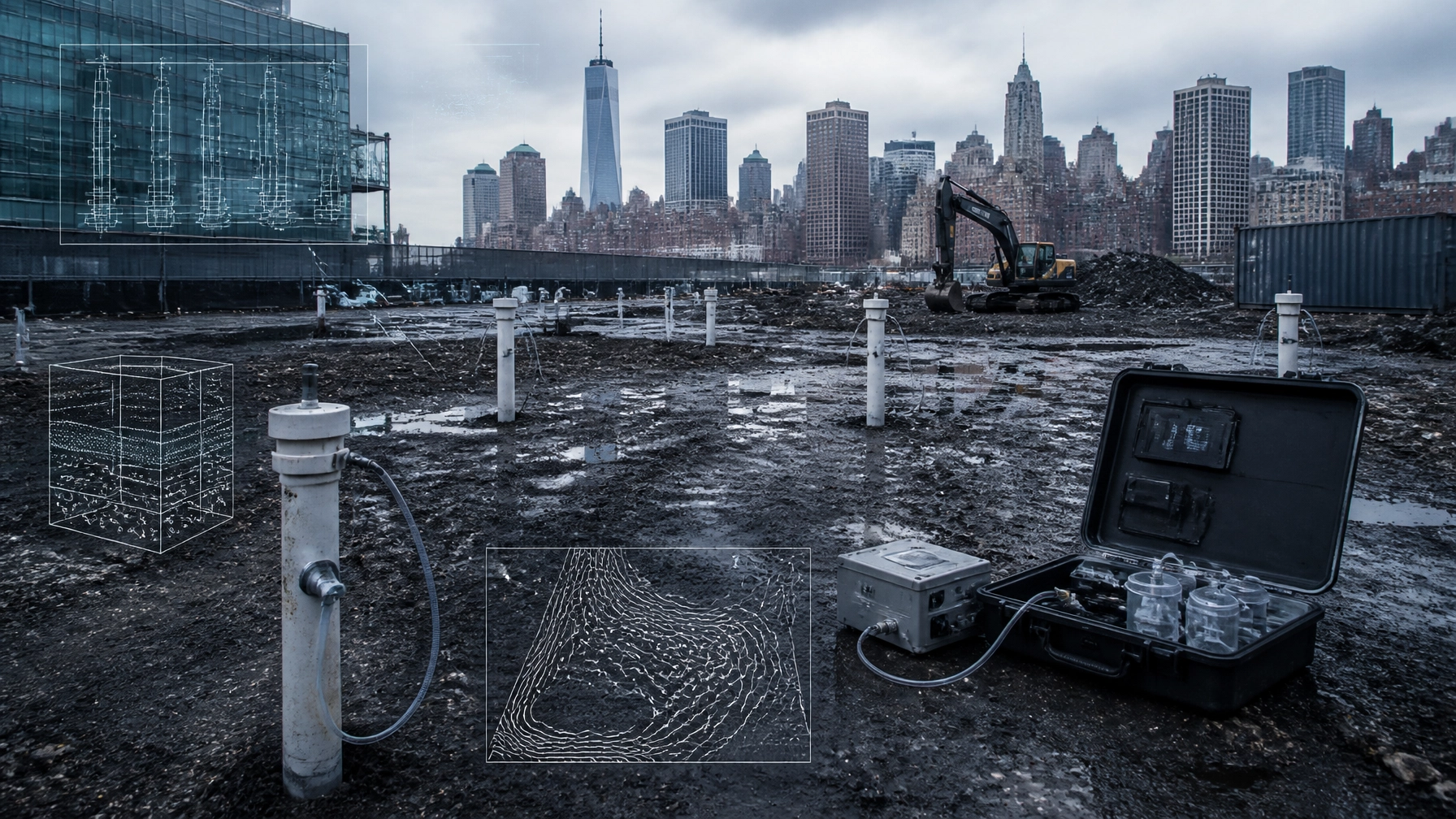
If you own, develop, or manage commercial and residential real estate in New York City, an E-Designation is likely part of your property’s legal and environmental DNA. Whether assigned for hazardous materials, ambient air quality, or noise attenuation during a zoning change, an E-Designation is not a paperwork formality that disappears once construction wraps up.
For properties requiring ongoing Site Management Plans (SMPs): such as those operating active vapor mitigation systems, sub-slab depressurization systems (SSDS), or engineered soil covers: the NYC Office of Environmental Remediation (OER) enforces strict annual compliance certification rules. Failing to submit these reports on time is no longer a minor administrative oversight. It triggers aggressive enforcement, steep monetary penalties starting at $10,000, and summonses adjudicated through the Office of Administrative Trials and Hearings (OATH).
At Envicon Group, we work daily with developers, property owners, and environmental attorneys across New York and New Jersey to navigate complex regulatory hurdles. Below is a breakdown of what NYC OER enforcement looks like, who is affected, and how to protect your assets from costly penalties.
Understanding E-Designations and Environmental Restrictive Declarations
An E-Designation is placed on a tax lot to signal that environmental requirements must be satisfied before the NYC Department of Buildings (DOB) will issue building permits or a Certificate of Occupancy (CO). Originally administered jointly or under the NYC Department of Environmental Protection (DEP), the regulatory landscape shifted significantly with the Split of the E-Designation Rule.
Under this rule framework:
- The Placement Side: The establishment and placement of E-Designations on properties remain under the purview of the DEP.
- The Remediation & Compliance Side: All post-remediation requirements, Remedial Action Plans (RAPs), Remedial Closure Reports, and ongoing site management rules are codified under OER’s regulations (Title 43, Chapter 14 of the Rules of the City of New York).
When a site is remediated under OER supervision but leaves behind contamination or engineering controls, OER requires a recorded environmental restrictive declaration and an approved SMP. This is where long-term institutional controls (ICs) and engineering controls (ECs) come into play: and where annual certification mandates become legally binding.

The Annual Certification Mandate: What Is Required?
If your property operates under an OER-approved SMP that incorporates engineering controls (such as vapor barriers, composite covers, or active venting systems) or institutional controls (such as use restrictions or groundwater use bans), you are legally obligated to submit annual compliance certifications.
Who Must Certify?
- For Active or Passive Remedial Systems: The annual certification must be completed and stamped by a Qualified Environmental Professional (QEP) or a New York State-licensed Professional Engineer (PE).
- For Institutional Controls Only: If the SMP involves strictly non-physical use restrictions or maintaining a certified site cover without active mechanical systems, the property owner may submit the certification, provided all criteria are fully met.
What the Certification Must Prove
OER’s inspection and reporting rules require your filing to explicitly state that:
- A comprehensive site inspection was conducted by the certifying professional.
- All required engineering controls and institutional controls remain in place, intact, and fully operational.
- Nothing has occurred that would impair the protective function of these controls or cause non-compliance with the SMP.
- The property owner continues to grant OER personnel site access to evaluate and verify maintenance of these controls.
If an inspection reveals that a vapor barrier has been breached, a utility trench has compromised a soil cover, or a sub-slab depressurization fan has failed, you cannot truthfully submit a clean certification. In such cases, the owner must promptly notify OER and submit a corrective work plan.
The Financial Sting: $10,000 to $20,000 Penalties and OATH Prosecution
OER’s enforcement regime is designed to eliminate chronic reporting delays. If a property owner fails to submit the required institutional and engineering control certifications by the mandated deadline, the financial and legal consequences are severe:
- Minimum Penalty: A baseline penalty of $10,000 for failing to submit an acceptable certification.
- Default Penalty: Penalties can default to $20,000 or higher depending on the duration of non-compliance and site risk factors.
- OATH Summonses: OER issues formal summonses for non-compliance, which are prosecuted through the Office of Administrative Trials and Hearings (OATH).
The 45-Day Cure Window
Fortunately, OER rules provide a narrow lifeline for owners who act quickly. If OER issues a summons for failing to file, the respondent can avoid monetary penalties entirely if they submit a formal “certification of correction” along with documentary proof of SMP compliance within 45 days of service. Once accepted by OER, prosecution of the summons is withdrawn.
Waiting past that 45-day window, however, locks in the financial penalties and invites intensified agency scrutiny across your entire portfolio.

Why Big-Box Consulting Firms Drop the Ball on Annual Compliance
Property owners often hire large national engineering firms during initial site acquisition, only to find themselves abandoned once the transaction closes. Big-box firms operate on high-volume models where junior staff manage dozens of disparate projects.
When annual OER compliance deadlines approach, large firms frequently:
- Miss the deadline: Because annual tracking is managed via generic spreadsheets rather than active project management dashboards, your filing slips through the cracks.
- Deliver defensive, slow reports: Reports written primarily to protect the consultant rather than move your project forward create friction with agency reviewers.
- Charge exorbitant change orders: Every routine coordination call or minor SMP amendment becomes an excuse for billable scope creep.
At Envicon Group, we believe collaboration is not a buzzword: it's how we operate. As a family-owned, PE-led firm with 20 years of direct NYC and NJ agency experience, we sit at the table with OER regulators, not behind a ticketing queue.
How Envicon Protects Your Assets and Keeps Projects Moving
We don't just deliver static reports; we deliver cleared paths. When you partner with Envicon for E-Designation management and annual compliance, you get:
- Proactive Scheduling & Tracking: Our proprietary technology and project management infrastructure track every OER and DEP milestone across your portfolio, eliminating surprise deadlines.
- Direct QEP & PE Oversight: Licensed professionals inspect your site, verify engineering controls, and handle all agency coordination directly.
- Real-Time Visibility: Clients gain access to transparent project reporting dashboards showing deliverable status, field activity, and compliance schedules in real-time.
- Seamless OATH & Agency Resolution: If your property receives a notice or summons, our regulator-facing team intervenes immediately to prepare corrective documentation well within the 45-day cure window.
Actionable Takeaways for NYC Property Owners & Developers
- Audit Your Portfolio Today: Confirm whether your tax lots carry an E-Designation or Environmental Restrictive Declaration requiring an active SMP.
- Calendar Annual Deadlines: Never assume your previous consultant or architect filed your annual certification automatically.
- Inspect Engineering Controls Early: Have a Qualified Environmental Professional evaluate vapor barriers, venting systems, and soil covers months before the filing deadline.
- Partner with Local Experts: Work with a regional firm that knows NYC OER reviewers by name and understands how to keep your development clear of legal liabilities.
Ready to Secure Your Site and Eliminate Compliance Risk?
Don't let missed OER certifications trigger costly OATH penalties and stall your property transactions. Talk directly with our licensed environmental engineers today.
- Use our online risk screener tool to evaluate your property's compliance standing
- Book a free consultation with our technical team
- Explore our comprehensive environmental consulting services
Leave a Reply