You’ve done the Phase I. The report came back with a few "Recognized Environmental Conditions" (RECs). Now your lender wants more than a general answer. They want a Phase II ESA sampling strategy for lender review that clearly addresses risk, data quality, and next steps.
In New Jersey and New York, that means your investigation has to do two things at once: satisfy the technical question and satisfy the credit question. A lender doesn’t just ask whether contamination exists. They ask whether the scope was focused, whether the data is reliable, and whether the findings are enough to support underwriting.
At Envicon, we’ve seen developers lose time and leverage because a consultant delivered a generic scope instead of a Phase II ESA sampling strategy for NJ and NY lender requirements. That’s where deals start to wobble.
Here’s how we approach Phase II ESA sampling strategies in NJ and NY so your report is targeted, defensible, and built for lender confidence.
The Lender’s Perspective: It’s About Uncertainty, Scope, and Defensibility
Lenders don’t necessarily walk away from contamination. They walk away from unclear exposure. A small, defined impact with a practical path forward is often easier to finance than a vague concern that hasn’t been properly investigated.
When a bank reviews your report, they want to see a Phase II ESA scope that lenders accept in NJ and NY. That means:
- clear links back to the RECs from the Phase I
- focused sampling around the most likely source areas
- groundwater evaluation where migration is a real issue
- a QA/QC program that supports the data
- conclusions that explain business impact, not just lab numbers
As ASTM notes in its Phase II framework, the work has to be designed around recognized concerns and property-specific conditions, not guesswork (ASTM Phase II ESA overview).
One point is simple: if your consultant is still using a one-size-fits-all approach, you’re leaving financing to chance. We build our sampling programs around the exact questions lenders and reviewer consultants tend to ask in the NJ/NY market.
“Good Phase II work reduces uncertainty. Great Phase II work reduces uncertainty in a way a lender can underwrite.”
Precision Over "Swiss Cheese" Sampling
One of the biggest mistakes we see is the "Swiss cheese" approach: drilling a bunch of shallow holes across a site and hoping something useful turns up. It costs money, creates noise in the data, and often fails to answer the lender’s real question.
A better Phase II ESA sampling strategy for commercial real estate due diligence follows the likely release mechanism and migration pathway. Where was the source? What media could be affected? Is groundwater exposure plausible? Is vapor intrusion a possible lender concern later in the deal?
Targeted AOC Investigation
Every sample needs a reason. If we’re evaluating a former underground storage tank, we don’t just sample one point near the pit and call it done. We look at:
- likely source soil
- sidewall and base conditions
- groundwater interface, if present
- downgradient migration
- utility corridors or disturbed fill that could affect movement
That’s especially important in northern New Jersey and NYC-adjacent sites where fill, shallow groundwater, tight access, and redevelopment pressure can complicate the picture fast.

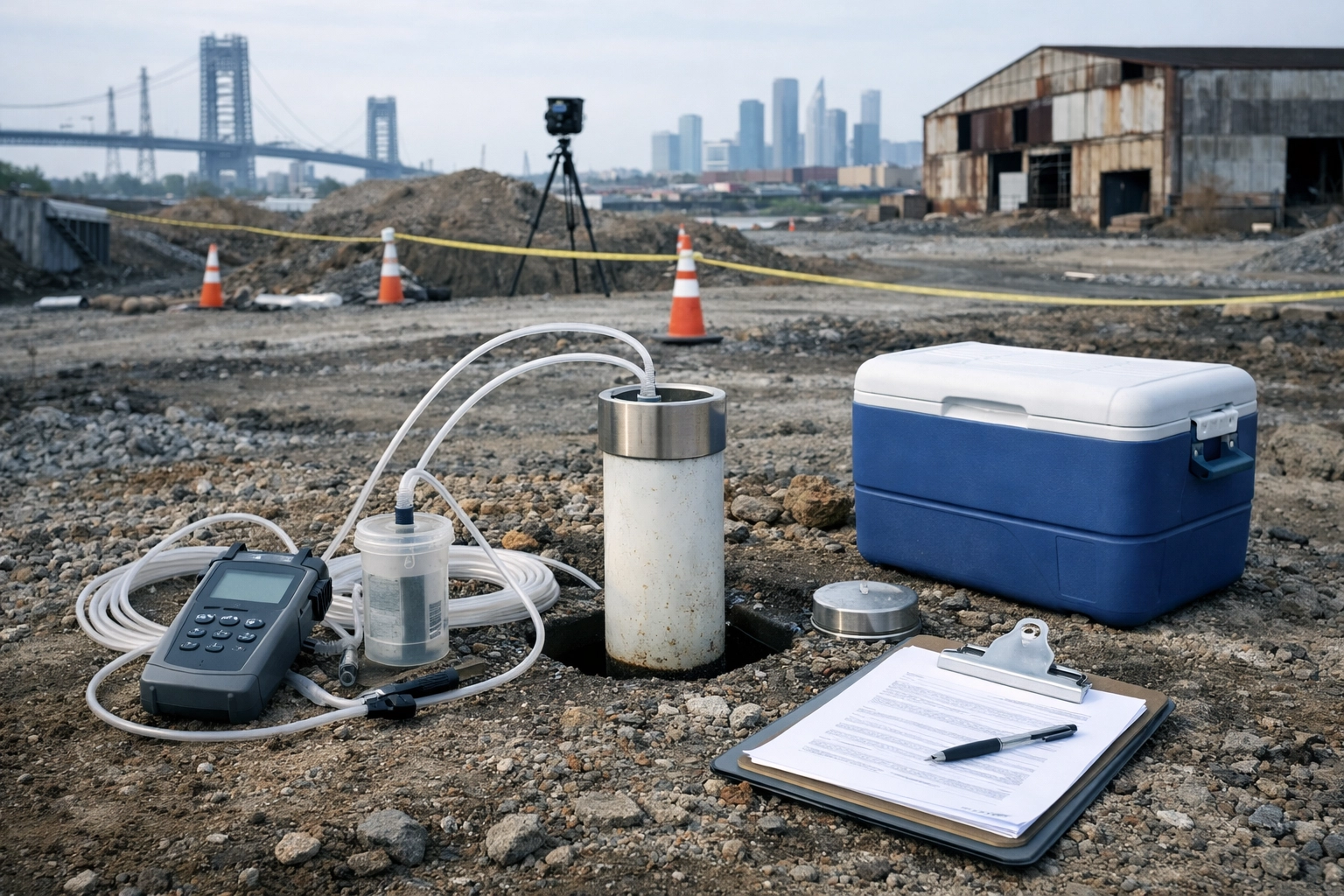
Technical detail: Groundwater sampling containers and field documentation prepared for a lender-driven Phase II ESA investigation.
Advanced Methods That Support Lender Review
To get results that hold up in credit review, you need methods that fit the site, not just the cheapest field day.
Incremental Sampling Methodology (ISM)
For larger sites or uneven fill areas, a single grab sample can overstate or understate conditions. Incremental Sampling Methodology (ISM) helps smooth out that problem by combining many small increments into one representative sample from a defined decision unit.
That matters when a lender is trying to understand whether soil impacts are isolated or broad-based. ITRC has published guidance showing why ISM can improve representativeness in the right setting (ITRC ISM guidance).
Direct-Push Technology (DPT)
In dense NJ/NY settings, access is tight and schedules are tighter. Direct-Push Technology (DPT) often lets us collect more targeted data with less disturbance than larger drilling methods. It can be a strong fit for:
- fast screening around former USTs
- focused soil and groundwater delineation
- constrained urban lots
- projects where turnaround time matters to the closing schedule
The point isn’t to use fancy tools for the sake of it. The point is to use the right tool so the report answers the lender’s questions the first time.

NJ and NY Rules Lenders Expect You to Respect
If you’re performing a Phase II environmental site assessment in New Jersey, you’re working within the NJDEP framework, especially the Technical Requirements for Site Remediation under N.J.A.C. 7:26E. Lenders and their environmental reviewers know that. If your report ignores that structure, it gets flagged.
In New York, lender review is often shaped by site-specific context, agency expectations, and whether the property may later need to align with programs overseen by NYSDEC or NYC OER. Even when a lender isn’t asking for a full remedial roadmap yet, they still want a Phase II ESA for lender requirements in NY commercial real estate that is logical, well documented, and ready for follow-up if impacts are found.
For groundwater, reporting limits, sample handling, and boring placement all matter. So does the plain-English explanation of what the data means. That’s where many consultants lose the room. They provide tables, but not clarity.
We write reports with two readers in mind:
- the regulator who checks technical compliance
- the lender reviewer who wants to know whether the deal is still financeable
“A lender-ready report doesn’t just present data. It shows that the investigation was designed to answer the right question.”
The "Boring" Stuff That Saves Deals: QA/QC
The difference between a lender accepting your report and pushing back on it often comes down to QA/QC. This is the structure behind the data, and it matters more than most people think.
- Chain of Custody: Every sample needs to be tracked from collection through lab receipt.
- Equipment Decontamination: If tools aren’t cleaned properly, the data can be questioned.
- Proper Well Construction: If groundwater sampling is part of the scope, the well has to be installed and developed correctly.
- Correct Analytical Match: The lab methods need to fit the site history and likely contaminants of concern.
- Detection Limits That Make Sense: If reporting limits are too high, the data may be technically complete but practically useless for lender review.
This is one reason some big consultants frustrate clients. They may have size, but not always accountability. We keep scopes tight, field execution disciplined, and reporting clear so your lender isn’t left filling in blanks on their own.

Technical detail: Properly installed groundwater monitoring point used for follow-up sampling and defensible site characterization.
Why the "Big Consultants" Often Fail You
You might think hiring a massive, global engineering firm provides more "security" for your lender. In reality, large firms often treat Phase IIs as entry-level "commodity" work. They send junior staff to the field who may miss the subtle visual cues of soil staining or odors that a seasoned expert would catch.
At Envicon, we treat every Phase II as a strategic operation.
- Agility: We can mobilize faster than the big guys, often getting crews on-site while they are still waiting for internal legal approval.
- Authority: We don't just provide data; we provide interpretation. We tell the lender what the results mean for the property's value and the project's timeline.
- Local Expertise: We know the soil in Hudson County, the bedrock in Bergen, and the regulatory quirks of the Pinelands. This local "insider" knowledge is something a global firm simply can't replicate.
"A Phase II is not a search for problems; it is the process of defining the boundaries of a solution."
Moving from Data to Development
Once the lab data comes back, the real value is interpretation. We don’t hand you a pile of tables and leave you to manage the lender conversation alone. We connect the findings to redevelopment risk, schedule impact, and next-step strategy.
If impacts are found, we move quickly into solution mode:
- Is the issue limited or expanding?
- Does it affect closing, escrows, or lender conditions?
- Can the site move forward with a focused remedial plan?
- How does the environmental picture affect civil design, foundation work, or construction planning?
That integrated thinking is where Envicon is different from the big-box consultant model. We combine environmental, geotechnical, and site-civil thinking so you get a practical answer, not just a technical memo.

Contact Envicon Group
If you’re underwriting a deal, managing an agency project, or trying to keep a redevelopment on schedule, we’ll give you a Phase II plan and report that holds up to lender and regulator review.
- Envicon Group
- Web: https://wp.envicongroup.com
- Contact: https://wp.envicongroup.com/contact
- Service area: Northern NJ + NYC
Summary: The Phase II Checklist for Success
To make your Phase II ESA sampling strategy for NJ/NY lender review more effective:
- Target the AOCs: Build the scope around the actual recognized concerns from the Phase I.
- Follow the pathway: Soil, groundwater, vapor, and fill conditions should drive the investigation.
- Match methods to the site: Use tools like ISM or DPT when they improve clarity and speed.
- Lock down QA/QC: Lenders trust data that is documented, traceable, and easy to defend.
- Reference the right standards: In New Jersey, that means aligning with NJDEP expectations. In New York, it means building a report that can stand up to lender and agency scrutiny.
- Choose a consultant who sees the deal: Technical data matters, but so does knowing what keeps a transaction moving.
Don’t let a generic report slow down a good project. In the NJ/NY market, lender confidence comes from clear scope, clean data, and direct interpretation.
Ready to move your project forward? Contact Envicon Group today to build a lender-ready Phase II strategy that keeps your deal on track.

Leave a Reply