
If you’ve been developing property in New Jersey for more than fifteen years, you remember the "Dark Ages." Back then, every single move you made on a contaminated site required the explicit, written blessing of a case manager at the New Jersey Department of Environmental Protection (NJDEP). You’d submit a report, wait six months (or a year), get a stack of comments back, and repeat the cycle. Projects didn't just crawl; they died on the vine.
Then came the Site Remediation Reform Act (SRRA) in 2009. It changed the landscape by introducing the Licensed Site Remediation Professional (LSRP). Suddenly, the keys to the kingdom were handed over to private-sector experts. But even with the LSRP program in full swing, we still see developers getting stuck. Why? Because having an LSRP is one thing: having an LSRP who understands the intersection of regulatory law, engineering, and your bottom line is another.
At Envicon Strategic Solutions, we don't just "check boxes" for the NJDEP. We use the LSRP program as a high-velocity tool to push your project through the finish line. Here is how you leverage the LSRP advantage to navigate environmental due diligence for developers in NJ without getting bogged down in the bureaucracy.
The Shift from "Permission" to "Professional Judgment"
The biggest hurdle for many developers is shifting their mindset from seeking permission to exercising judgment. Under the old system, the NJDEP was the driver. Under the current NJDEP LSRP rules, your LSRP is the driver, and the NJDEP is more like the highway patrol. They set the rules of the road, but they aren't steering your car.
An LSRP has the statutory authority to review and certify work plans, approve remediation strategies, and issue the final closure document: the Response Action Outcome (RAO). This means you aren’t waiting for a state employee to get to your file. You are working with a partner who is incentivized to keep the project moving.

Speed: The 50% Rule
Time is the most expensive variable in any development deal. Research shows that the LSRP program can reduce project duration by up to 50% compared to the old traditional oversight system. Think about the carrying costs of a multi-million dollar property in Hudson County or Newark. Cutting two or three years off a remediation schedule isn't just a "nice to have": it’s the difference between a profitable exit and a failed investment.
Take the cleanup of the former River Oil Terminal in Passaic as a benchmark. Transitioning that site into the LSRP program was estimated to shave three full years off the remediation timeframe. That is three years of avoided taxes, insurance, and interest. When we handle environmental due diligence, we aren't just looking for contaminants; we are looking for the fastest path to an RAO.
Navigating the ARRCS and Technical Requirements
The LSRP program is governed by a complex web of regulations, primarily the Administrative Requirements for the Remediation of Contaminated Sites (ARRCS) and the Technical Requirements for Site Remediation (N.J.A.C. 7:26E).
To the uninitiated, these are a labyrinth of mandatory timeframes and technical standards. If you miss a "Mandatory Remedial Measure" deadline, you lose your LSRP’s oversight and fall back into "Direct Oversight" by the NJDEP. That is the penalty box. You do not want to be in the penalty box.
An expert LSRP doesn't just know the rules; they know how to apply them with "professional judgment." This is a specific legal term that allows an LSRP to deviate from technical guidance if they can scientifically prove that the alternative protects public health and the environment just as well. This is where the real value happens.

Visual: A technical flow-chart schematic detailing the LSRP decision-making process, contrasting standard NJDEP technical guidance vs. the application of Professional Judgment for site-specific conditions.
Cost Certainty in a Volatile Market
One of the biggest complaints we hear from developers who come to us from "big box" consulting firms is the lack of cost certainty. They get a low-ball estimate for a Phase I or Phase II, only to be hit with "change order after change order" as the LSRP uncovers new issues.
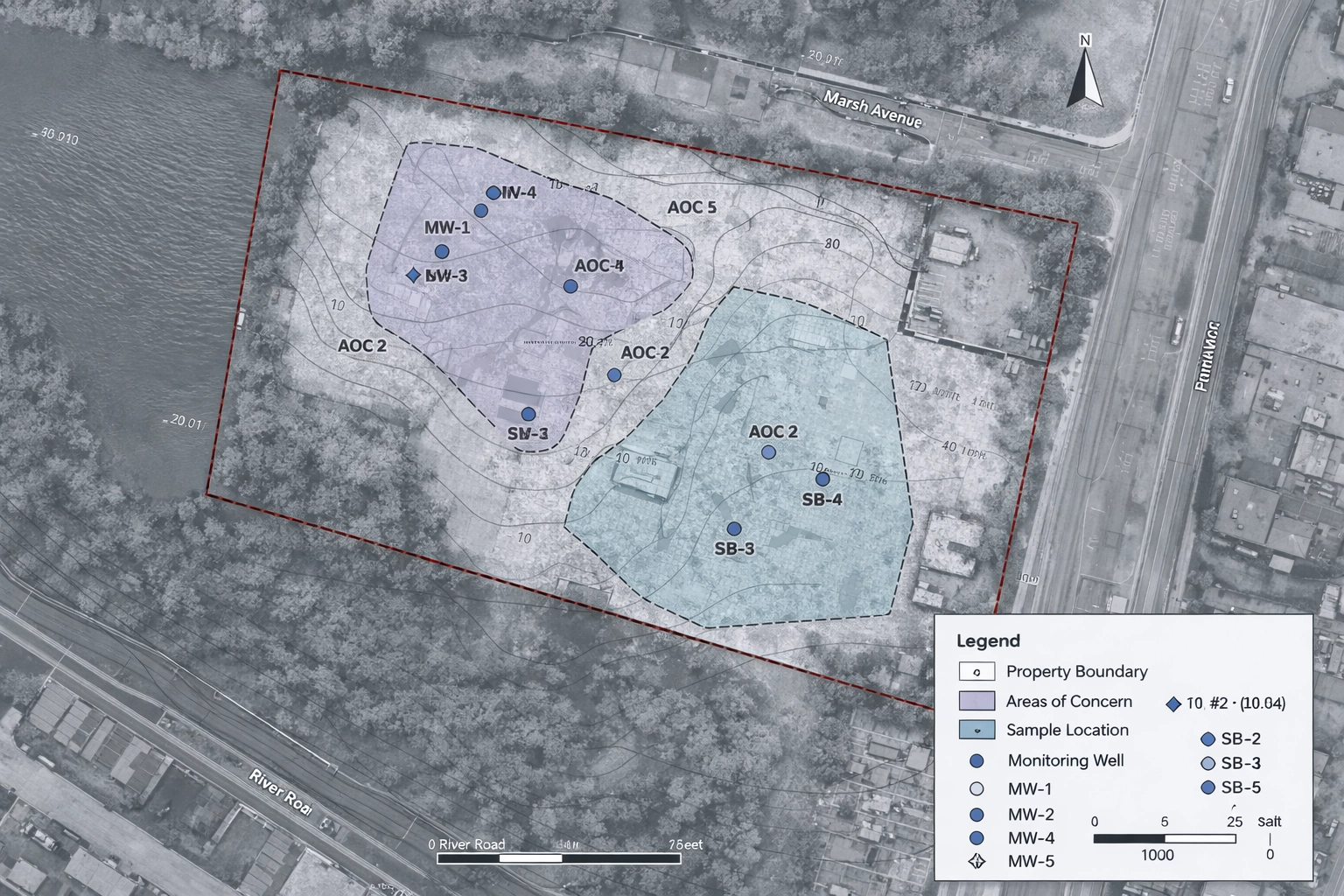
At Envicon, we view environmental due diligence for developers in NJ as a risk management exercise. We don't just identify a problem; we quantify the financial exit. By using high-resolution site characterization: like the utility and monitoring overlays seen in technical mapping: we reduce the "unknowns" early in the process.
"The LSRP's primary obligation is to protect public health and the environment, but their secondary obligation is to provide the client with a clear, predictable path to closure. If you don't have both, you don't have a strategy; you have a liability." : Jason Pancoast, CEO.
Why Your Current Consultant Might Be Holding You Back
If you are working with a massive, multi-national engineering firm, you might feel like you’re in good hands. But the reality is that these firms often operate with a "defensive" mindset. Their LSRPs are often more worried about their firm’s internal liability than your project’s schedule. They over-sample, over-report, and play it so safe that your project grinds to a halt.
The Envicon Approach vs. The Big Consultant:
- Responsiveness: When a tank is pulled and the soil looks "hot," you need a decision in an hour, not a week. We are built for speed.
- Accountability: You deal with senior experts who own the outcome, not a junior staffer who is just following a checklist.
- Adaptability: We don’t just follow the Technical Requirements blindly. We look for the "Professional Judgment" opportunities that save hundreds of thousands in excavation costs.
- Integrated Vision: Because we understand civil and geotechnical engineering, we don't look at environmental issues in a vacuum. We see how a remediation cap can double as your parking lot sub-base.

The RAO: Your "Get Out of Jail" Card
The ultimate goal of any LSRP interaction is the Response Action Outcome (RAO). This is the document that replaces the old "No Further Action" (NFA) letter. It is what your bank wants to see, what your buyers want to see, and what stops the clock on your environmental liability.
However, not all RAOs are created equal. An RAO can be "Unrestricted Use" (the gold standard) or "Restricted Use" (requiring a Deed Notice and Engineering Controls). A visionary LSRP looks at your final site plan and determines if a Restricted Use RAO is actually better for your ROI. If you're building a warehouse, you don't need "residential" soil standards under the slab. Navigating these NJDEP LSRP rules requires an insider’s understanding of how the state views long-term stewardship.
Due Diligence is Not a Commodity
If you are choosing an LSRP based on the lowest bid for a Preliminary Assessment (PA), you are making a mistake. A cheap PA often leads to an expensive Remedial Investigation. We’ve seen $5,000 reports cost developers $500,000 in missed "Areas of Concern" (AOCs) that were only discovered after the closing.
When we conduct environmental due diligence for developers in NJ, we look at the historical context of the site through a technical lens. We look at the utility pathways, the former process lines, and the specific chemical signatures of NJ’s industrial past. We find the problems before you own them, and we give you the price tag to fix them before you sign the contract.

Summary and Takeaways
Navigating the NJDEP doesn't have to be a nightmare of red tape and delays. The LSRP program was designed to put you in control, provided you have the right person in the driver's seat.
- Leverage Professional Judgment: Don't settle for "by the book" if the book is killing your project. Demand an LSRP who uses scientific evidence to find efficiencies.
- Watch the Deadlines: Compliance is non-negotiable. Ensure your LSRP has a rigorous tracking system for ARRCS mandatory timeframes.
- Integrate Early: Environmental strategy should start during the due diligence phase, not after the purchase.
- Think Beyond Environmental: Choose a partner like Envicon who understands how soil remediation impacts foundation design and site civil work.
At Envicon Strategic Solutions, we don't just manage cases; we solve puzzles. We are the insiders who know the rules well enough to know exactly where the flexibility lies. If you are tired of your current consultant telling you why you "can't" do something, it’s time to switch to a team that focuses on how you can.
Ready to move your project forward? Contact our LSRP team today and let’s get your site to an RAO without the headache.
Envicon Strategic Solutions — Contact
- Website: https://wp.envicongroup.com
- Contact: https://wp.envicongroup.com/contact
- Services: https://wp.envicongroup.com/services
Leave a Reply