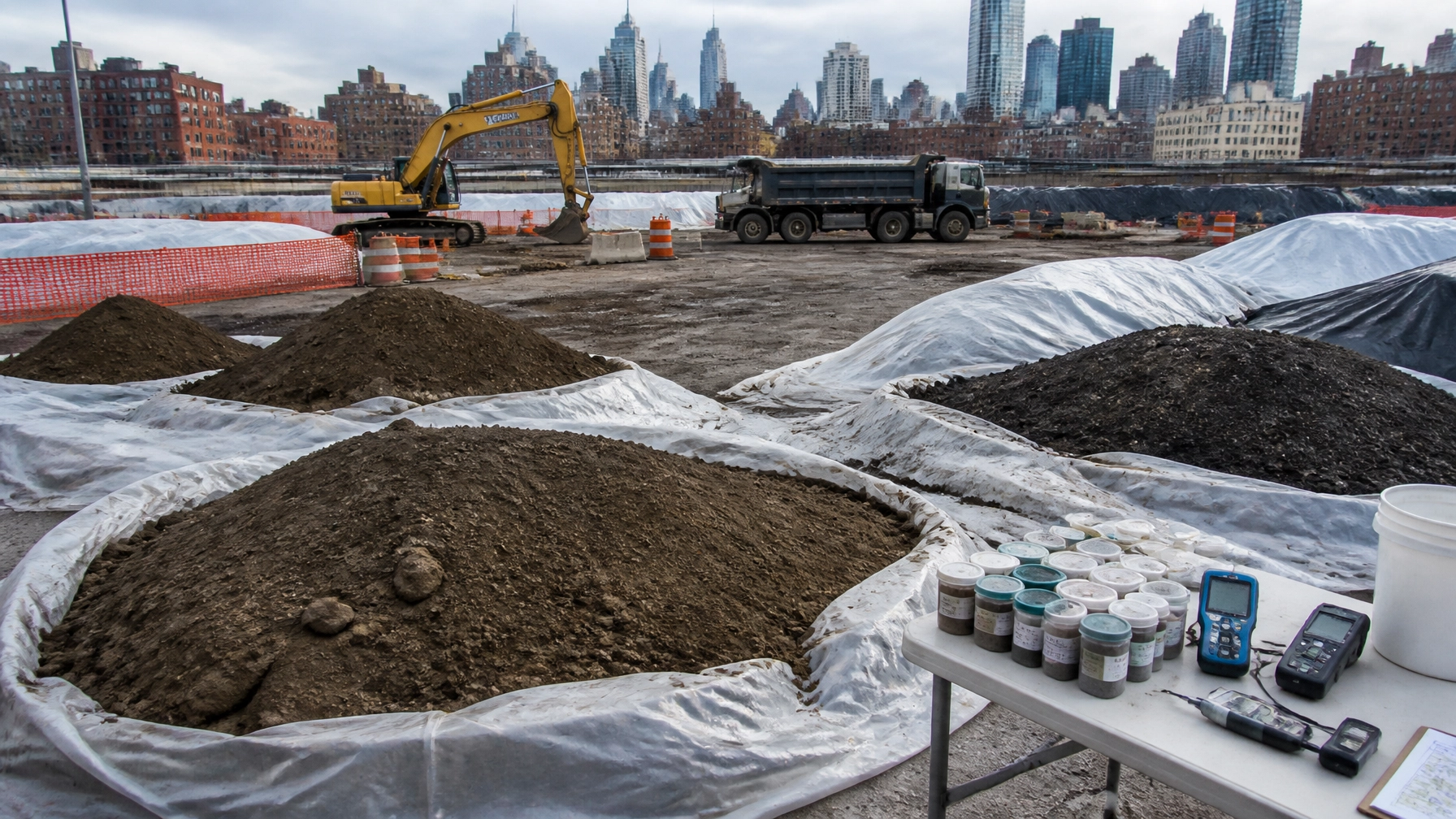
In New York City, dirt is never just dirt. If you’re developing a site with an E-Designation or a Restrictive Declaration, every yard of soil you move is a potential regulatory minefield. The "dirt police": a loose coordination between the NYC Office of Environmental Remediation (OER), the NYSDEC, and the DOB: are not looking for "good faith efforts." They are looking for documented compliance.
If you treat your NYC OER Soil Management Plan (SMP) as a report to be filed and forgotten, you are inviting stop-work orders, $50,000+ fines, and catastrophic delays to your Certificate of Occupancy. At Envicon, we don’t sell you a PDF to sit on a shelf. We provide the operational roadmap that keeps your project moving and your site compliant.
What is a Soil Management Plan (SMP)?
An SMP is not a suggestion; it is a legally binding operational rulebook. When OER grants a Notice of Satisfaction or a Remedial Closure Report (RCR), it often comes with the requirement to manage residual contamination under an SMP.
This document dictates exactly how soil must be screened, stockpiled, tested, and transported. It defines the "Engineering Controls": like vapor barriers or composite cover systems: that must remain intact for the life of the building. Failing to follow the SMP isn't just a technicality; it’s a breach of the recorded covenant on your property.

The NYC OER Soil Management Plan Compliance Checklist
To stay ahead of the "dirt police," your site team needs a tactical checklist that translates the 50-page SMP into daily field actions. If your current consultant isn't giving you this level of specificity, you’re paying for a report that won’t protect you in the field.
1. Pre-Excavation Prerequisites
- Approval Status: Has the OER approved the Remedial Action Plan (RAP) and the specific SMP? You cannot break ground without a Notice to Proceed.
- Waste Characterization: Have you performed "in-situ" sampling? Big-box firms often wait until soil is stockpiled, which doubles your handling costs. We sample while the dirt is still in the ground to get facility approvals before the first shovel hits.
- Facility Acceptance: Do you have written approval letters from the receiving landfill or recycling center?
2. On-Site Handling & Field Screening
- Field Screening: A qualified environmental professional (QEP) must be on-site to screen soil with a Photoionization Detector (PID) and visual/olfactory checks.
- Stockpile Management: Are stockpiles on poly-sheeting (20-mil minimum)? Are they covered at the end of the day?
- Segregation: Never mix "clean" soil with "impacted" soil. One bucket of contaminated fill dumped into a clean pile can turn a $15/ton disposal into a $90/ton nightmare.
3. Dust, Odor, and Vapor Control
- Air Monitoring: Is your Community Air Monitoring Program (CAMP) active? Real-time particulate monitoring isn't just for OER; it’s your primary defense against neighbor complaints that trigger DOB inspections.
- Suppression: Do you have a dedicated water source for dust suppression? In NYC, "we'll get a hose later" is a fast track to a violation.
4. Transportation and Disposal Documentation
- Licensed Haulers: Are your trucks carrying Part 364 permits?
- Manifests: Every single load must have a non-hazardous or hazardous waste manifest.
- Weight Tickets: You need a 1-to-1 match between your manifests and the facility weight tickets. Missing one ticket can stall an OER closure for months.

Avoiding the "Dirt Police" and Costly Violations
The most common reason for an NYC project to stall at the 11th hour is "missing documentation." When you apply for your Certificate of Occupancy, OER reviews the Remedial Closure Report. If you can’t prove where 200 tons of soil went, or if your end-point samples weren’t taken at the correct frequency, OER will not sign off.
The Envicon Difference: Large national firms treat this as a "clerical task" handled by junior staff. At Envicon, we treat documentation as a high-stakes engineering deliverable. We use real-time project reporting dashboards that track every manifest, every sample result, and every truck in real-time. You don’t have to wait for a monthly PDF to know if you're in compliance; you can see it on your phone at 7:00 AM.
Dirt is Money: The Clean Soil Bank Opportunity
Not all soil leaving an NYC site is "waste." The NYC Clean Soil Bank is a massive, underutilized resource that can save developers hundreds of thousands in disposal fees. If your soil meets the "Clean Fill" criteria (typically TAGM 4046 or unrestricted SCOs), it can be transferred to other NYC capital projects or public works.
However, the window to qualify for the Clean Soil Bank is narrow. It requires early coordination with OER and rigorous testing protocols. Most "big-box" consultants won't bother with the paperwork because it’s easier for them to just tell you to ship it to a landfill in Pennsylvania. We look for the path that protects your budget, not the path of least resistance for the consultant.

Why Experience Matters in the 5-Boroughs
NYC OER reviewers are specialists. They know the history of every block in Long Island City, the Bronx, and Brooklyn. If you submit a cookie-cutter SMP designed for a site in Ohio, they will flag it immediately.
Envicon brings 20 years of direct agency relationships. We don’t sit in a queue; we sit at the table. We know what the reviewers expect because we work with them daily. When a field challenge arises: like hitting an abandoned UST that wasn't on the maps: we don't wait three days to "consult with the partner." We solve it on the spot, coordinate with OER, and keep the machines moving.
Summary of Key Takeaways:
- The SMP is Law: It is a legally binding document that stays with the property.
- In-Situ Sampling is Essential: Characterizing soil before excavation saves time and money.
- Documentation is the Product: Without manifests and weight tickets, you don't have a buildable site.
- Technology Beats Paper: Real-time tracking prevents 11th-hour delays for your Certificate of Occupancy.
Take Control of Your Site
Stop paying for bloated reports that leave you vulnerable to field violations. You need a partner who understands that a "cleared path" is more valuable than a "defensive report."
Whether you’re dealing with an active E-Designation or preparing for a Phase II Site Investigation, Envicon Group is built to move at the speed of New York development.
Contact Envicon Group today to review your Soil Management Plan and ensure your project stays on schedule and under budget.
Leave a Reply