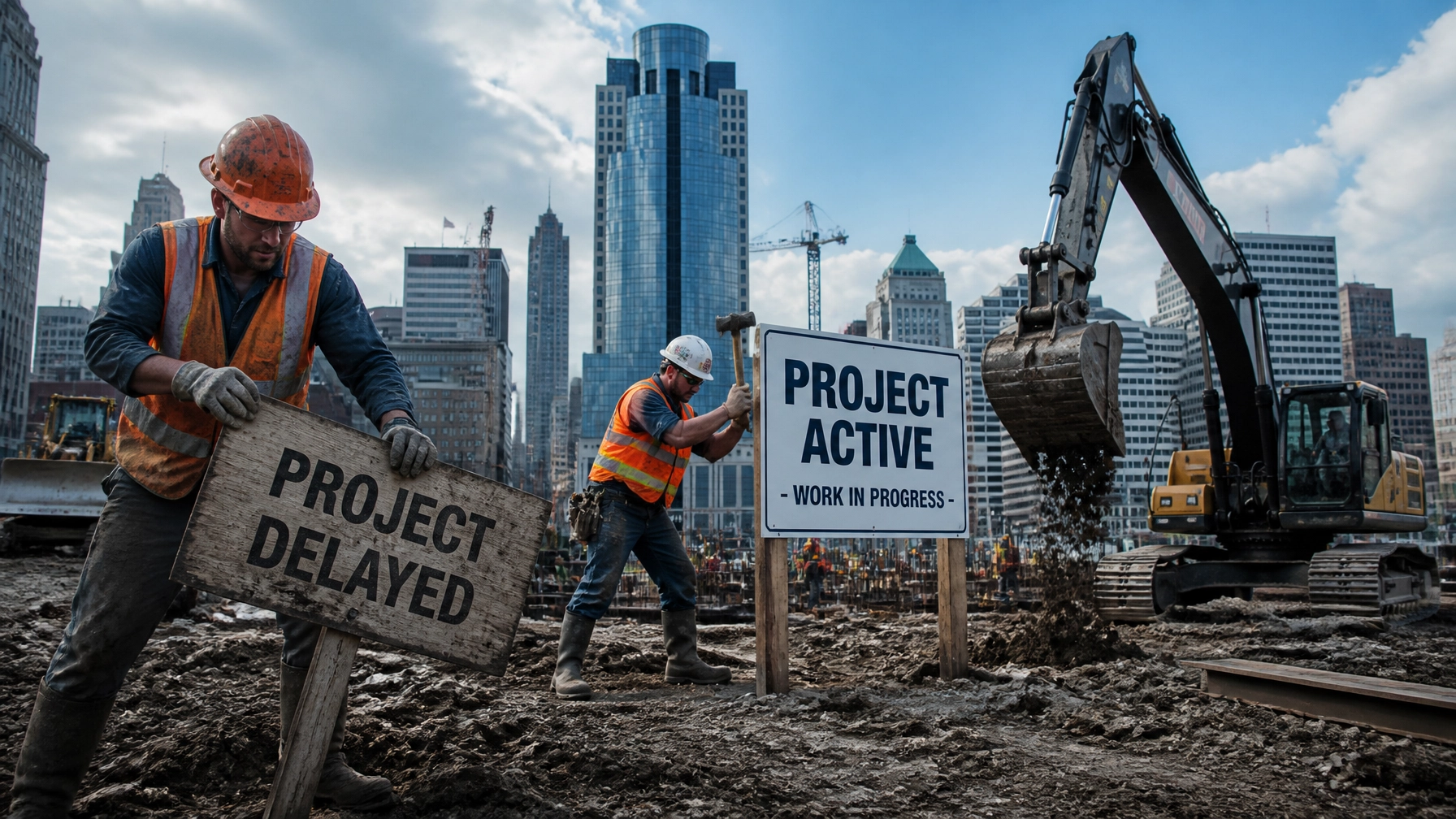
In the high-stakes world of New York and New Jersey real estate development, "wait and see" is often framed as a conservative, risk-mitigation strategy. On paper, it sounds logical: Let’s wait for the full Phase II results. Let’s see what the regulator says about the initial characterization. Let’s wait until the loan is fully closed before we spend a dime on remedial design.
But in the field, "wait and see" is usually just code for "losing money."
When you delay the integration of environmental remediation design into your early-stage planning, you aren’t avoiding risk: you’re compounding it. You are trading a relatively small, upfront investment in expert engineering for a massive, daily "burn rate" of carrying costs that can easily exceed $100,000 before you even break ground.
At Envicon Group, we see this play out constantly. A developer hires a big-box firm that delivers a defensive, 400-page report that sits in a queue for weeks. Meanwhile, the project stalls, the lender gets nervous, and the "burn" begins. We don’t sell reports; we sell cleared paths. And the fastest way to clear a path is to stop waiting and start designing.
The Math of Inertia: Breaking Down Your Daily Burn Rate
Let’s be blunt: every day your project sits idle because of an unresolved environmental "question mark," you are writing a check to your lender, the insurance company, and the tax man.
In the NYC and NJ markets, the carrying costs of a stalled site are staggering. Industry data suggests that once financing is in place, remediation-related delays burn approximately 0.5% to 3.0% of the total project value per month.
For a $30 million development: a standard mid-sized project in our region: that is a monthly cost of $150,000 to $900,000. If you’re "waiting and seeing" for just three months, you’ve already incinerated enough capital to have paid for your entire remedial design ten times over.
Here is where that money goes:
- Financing Costs: On a $30M loan at 7%, your interest alone is roughly $175,000 per month. That interest accrues whether or not there’s an excavator on-site.
- Insurance Premiums: In New York, construction insurance is a massive budget line, often accounting for 8–10% of total project costs due to the Scaffold Law and other regional factors. Every month of delay extends these high-premium periods.
- Property Taxes: The municipality doesn’t care that your Phase II is sitting in a consultant’s "review" pile. The taxes keep running.
- Opportunity Costs: Missing a peak leasing window or a favorable market exit can reduce your projected IRR by 10-15%. In a volatile market, timing is everything.
The Regulatory Clock: Why Delay is Dangerous
Waiting doesn’t just cost you interest; it risks your compliance status. The regulatory landscape in NY and NJ is shifting faster than most "big-box" consultants can keep up with.
Take the NJDEP REAL (Resilient Environments and Landscapes) Rule. These updates are fundamentally changing how we look at flood zones and stormwater management. If you wait to finalize your design, you might find that the rules of the game have changed by the time you’re ready to submit. Suddenly, your "wait and see" approach means your project is now subject to more stringent, more expensive requirements than it would have been three months ago.
The same applies to the NYC OER (Office of Environmental Remediation) and the Voluntary Cleanup Program (VCP). Navigating an E-Designation requires precise, proactive coordination. If you treat remediation as a "later" problem, you’re setting yourself up for a collision with your foundation and utility schedules.

The Consultant Gap: Defensive Reporting vs. Action Plans
Why do so many developers fall into the "wait and see" trap? Usually, it’s because their consultant is leading them there.
Large national firms are built on a model of risk aversion: for themselves, not for you. They produce bloated, defensive reports designed to protect the consultant from liability. These reports are often written by junior staff who have never stood on your site and then reviewed by a partner you haven’t talked to since the pitch.
The result? A document that tells you what might be wrong, but doesn't give you a clear, engineered path to fix it. They hand you a report and leave you to figure out what it means for your bottom line.
At Envicon, we do the opposite. We are PE-led and field-first. When we find an issue during a Phase II Environmental Site Assessment, we don’t just flag it. We immediately begin looking at the remedial design and how it integrates with your civil and site engineering.
We ask the hard questions early:
- Can we reuse this soil on-site to avoid $200/ton disposal fees?
- Will this vapor barrier interfere with your foundation's structural integrity?
- Can we coordinate the remediation with the utility installation to save on mobilization?
We don’t wait for the regulator to tell us what to do. We sit at the table with the NYC OER, NYSDEC, and NJ DEP and present them with a solution that works for the project and meets the code. That’s the difference between a consultant who sells "billable hours" and a partner who sells "cleared paths."
Transparency: The Tech Advantage
One of the biggest drivers of the "wait and see" delay is the information vacuum. If you don’t know exactly where your project stands, you can’t make an informed decision to move forward.
Most firms send a monthly PDF report that is outdated the moment it hits your inbox. Envicon has built a proprietary environmental dashboard infrastructure that gives our clients real-time visibility into their site.

With our dashboard, you can see exactly:
- Which soil samples have been cleared.
- Where the regulatory hurdles stand in the timeline.
- The status of every SWPPP inspection and air monitoring result.
When you have the data, you don't have to "wait and see." You can lead. You can show your lender exactly how you are managing the risk, and you can keep your construction teams moving.
The Envicon Resolution: Ownership of Outcomes
We believe that integrity isn't just about ethics; it's about delivering the truth and standing behind the work. If we tell you a site can be cleared by July, we take ownership of that outcome. We don't hide behind "pending results" or "agency delays" if there's a way to push the project forward.
Our team has 20 years of direct relationships with the reviewers at the NJ DEP and NYC OER. We know them by name. We know how they work. We don't just send an email and wait; we pick up the phone because alignment is how projects actually get done.
"Collaboration is not a buzzword: it's how we work." : Jason Pancoast, CEO
Summary and Key Takeaways
Delaying your remediation design is a gamble where the house (the bank and the regulator) always wins. The "Wait and See" strategy almost always leads to:
- Inflated Carrying Costs: $100k+ in interest and insurance "burn" per month.
- Regulatory Traps: Missing windows for grandfathered rules or tax credit deadlines.
- Construction Stalls: Remediation issues discovered during excavation are 5x more expensive to fix than those addressed in design.
- Communication Gaps: Large firms leave you in the dark; Envicon keeps you in the driver's seat with real-time data.

Don't Let Your Project Sit in a Queue
If you’re tired of paying premium rates for junior-staff execution and defensive reports that don't move the needle, it's time to switch. Whether you need a Phase I ESA with a 48-hour turnaround or an LSRP for a complex NJ site, Envicon is ready to get on-site at 7 AM and find your path to closure.
Stop waiting. Start building.
Contact Envicon Group today to schedule a site-specific strategy session and see how we can shave months off your schedule and hundreds of thousands off your carrying costs.
Leave a Reply