A vapor intrusion investigation answers one practical question: Are volatile chemicals in soil, soil gas, or groundwater entering a building at concentrations that require further action?
The answer depends on the jurisdiction, the chemical, the building, and the quality of the sampling data. New Jersey and New York City use related but different frameworks. NJDEP applies media-specific screening levels and rapid action levels. NYC OER evaluates E-designation properties through site-specific testing protocols, approved remedial plans, and NYSDOH/NYSDEC vapor intrusion guidance.
This distinction matters for developers, lenders, attorneys, and construction teams. A report that applies the wrong table: or ignores crawlspace conditions, indoor background sources, or preferential pathways: can delay permitting, financing, occupancy, or construction.
What Vapor Intrusion Testing Evaluates
Vapor intrusion occurs when volatile organic compounds, or VOCs, migrate from contaminated soil or groundwater through the subsurface and enter an enclosed structure.
A complete vapor intrusion pathway generally requires:
- A volatile contaminant source
- A migration pathway through soil, groundwater, utility corridors, or foundation openings
- A current or future occupied structure
The investigation should begin with a clear conceptual site model. That model maps the source, subsurface conditions, building foundation, utilities, crawlspaces, basements, HVAC systems, and potential receptors.
NJDEP’s Vapor Intrusion Technical Guidance uses a staged approach. Existing groundwater data may be reviewed first, followed by soil gas, sub-slab vapor, and indoor air sampling where warranted.
“Exceedances of the screening levels indicate that VI is of potential concern and that further evaluation and/or potential remediation of the pathway is necessary.” : NJDEP
The result is not simply a laboratory number. It is a decision about whether the pathway is incomplete, requires additional investigation, or needs mitigation.
The Three Core Sampling Lines of Evidence
1. Sub-slab soil gas sampling
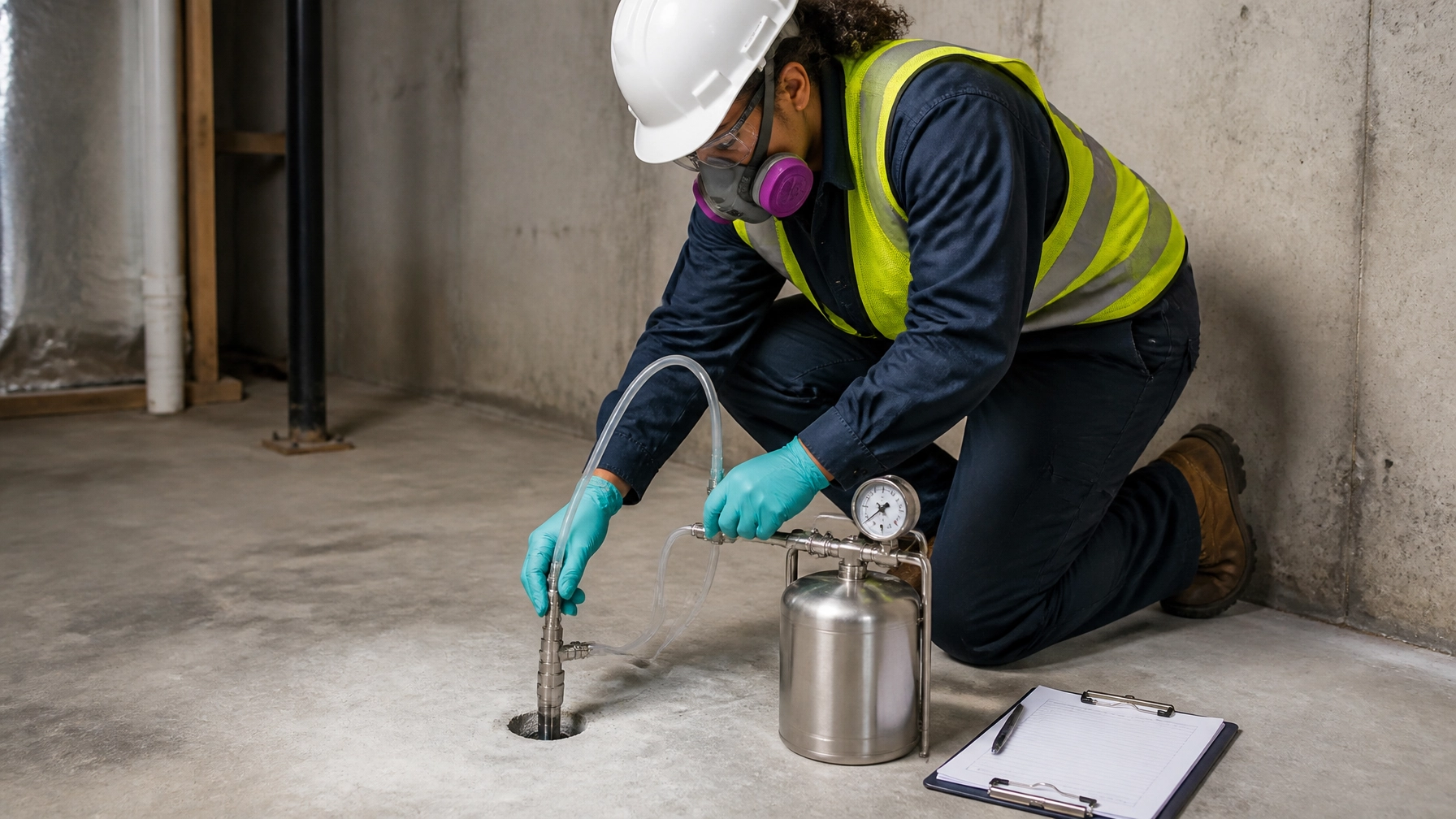
Sub-slab sampling measures vapor directly beneath an existing building slab. Technicians install a temporary or permanent probe through the concrete and connect it to a clean sampling train and stainless-steel canister.
This is usually the strongest soil-gas line of evidence because it measures conditions immediately below the structure rather than conditions at a distant exterior location.
A defensible sub-slab program should address:
- Probe location and depth
- Foundation construction
- Slab cracks, seams, sumps, and penetrations
- Soil type and moisture
- Utility corridors and preferential pathways
- Leak testing and tracer gas
- Canister vacuum and flow-rate documentation
- Laboratory reporting limits and QA/QC
Under NJDEP’s current framework, sub-slab soil gas results are compared to the applicable Soil Gas Screening Level, or SGSL. Exterior soil gas should not automatically be treated as equivalent to sub-slab data.
2. Indoor air sampling
Indoor air sampling measures the concentration occupants may actually breathe. Samples may be collected in basements, crawlspaces, first-floor rooms, or other occupied areas.
Indoor air results require careful interpretation because VOCs can come from ordinary building sources, including:
- Dry-cleaned clothing
- Paints, adhesives, and solvents
- Fuel storage
- Cleaning products
- Attached garages
- New flooring or furniture
- Smoking and vehicle exhaust
- HVAC or combustion equipment
For that reason, a strong vapor intrusion testing program often includes ambient outdoor air, sub-slab vapor, and indoor air collected during the same event. Investigators also perform a building survey and provide occupant instructions before sampling.
NJDEP evaluates indoor air against current indoor air remediation standards and rapid action levels. Crawlspace air is treated as indoor air for NJDEP screening purposes.
3. Crawlspace sampling
Crawlspaces create a common blind spot. They may have exposed soil, limited ventilation, moisture, utility penetrations, or direct communication with occupied rooms.
A crawlspace evaluation should consider:
- Whether the crawlspace has a concrete slab, vapor barrier, or exposed soil
- Whether it connects to living or working areas
- Air exchange and ventilation conditions
- Sumps, drains, cracks, and utility penetrations
- Sub-slab or near-slab soil gas conditions
- First-floor indoor air above the crawlspace
A crawlspace sample alone does not always establish the source. It must be evaluated with the building layout and subsurface data.

NJDEP Vapor Intrusion Screening Levels
NJDEP’s current Vapor Intrusion Screening Levels and Indoor Air Remediation Standards include three principal screening categories:
- Groundwater Screening Levels (GWSL)
- Soil Gas Screening Levels (SGSL)
- Indoor Air Remediation Standards and Rapid Action Levels (RALs)
The applicable value depends on the chemical and exposure scenario. Residential, school, daycare, and certain sensitive-use properties are evaluated differently from typical commercial or industrial settings.
Representative NJDEP values
The following examples come from NJDEP’s February 2025 screening-level basis and background tables. They are provided for orientation, not as a substitute for reviewing the current NJDEP table for a specific project.
| Chemical | Residential sub-slab soil gas SGSL | Nonresidential sub-slab soil gas SGSL | NJDEP groundwater screening level |
|---|---|---|---|
| Benzene | 18 µg/m³ | 79 µg/m³ | 23 µg/L |
| PCE | 540 µg/m³ | 2,400 µg/m³ | 36 µg/L |
| TCE | 34 µg/m³ | 150 µg/m³ | 3.0 µg/L |
| Vinyl chloride | 32 µg/m³ | 140 µg/m³ | 0.59 µg/L |
NJDEP uses an attenuation factor of 0.02 when developing soil gas screening values from health-based indoor air criteria. The screening values are not cleanup standards. They are decision points that determine whether the vapor intrusion pathway needs additional evaluation or response.
When does an NJDEP result trigger more work?
A result above the applicable screening value does not mean that every project immediately requires excavation or a mitigation system. It means the pathway cannot be dismissed based on that data point.
Typical next steps include:
- Confirming that the sample is representative and valid
- Reviewing the conceptual site model
- Collecting confirmation samples
- Evaluating indoor background sources
- Performing indoor-air sampling
- Reviewing groundwater, soil, and utility data
- Assessing seasonal variability
- Designing and implementing mitigation where necessary
NJDEP also uses Rapid Action Levels for indoor air. An occupied building result above the applicable RAL requires prompt action to investigate and reduce potential exposure. Depending on the contaminant and building use, that may include an interim remedial measure, additional confirmation sampling, or immediate mitigation.
NYC OER and E-Designation Requirements
NYC OER does not use NJDEP screening tables for New York City properties.
An E-designation means a property has environmental requirements connected to a zoning action. For hazardous-materials E-designations, those requirements must be addressed before the owner can obtain a building permit, and the approved remedy must be implemented before occupancy.
The NYC Office of Environmental Remediation E-Designation page explains that hazardous-materials E-designations may require soil testing and an OER-approved remedial action plan.
For vapor intrusion concerns, the site-specific work plan may include:
- Soil vapor sampling
- Sub-slab soil gas sampling
- Crawlspace air sampling
- Indoor air sampling
- Ambient outdoor air sampling
- VOC analysis using EPA Method TO-15
- Laboratory data from an appropriately certified laboratory
- Vapor barrier or sub-slab depressurization design
- Construction Health and Safety Plan requirements
- Long-term operation, monitoring, and maintenance
NYC projects commonly rely on the NYSDOH Soil Vapor Intrusion Guidance and Updates. NYSDOH decision matrices compare sub-slab vapor and indoor air concentrations for specific chemical groups and identify outcomes such as no further action, monitoring, additional investigation, or mitigation.
The controlling document, however, remains the E-designation language and the OER-approved testing and remedial plans for the property.

What Happens When a Trigger Is Exceeded?
The right response depends on the data, not on a generic checklist.
A project team should immediately confirm:
-
Which jurisdiction applies?
NJDEP values do not control a NYC OER project. -
Which medium exceeded the threshold?
Groundwater, soil gas, sub-slab vapor, crawlspace air, and indoor air have different decision criteria. -
Was the sample collected correctly?
Probe leaks, excessive moisture, poor canister vacuum, elevated reporting limits, or inadequate QA/QC can make results unusable. -
Could the result come from an indoor or outdoor background source?
PCE from dry-cleaned clothing and benzene from fuel or vehicle exhaust are common examples. -
Is the pathway complete?
A high sub-slab result with no corresponding indoor-air impact may still require monitoring or mitigation, but it does not carry the same meaning as a confirmed indoor-air exceedance. -
Will the building use change?
A future residential conversion may require a more protective evaluation than the current commercial use.
Mitigation may include a vapor barrier, sub-slab depressurization system, membrane or coating, foundation sealing, HVAC adjustments, or source removal. The selected remedy must fit the building and the regulator’s requirements.

Why the Investigation Team Matters
Vapor intrusion testing is not a commodity sampling exercise. The value comes from connecting field data to the decision that follows.
Envicon approaches these projects with:
- Direct, senior-level involvement from planning through closeout
- Field-first investigation and construction coordination
- Experience working with NJDEP, NYC OER, NYSDEC, and NYC agencies
- Clear documentation built for lenders, attorneys, regulators, and contractors
- Real-time project visibility through our technology platform
- Practical recommendations instead of a report that leaves the next step to you
Our team can coordinate Phase II investigations, soil gas and indoor air sampling, remedial design, vapor mitigation, regulatory submissions, and construction oversight as one connected process.
The Takeaway
For New Jersey properties, compare groundwater, sub-slab or near-slab soil gas, crawlspace air, and indoor air data against the current NJDEP tables. For NYC E-designation properties, follow the site-specific OER requirements and the applicable NYSDOH/NYSDEC vapor intrusion framework.
A screening exceedance is a decision point. It is not the end of the project, and it is not a reason to guess. It is the point where qualified professionals need to confirm the data, understand the pathway, and move quickly toward the right response.
If you need the next step after testing, review Envicon’s vapor intrusion mitigation hub.
Get a Clear Path Forward
- Call Envicon now to discuss your site and regulatory deadline.
- Get a free quote today.
- Use our proprietary project risk screener to identify potential project obstacles before they become delays.
Leave a Reply