A municipal renovation or demolition project in New Jersey can be delayed before the first wall is opened if asbestos requirements are not addressed during design and permit coordination.
For public buildings, educational facilities, daycare centers, and other properties subject to New Jersey’s Asbestos Hazard Abatement Subcode, the process involves more than ordering an asbestos test. Owners and project teams must coordinate:
- A pre-renovation or pre-demolition asbestos assessment
- Architect or engineer certification regarding potential asbestos disturbance
- A construction permit for asbestos abatement
- A licensed New Jersey asbestos contractor
- An authorized Asbestos Safety Control Monitoring (ASCM) firm
- A New Jersey Department of Community Affairs-certified Asbestos Safety Technician (AST)
- Air monitoring, containment, waste handling, and final clearance
- Separate demolition, structural, and other Uniform Construction Code permits
The governing rule is N.J.A.C. 5:23-8, the New Jersey Asbestos Hazard Abatement Subcode. This article explains how it fits into the municipal building permit process.
“It shall be unlawful to undertake an asbestos hazard abatement project” without first filing an application and obtaining the required permit. : N.J.A.C. 5:23-8.5
Who must follow New Jersey’s asbestos subcode?
N.J.A.C. 5:23-8 applies directly to asbestos abatement projects in:
- Public buildings
- Municipal facilities
- County and state facilities
- Educational facilities
- Daycare centers and nurseries
A municipal facility includes buildings under municipal ownership or control, such as:
- City halls and municipal offices
- Police and fire stations
- Public works buildings and garages
- Libraries and community centers
- Maintenance facilities
- Municipal housing or service buildings
The subcode can also apply to common areas and building systems serving public employees in a building leased or managed by a public entity.
The rule is not limited to interior rooms. Exterior hallways, porticos, cooling towers, mechanical insulation, tunnels, and service areas may also fall within the project scope when asbestos abatement occurs.
For private commercial and residential properties, New Jersey Department of Labor asbestos licensing rules, New Jersey Department of Health requirements, federal NESHAP, OSHA standards, and NJDEP waste-management rules may still apply even when the project is outside the direct scope of N.J.A.C. 5:23-8.
That distinction matters. A project team should not assume that a private building is exempt from an asbestos survey simply because it is not a municipal facility.
The first step: asbestos inspection before renovation or demolition
Before renovation or demolition, the owner must determine whether planned work could disturb asbestos-containing materials (ACM).
Under N.J.A.C. 5:23-8.6, an architect or engineer must certify to the construction official whether asbestos will be disturbed and, if so, the extent of the disturbance. When the work does not require an architect or engineer, the contractor may provide the certification.
If asbestos may be disturbed in a covered public or educational building, an asbestos assessment is required unless the New Jersey Department of Health waives the requirement in writing.

A proper asbestos inspection should identify suspect materials that may be impacted by the construction scope, including:
- Thermal system insulation on pipes, boilers, and tanks
- Sprayed or troweled surfacing materials
- Vinyl asbestos tile and sheet flooring
- Floor tile and mastic
- Ceiling tile and acoustic plaster
- Transite and asbestos cement products
- Roofing, siding, flashing, and sealants
- Fireproofing and fire-resistive materials
- Gaskets, packing, caulking, and glazing compounds
A visual walkthrough alone is not enough. The inspection should account for concealed conditions, phased construction, mechanical rooms, plenums, pipe chases, crawl spaces, and areas that will be accessed during demolition.
For a commercial asbestos survey in New Jersey, the assessment should be performed by an appropriately accredited inspector. Bulk samples should be analyzed by a qualified laboratory using applicable EPA methods. The final report should connect each confirmed ACM location to the construction drawings and planned disturbance.
That is the difference between a report that sits in a project file and an assessment that helps obtain a permit.
What N.J.A.C. 5:23-8.6 requires for permit coordination
N.J.A.C. 5:23-8.6 is often misunderstood. It does not eliminate the need for other construction permits. Instead, it coordinates asbestos review with the rest of the municipal permitting process.
Before a repair, renovation, or demolition permit is issued for a covered building, the construction official must receive:
- An architect or engineer certification regarding asbestos disturbance, or contractor certification where applicable.
- An asbestos assessment when the certification indicates that asbestos may be disturbed.
- The resulting abatement requirements, if the assessment identifies an asbestos hazard.
When abatement is required, the disturbance-causing work cannot proceed until the asbestos hazard is abated or the material no longer presents a hazard.
The construction official may issue a partial permit for work that clearly will not disturb or interfere with the asbestos abatement work. This can help keep a project moving, but only when the scopes are genuinely separated.
A municipal building permit package may therefore need to coordinate:
- Asbestos abatement permit
- Demolition permit
- Structural permit
- Building, electrical, plumbing, or mechanical permits
- Approved abatement plans and specifications
- Waste hauler and disposal facility information
- NESHAP and state notifications, when applicable
A separate demolition permit remains required under the Uniform Construction Code. The asbestos permit does not authorize the entire demolition or renovation project.
Construction permit for asbestos abatement
For a covered asbestos hazard abatement project, the owner or authorized representative must file a written application with the enforcing agency and obtain the permit before abatement begins.
The application generally includes:
- Licensed asbestos contractor name, address, and license number
- Asbestos hazard assessment
- Authorized ASCM firm information
- Scope of work and asbestos quantities
- Containment measures and work-area controls
- Site and floor plans
- Exit routes and waste travel routes
- Waste hauler and disposal facility information
- Scheduled start and completion dates
- Final air-analysis method
- Occupancy documentation, if the building will remain occupied
The ASCM must review and release the plans and specifications in writing. The enforcing agency also reviews the submission to determine whether replacement materials are needed to maintain structural integrity or fire resistance.
The permit authorizes preparation of the work area. It does not authorize actual asbestos removal until the AST completes and approves the pre-commencement inspection.
The role of the ASCM firm and certified AST
A covered project requires an authorized Asbestos Safety Control Monitoring firm. The ASCM works for the building owner and is responsible for monitoring and controlling the abatement work under N.J.A.C. 5:23-8.
The ASCM must:
- Review and release plans
- Provide technical assistance during permit preparation
- Schedule and perform required inspections
- Coordinate air monitoring and laboratory analysis
- Maintain inspection records and daily logs
- Report deficiencies and project status
- Issue required notices and certificates
- Prepare the final comprehensive project report
The field representative is the Asbestos Safety Technician. An AST is certified by the New Jersey Department of Community Affairs and must remain on site while abatement work is underway.

The AST’s responsibilities include:
- Observing work-area preparation
- Confirming containment and decontamination controls
- Verifying worker permits
- Conducting pre-commencement inspections
- Monitoring pressure differentials and engineering controls
- Performing required air sampling
- Inspecting progress and pre-sealant conditions
- Directing corrective action
- Conducting cleanup and final inspections
- Maintaining daily logs and final reports
No actual abatement work should begin until the AST issues written authorization to proceed.
If the contractor fails to correct a violation, the AST can order the work stopped in writing. If the contractor does not comply, the enforcing agency can issue a stop-work order, secure the work area, and assess penalties.
Air monitoring, containment, and clearance
Asbestos safety control monitoring is not a paperwork exercise. It is an active field-control function.
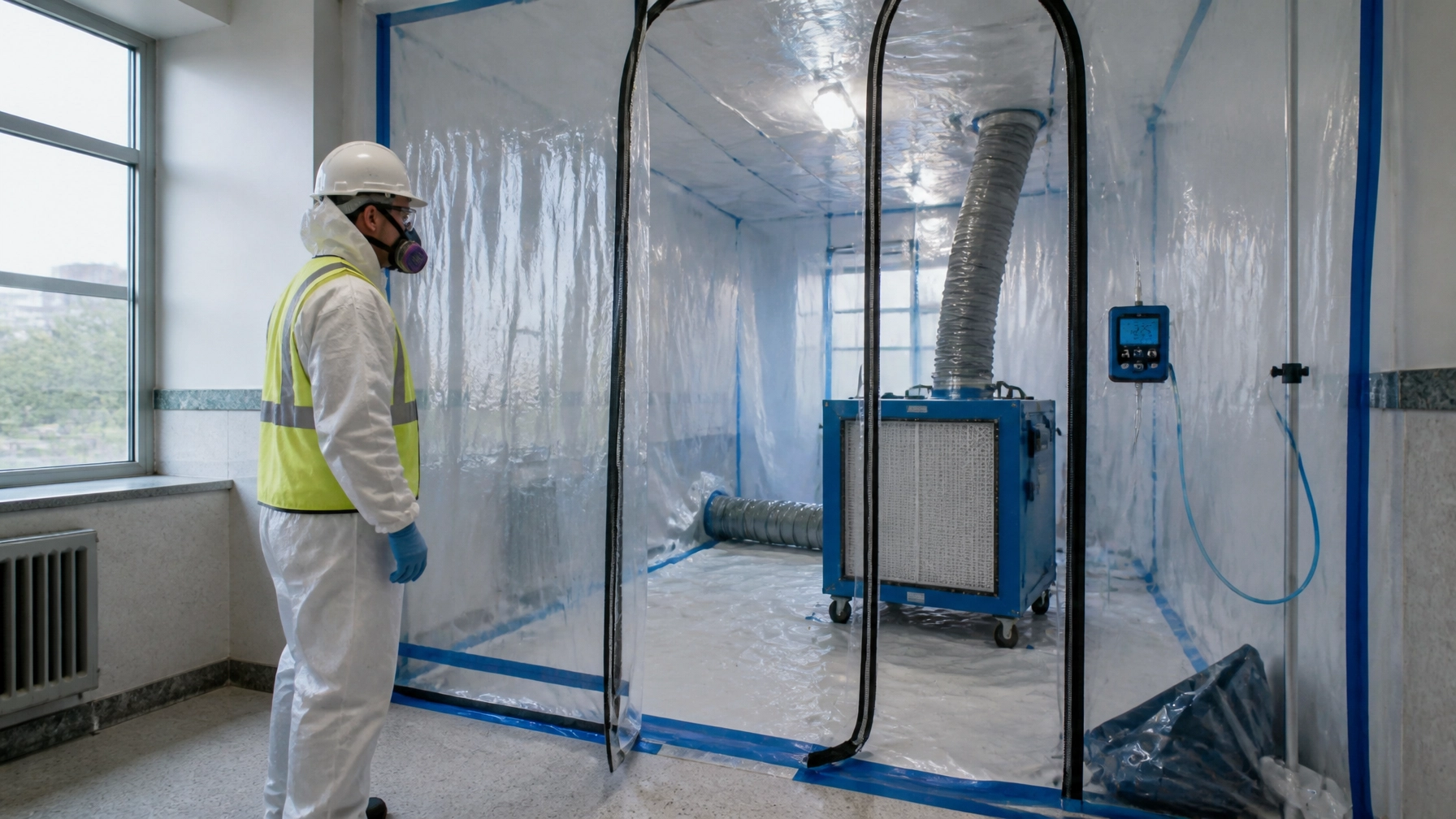
For a typical full-containment abatement project, the contractor may need to install:
- Critical barriers
- Separation barriers
- Decontamination facilities
- HEPA-filtered air filtration units
- Negative-air systems
- Digital manometers
- Controlled waste routes
- Emergency procedures and posted contact information
For unoccupied buildings, N.J.A.C. 5:23-8.15 requires engineering controls capable of maintaining a pressure differential of at least 0.03 inches water column between the work area and adjacent spaces. Occupied-building projects generally require at least 0.05 inches water column, along with additional separation, occupancy, and air-monitoring controls.
Air sampling must follow the applicable methods in N.J.A.C. 5:23-8.21, including NIOSH 7400 for PCM analysis and applicable TEM requirements for final clearance.
The work area must pass:
- Visual inspection
- Cleanup inspection
- Final air monitoring
- Final inspection
- Documentation review
A building area cannot be reoccupied simply because the contractor says the work is complete. The owner must obtain the required Certificate of Completion, and the enforcing agency must issue the certificate of occupancy or other approval required for reoccupancy.
Occupied buildings require additional planning
N.J.A.C. 5:23-8 generally expects asbestos abatement to occur in unoccupied buildings. If portions of a building will remain occupied, the project must meet additional requirements.
The owner must provide written occupant notification 20 business days before the project begins. The notice should address:
- Relocation plans
- Blocked entrances and alternate routes
- Emergency contacts
- Affected areas
- Precautions and protective measures
The ASCM must also provide a written statement identifying the occupied areas and confirming that required controls will remain in place.
Occupied-building projects require tighter coordination between the owner, construction manager, contractor, building occupants, fire protection personnel, and municipal enforcing agency. A missed detail can shut down the work or create an unacceptable exposure pathway.
State and federal notifications
Depending on the building type, material, quantities, and planned disturbance, additional notifications may be required.
Under federal 40 CFR Part 61, Subpart M, the asbestos NESHAP applies to demolition and renovation of most facilities, excluding residential buildings with four or fewer dwelling units. Notification requirements can apply when regulated asbestos-containing material exceeds applicable thresholds.
NJDEP guidance identifies the common NESHAP thresholds as:
- More than 260 linear feet on pipes
- More than 160 square feet on other facility components
- More than 35 cubic feet where the quantity cannot be measured before removal
For regulated asbestos-containing material, written notification generally must be submitted at least 10 working days before demolition or renovation begins.
NJDEP also regulates asbestos waste transportation and disposal under N.J.A.C. 7:26. Waste must be properly packaged, labeled, transported by an appropriate registered hauler, and disposed of at an authorized facility.
New Jersey Department of Labor licensing and notification requirements may apply to asbestos work in public, commercial, and residential buildings. Contractors and workers must hold the required licenses and permits unless a specific exemption applies.
Review the current requirements directly through:
- NJ DCA Asbestos Hazard Abatement program
- N.J.A.C. 5:23-8 Asbestos Hazard Abatement Subcode
- NJDEP asbestos management guidance
- New Jersey Asbestos Control and Licensing Act
- EPA asbestos laws and regulations
New Jersey asbestos inspection checklist
Before submitting a municipal renovation or demolition permit, confirm that your project team has:
- Defined the full construction disturbance area
- Completed a pre-renovation or pre-demolition asbestos survey
- Obtained the required architect, engineer, or contractor certification
- Identified ACM, RACM, and suspect materials
- Selected a licensed asbestos contractor
- Selected an authorized ASCM firm
- Confirmed AST coverage
- Prepared abatement plans and containment details
- Coordinated demolition and other UCC permits
- Identified waste hauler and disposal facility
- Submitted required state and federal notifications
- Planned occupant relocation or protection
- Established air-monitoring and clearance procedures
- Built final reporting into the project schedule
How Envicon keeps the permit path clear
Asbestos coordination sits at the intersection of environmental compliance, construction sequencing, public safety, and municipal review. It should not be handed from one consultant to another with no single point of ownership.
Envicon Group brings environmental assessment, regulatory coordination, construction oversight, and field-level documentation into one project workflow. Our team works directly with owners, architects, contractors, attorneys, code officials, and agency reviewers across New Jersey and New York.
We do not just deliver an asbestos report. We help you understand what the findings mean, what must happen next, and how to keep unrelated portions of your project moving where the regulations allow it.
That is how complex buildings become buildable projects.
Summary
For a New Jersey municipal building renovation or demolition, asbestos review must begin before permit submission: not after a contractor discovers suspect material in the field.
The essential sequence is:
- Survey the building and planned disturbance areas.
- Certify whether asbestos may be disturbed.
- Complete the required assessment.
- Coordinate the asbestos abatement permit with other UCC permits.
- Use a licensed asbestos contractor and authorized ASCM firm.
- Maintain continuous AST oversight and required air monitoring.
- Complete clearance, reporting, and occupancy approvals before reentry.
If your project involves a municipal building, public facility, school, daycare, commercial property, or older residential structure in New Jersey, early asbestos coordination can prevent permit rejection, stop-work orders, re-mobilization, and avoidable schedule loss.
Plan your next step with Envicon

Leave a Reply