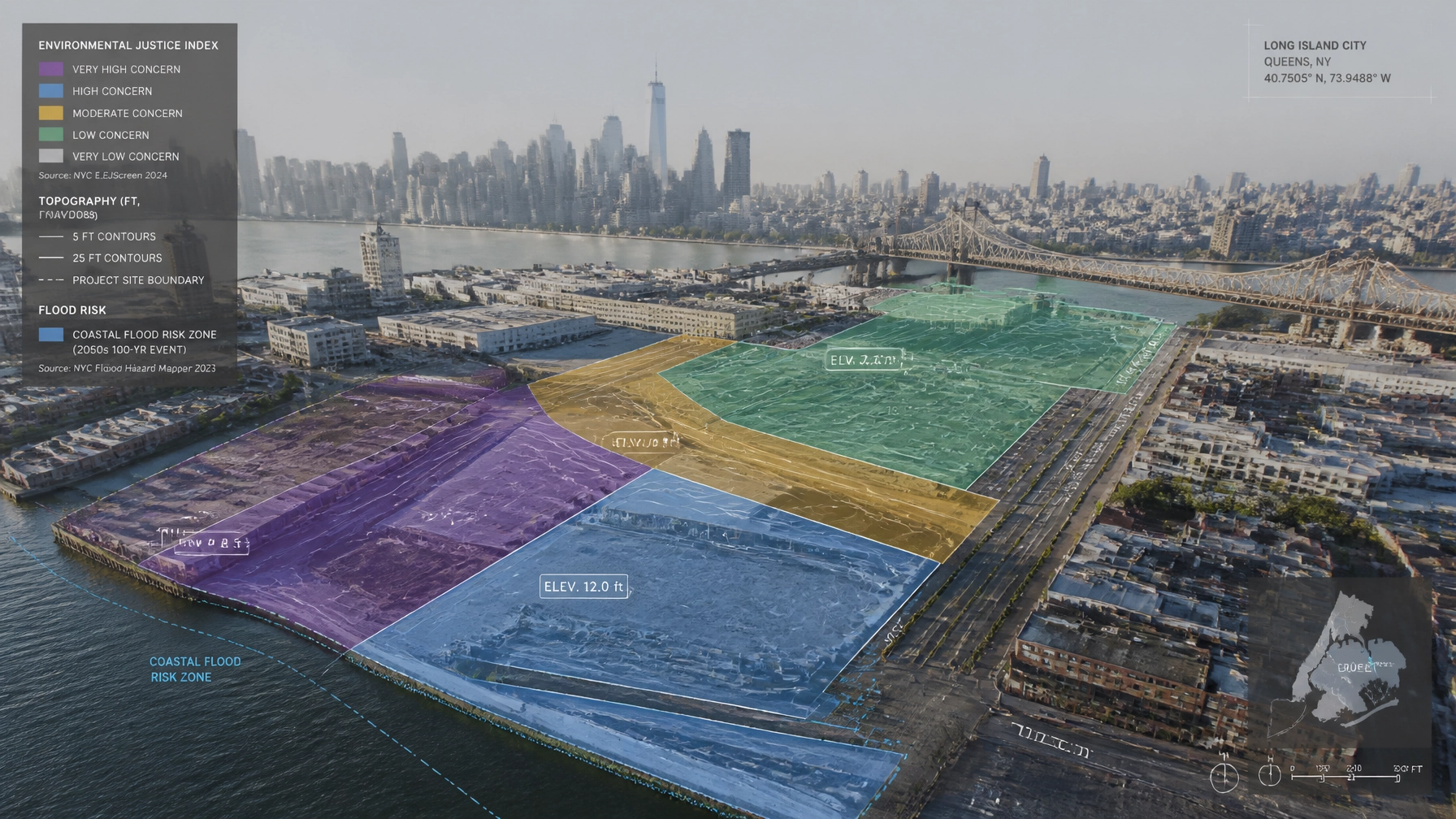
For decades, the State Environmental Quality Review Act (SEQRA) was largely a "check-the-box" procedural hurdle for many developers in New York. You filled out your Environmental Assessment Form (EAF), addressed the obvious impacts like traffic and noise, and: if your consultant knew what they were doing: you walked away with a Negative Declaration.
That era ended on June 12, 2026.
With the official implementation of the New York Environmental Justice Siting Law (EJSL) amendments, the threshold for what constitutes a "significant adverse impact" has fundamentally shifted. If your project is in or near a Disadvantaged Community (DAC), the path to a Negative Declaration just became significantly narrower.
The New Baseline: "Disproportionate Pollution Burden"
The June 2026 amendments to 6 NYCRR Part 617 have operationalized a concept that was previously high-level policy: the Disproportionate Pollution Burden.
Agencies are now legally mandated to evaluate whether a proposed action may cause or increase this burden on a DAC. This isn’t a suggestion; it’s a requirement for every determination of significance. If the lead agency finds that your project may add even a marginal amount of pollution to a community already carrying a heavy environmental load, the law now points directly toward a mandatory Environmental Impact Statement (EIS).
In the past, you might have argued that your project’s individual emissions were negligible. Under the new rules, that argument fails. The review now looks at cumulative impacts. It’s no longer about what you are adding in isolation; it’s about what the community is already enduring.
The Death of the Negative Declaration in DACs
For any site located within or within a half-mile of a DAC (as defined by the NYS Climate Justice Working Group), the "Negative Declaration" is effectively on life support.
The amended regulations explicitly state that a project may trigger an EIS if it increases disproportionate pollution burdens. Because many urban areas in New York City and Northern New Jersey are already classified as DACs due to historical industrial use and socioeconomic factors, almost any mid-to-large-scale redevelopment will now face intense scrutiny at the EAF stage.

The New Model EAF: Air and Climate Take Center Stage
The Model EAFs (both Short and Full) have been overhauled to capture data that many consultants aren't used to providing at the early stages of a project.
1. Granular Air Emissions Data
The new forms align closely with NYSDEC air permitting requirements. You are now asked to disclose potential new or increased air emissions within a DAC before you’ve even finished your preliminary design. This includes not just permanent stack emissions, but construction-related dust and long-term traffic-related exhaust.
2. Physical Climate Risk
Following the Community Risk and Resiliency Act (CRRA), the EAF now includes explicit questions about future physical climate risks. You must document how your project will handle:
- 100-year and 500-year flood events.
- Projected sea-level rise over the life of the asset.
- Ecological changes associated with a warming climate.
If your consultant hands you an EAF that glosses over these points with "To be determined," your project will likely be stalled by a savvy regulator or an environmental attorney looking for a reason to challenge your permit.
The Business Impact: Carrying Costs and Lender Patience
In our world, time is the most expensive line item. Every week your project sits in a reviewer's queue because of an incomplete DAC analysis, your carry costs mount.
Lenders are already flagging these new SEQRA requirements. They want to know: before they close on the construction loan: that your environmental clearance is "bulletproof." A rejected submittal or a late-stage move from a Negative Declaration to an EIS can blow a hole in your pro forma and destroy your market timing.

Why the "Big Box" Firms Will Fail You Here
Large national firms typically use a cookie-cutter playbook for SEQRA. They have junior staff in remote offices filling out these EAFs based on templates. They write "defensive" reports designed to protect the consultant from liability rather than move your project forward.
But the 2026 amendments require regional fluency. You need an engineer who knows the NYSDEC or NYC OER reviewer by name: someone who knows how that specific reviewer interprets "disproportionate burden."
At Envicon, we don't just deliver a report and wish you luck. We take ownership of the outcome. We’ve built proprietary technology: including our own real-time GIS mapping dashboards: that allows us to screen your site against DAC criteria and air quality data before you even sign a contract.
We see the obstacles before they become delays.
The Envicon Resolution
We believe in doing the work right and standing behind our word. To navigate the June 2026 SEQRA amendments, you need a partner who:
- Performs early-stage DAC screening using the Disadvantaged Community Assessment Tool (DACAT) during due diligence.
- Integrates air and climate modeling directly into the Phase II Site Investigation rather than treating it as an afterthought.
- Coordinates directly with regulators (NYSDEC, OER, NJ DEP) to align on the scope of the EJ analysis before the formal submittal.

Summary & Takeaway
- The Law is Active: As of June 12, 2026, all new SEQRA reviews must address disproportionate pollution burdens in DACs.
- Mandatory EIS: If your project may increase environmental stress in a DAC, expect a full Environmental Impact Statement.
- EAF Overhaul: Air quality and physical climate risks (flooding, sea level rise) are now front-end requirements, not late-stage studies.
- Strategic Risk: Relying on generic consultants for these high-stakes urban sites is a recipe for delay and litigation.
"We don’t sell reports. We sell cleared paths." If you’re looking at a site in New York or New Jersey and the new EJ Siting Law has you concerned, let’s talk. We’ll look at the data together and find the most direct route to a buildable, compliant asset.
Ready to Navigate the New SEQRA?
- Read more on the blog homepage: Latest Environmental Insights
- Call now for a project review: (917) 764-2171
- Get a preliminary budget: Cost Estimator Tool
Leave a Reply