Category: Industry Insight

  • New York Asbestos Notification Deadline: The 10-Working-Day Rule for 2026 Renovation and Demolition Projects

    New York Asbestos Notification Deadline: The 10-Working-Day Rule for 2026 Renovation and Demolition Projects

    Status: DRAFT. Not scheduled or published.

    For 2026 renovation, demolition, and property acquisition schedules, the New York asbestos notification deadline needs to be analyzed before you set a construction start date.

    There is an important distinction that causes frequent project delays:

    • NYSDOL Industrial Code Rule 56 generally requires at least 10 calendar days of advance notice for applicable asbestos projects.
    • Federal EPA NESHAP rules require 10 working days of advance notice for applicable demolition and renovation projects.
    • NYC DEP generally requires an ACP-7 filing at least one week before qualifying asbestos work begins.

    These are separate requirements. Filing one notification does not automatically satisfy the others.

    For a New York City or Westchester County project, the safest approach is to build the longest applicable review and notification period into the schedule. A late asbestos determination can delay permits, closing conditions, abatement mobilization, and demolition.

    The New York asbestos notification deadline in plain English

    The phrase “10-working-day asbestos notification” often appears in construction schedules. It usually refers to the federal National Emission Standards for Hazardous Air Pollutants, or NESHAP, requirements under 40 CFR Part 61, Subpart M.

    The NYSDOL requirement under 12 NYCRR Part 56 uses a different clock. For applicable large asbestos projects, the notification must generally be received by the NYSDOL Asbestos Control Bureau at least 10 calendar days before the start of Phase II A work, unless the Commissioner grants a written waiver or emergency procedures apply.

    The notification clock also depends on receipt and payment. A submission that remains incomplete or unpaid may not start the waiting period.

    Before scheduling work, confirm:

    • Whether the project is regulated under NYSDOL Industrial Code Rule 56
    • Whether federal NESHAP notification applies
    • Whether NYC DEP filing through ARTS is required
    • Whether the work requires an ACP-5, ACP-7, ACP-20, ACP-21, or A-TRU review
    • Whether NYSDEC or another local authority requires a separate demolition filing
    • Whether the work affects occupied areas, public spaces, fire protection, or means of egress

    Review the current NYSDOL Industrial Code Rule 56 requirements and the NYSDOL Asbestos Control Bureau guidance for the project-specific rule.

    Start with a pre-renovation or pre-demolition asbestos survey

    An asbestos survey is not the same thing as an asbestos project notification.

    A qualified and appropriately certified asbestos inspector evaluates the building materials that the planned work may disturb. The inspection should reflect the actual demolition or renovation drawings, not just the building address.

    A proper survey may include:

    • Review of available building records and prior surveys
    • A room-by-room visual inspection
    • Identification of suspect asbestos-containing materials
    • Bulk sampling of representative materials
    • Laboratory analysis by an accredited laboratory
    • Mapping of material locations and quantities
    • Evaluation of the proposed disturbance area
    • A written report suitable for the owner, design team, contractor, lender, and permitting authority

    For NYC projects, the building owner must use a NYC DEP Certified Asbestos Investigator, or CAI, when an asbestos assessment is required. NYC DOB explains that asbestos certification must be addressed before a DOB permit can be issued for applicable renovation, alteration, or demolition work.

    Read the NYC DOB project requirements for asbestos and the NYC DEP asbestos filing instructions.

    Why bulk sampling matters

    A visual inspection alone cannot confirm whether a material contains asbestos. Common suspect materials include:

    • Pipe and boiler insulation
    • Floor tile and associated mastic
    • Transite panels
    • Roofing materials
    • Ceiling tile and plaster
    • Window caulk and glazing compound
    • Fireproofing
    • Spray-applied insulation
    • Joint compound
    • Electrical and mechanical insulation

    Sampling locations should correspond to the construction scope. If the contractor later opens a wall, ceiling, chase, or floor area that was not adequately surveyed, the project may face a stop-work condition, additional notification, re-mobilization, and a change order.

    ACP-5, ACP-7, ACP-20, and ACP-21 are not interchangeable

    NYC projects require careful coordination between the asbestos survey, DEP filing, and DOB permit package.

    ACP-5

    An ACP-5 Asbestos Assessment Report is used when the CAI determines that:

    • No asbestos-containing material will be disturbed
    • The affected area is free of asbestos-containing material
    • The work is exempt
    • The quantity of friable material falls within the minor project threshold
    • Identified asbestos-containing material will remain undisturbed

    For a full building demolition application, NYC DOB requires an ACP-5 with the appropriate certification that the entire building is free of asbestos-containing material, subject to limited exceptions.

    ACP-7

    An ACP-7 Asbestos Project Notification is used when the proposed work is an asbestos project. NYC DEP defines an asbestos project as work disturbing more than 25 linear feet or more than 10 square feet of asbestos-containing material.

    The ACP-7 generally must be filed through the NYC Asbestos Reporting and Tracking System at least one week before work begins. Applicable federal and NYSDOL notification periods may be longer.

    ACP-20 and ACP-21

    An ACP-21 documents asbestos project completion. An ACP-20 addresses conditional completion in circumstances allowed by NYC rules and project phasing.

    Neither form replaces the initial survey or project notification. They also do not automatically authorize construction work in every area. The design team and owner must coordinate the forms with DOB applications, DEP requirements, project phasing, and any required A-TRU review.

    The NYC DOB asbestos permit page explains how these forms fit into the permit process.

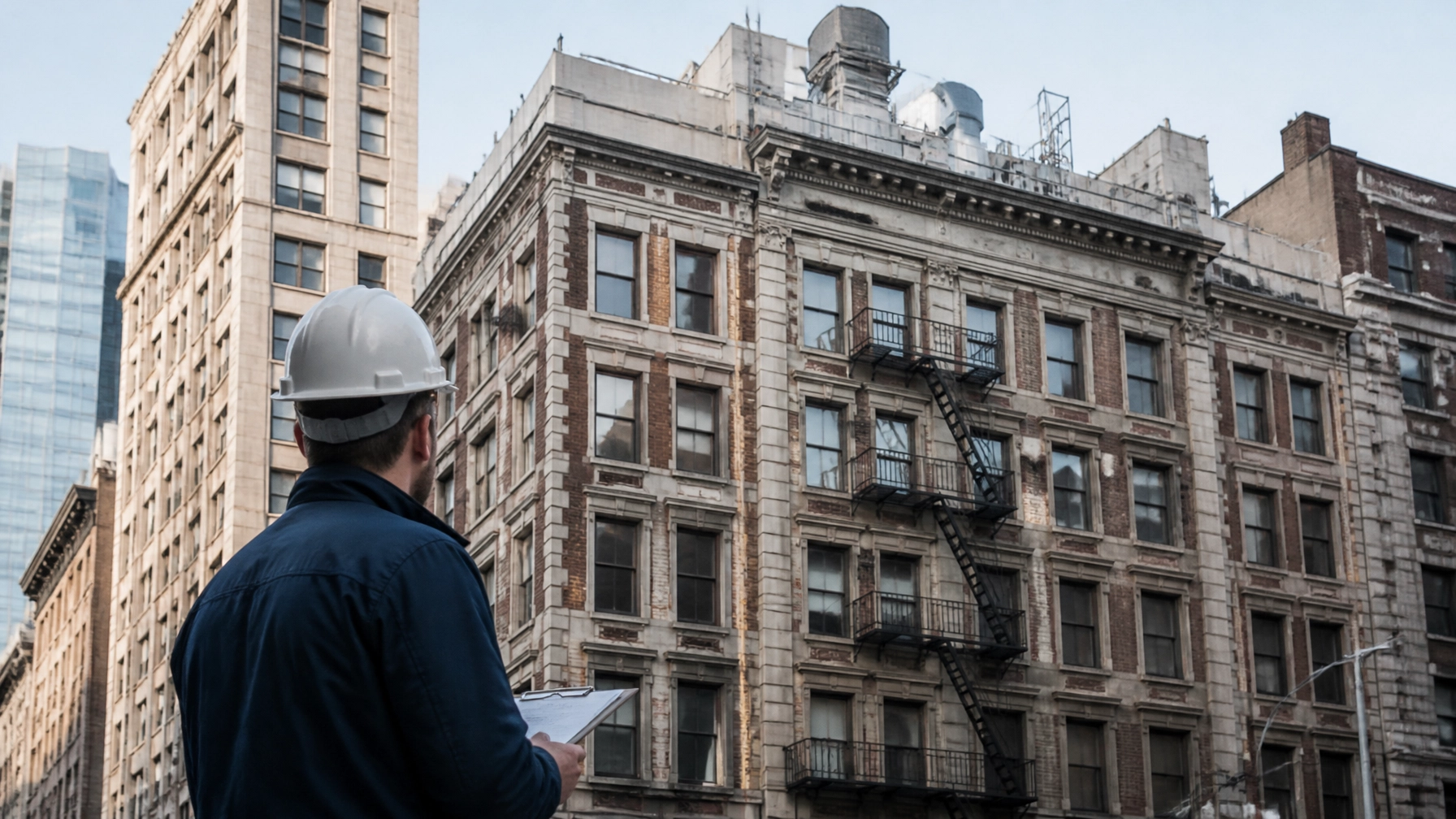
    NYC renovation permit coordination desk with asbestos survey plans and technical drawings

    Five documents that should not be confused

    A clean project file distinguishes these documents and activities:

    1. Asbestos inspection
      A certified professional evaluates suspect materials and collects samples.

    2. Project notification
      The owner or contractor notifies the applicable agency before regulated work begins.

    3. Abatement
      A licensed asbestos abatement contractor removes, encloses, encapsulates, or otherwise manages asbestos-containing material under an approved work plan.

    4. Air monitoring
      An independent air-monitoring firm evaluates airborne fiber conditions during and after abatement.

    5. Clearance
      The project monitor performs final inspections and clearance air monitoring to determine whether the work area meets the applicable completion standard.

    An inspection does not remove asbestos. A notification does not authorize unsafe work. Air monitoring does not replace clearance. Each step has a separate purpose.

    How asbestos conditions affect acquisitions and lender diligence

    A buyer may search for “asbestos survey for commercial property sale NYC” because asbestos creates both physical and transaction risk.

    A sale itself may not trigger the same requirements as demolition or renovation. However, lenders, investors, insurers, and attorneys frequently request hazardous building materials information before closing, particularly for older commercial properties.

    Asbestos findings can affect:

    • Purchase price and escrow negotiations
    • Representations and indemnities
    • Capital improvement budgets
    • Construction loan conditions
    • Demolition and renovation schedules
    • Tenant protection planning
    • Contractor pricing
    • Insurance and risk allocation
    • Closing certainty

    The most useful report does more than say “asbestos present.” It identifies where the material is, whether the planned scope will disturb it, what notification and abatement steps may apply, and how the condition affects the project schedule.

    Envicon integrates asbestos and lead surveys with broader environmental assessment services, including Phase I and Phase II due diligence for commercial real estate transactions.

    Local planning by market

    Manhattan

    For Manhattan office conversions, tenant improvements, hotel renovations, and full or partial demolitions, the survey must track the DOB work area and building occupancy plan. Work involving corridors, stairways, fire doors, risers, elevators, or other life-safety systems may require additional A-TRU review.

    See Envicon’s Manhattan project coverage.

    Brooklyn

    Brooklyn projects often combine adaptive reuse, residential conversion, industrial redevelopment, and phased demolition. In older buildings, floor tile, pipe insulation, roofing, and plaster can create scope gaps if the survey only covers visible areas.

    See asbestos and environmental support in Brooklyn.

    Queens

    Queens commercial properties and industrial conversions frequently involve multiple structures, additions, and undocumented renovations. Confirm that the survey covers every building and each proposed demolition or renovation area before the contractor prices the work.

    See Envicon’s Queens services.

    Bronx

    South Bronx and Hunts Point projects may involve occupied buildings, public-facing facilities, and complex construction sequencing. Abatement, air monitoring, tenant protection, and contractor access should be coordinated before the permit package is finalized.

    See environmental consulting in the Bronx.

    Staten Island

    Staten Island redevelopment schedules can be affected by mobilization, weather, and multi-structure site conditions. A complete pre-demolition survey helps prevent the discovery of undocumented asbestos during structural removal.

    See Envicon’s Staten Island coverage.

    Westchester County

    In Westchester, older commercial buildings, schools, medical facilities, warehouses, and former industrial properties require careful review before renovation or demolition. Municipal building departments may have their own permit submittal procedures, while NYSDOL, EPA, and other agencies may impose separate notification requirements.

    For a Westchester project, confirm:

    • The local building department’s asbestos documentation requirements
    • Whether the work qualifies as a demolition or renovation under NESHAP
    • NYSDOL notification timing under Part 56
    • Occupant notification requirements
    • The abatement contractor’s license and schedule
    • Independent air-monitoring coverage
    • Final clearance and closeout documentation

    See Envicon’s Westchester County location services.

    Westchester commercial building interior prepared for renovation with asbestos survey equipment

    A permit-readiness checklist for 2026

    Before setting a demolition or renovation start date, confirm that:

    • The survey covers the actual proposed work areas
    • The inspector is certified for the applicable jurisdiction
    • Bulk samples were collected and analyzed appropriately
    • Material quantities are documented in square feet or linear feet
    • The project is classified correctly
    • ACP-5 or ACP-7 requirements are addressed
    • NYSDOL notification timing is confirmed
    • EPA NESHAP notification timing is confirmed when applicable
    • The abatement contractor is selected and coordinated
    • Independent air monitoring is scheduled
    • A-TRU review is evaluated for trigger conditions
    • Occupant and tenant protection requirements are addressed
    • Clearance and closeout forms are included in the schedule
    • The lender, attorney, architect, and general contractor have the same project information

    The cost of a survey is usually small compared with the cost of an avoidable shutdown, re-sampling, emergency notification, or demolition change order.

    The practical takeaway

    The New York asbestos notification deadline is not one universal clock.

    For 2026 projects, treat the schedule as a coordinated set of requirements:

    • NYSDOL Part 56: generally 10 calendar days for applicable asbestos project notification
    • EPA NESHAP: 10 working days for applicable demolition and renovation notification
    • NYC DEP: generally one week for ACP-7 filing, with additional review time for complex work
    • NYC DOB: asbestos documentation must support the permit and project closeout path

    Start with the survey. Map the findings to the construction scope. Confirm the agency requirements. Then schedule abatement, air monitoring, clearance, and permit readiness as one process.

    Envicon provides certified asbestos and lead survey support, environmental due diligence, and direct project coordination across NYC and Westchester County. We do not hand you a report and leave you to interpret it. We help turn the findings into a clear path to closing, permitting, and construction.

    Sources

    Request a permit-readiness review

    If your NYC or Westchester County project has a renovation, demolition, acquisition, lender, or closing deadline, send us the address, scope, and target start date.

    Envicon Group official logo

  • NJ REAL Rules Legacy Deadline July 20, 2027: A Permit Readiness Plan for Hudson County Developers

    NJ REAL Rules Legacy Deadline July 20, 2027: A Permit Readiness Plan for Hudson County Developers

    Status: DRAFT. Not scheduled or published.
    Current as of September 3, 2026

    For developers planning projects in Jersey City, Hoboken, Bayonne, Newark, and the broader Hudson County waterfront market, the NJ REAL rules legacy deadline may create an important permitting opportunity.

    The New Jersey Department of Environmental Protection, or NJDEP, has proposed extending the legacy period for eligible applications through July 20, 2027. If the proposal becomes effective as written, qualifying applications that are administratively and technically complete by that date may be reviewed under certain pre-REAL regulatory standards.

    That does not mean every project receives legacy treatment. It does not mean a preliminary filing protects your project. It does not eliminate the need for flood, wetlands, stormwater, coastal, or environmental analysis.

    The deadline is useful only if your permit strategy, technical documents, and submittal package are ready.

    What the NJ REAL rules July 20 2027 proposal means

    NJDEP adopted the Resilient Environments and Landscapes, or REAL, rule amendments on January 20, 2026. The amendments significantly changed elements of the:

    • Coastal Zone Management rules under N.J.A.C. 7:7
    • Freshwater Wetlands Protection Act rules under N.J.A.C. 7:7A
    • Stormwater Management rules under N.J.A.C. 7:8
    • Flood Hazard Area Control Act rules under N.J.A.C. 7:13

    The original legacy period was scheduled to expire on July 20, 2026.

    On June 1, 2026, NJDEP proposed extending that period by one year. Under the proposal, qualifying applications would have to be declared administratively and technically complete, or complete for the applicable CAFRA public hearing or public comment stage, before July 20, 2027.

    NJDEP’s current REAL resources page states that the Department intends to continue applying legacy provisions to eligible applications received on or after the original July 20, 2026 date while the rulemaking proceeds.

    However, the proposal and the final agency position are not the same thing.

    “Until that time, the Department will continue to apply the legacy provisions in the REAL rule to review eligible applications received on or after the initial legacy period end-date of July 20, 2026.”

    Developers should verify the current status directly with NJDEP’s REAL resources before relying on legacy treatment in a purchase agreement, financing model, design schedule, or closing timeline.

    Which applications may qualify for legacy treatment?

    The proposed extension applies to qualifying applications in several permit and authorization categories. The application must still satisfy NJDEP’s completeness requirements.

    Potentially eligible categories include:

    • Individual permits
    • General permits submitted as full applications
    • Flood hazard area verifications
    • Freshwater wetlands Letters of Interpretation
    • Transition area waivers
    • Water quality certificates
    • Major development stormwater applications
    • Certain CAFRA individual permit applications that reach the applicable public hearing or public comment completeness stage

    The proposal would allow qualifying applications to use specified pre-REAL standards, including standards in effect before the January 20, 2026 REAL adoption.

    For some programs, the applicable prior rule date differs. The proposal references earlier standards for coastal, wetlands, stormwater, and flood hazard reviews. That means your team needs to identify the specific rule set that applies to the site and permit pathway.

    A general assumption that “the old rules apply” is not enough.

    What does administratively and technically complete mean?

    A permit application is not protected simply because someone uploaded a form or opened an NJDEP file.

    Administrative completeness generally involves the procedural elements NJDEP needs to accept and process the application, including:

    • Correct application forms
    • Required signatures and certifications
    • Appropriate fees
    • Applicant and property information
    • Ownership and authorization documents
    • Required municipal or professional certifications
    • Correct permit category and filing pathway

    Technical completeness concerns whether the submission contains enough reliable information for NJDEP to evaluate the proposed activity.

    For a Hudson County waterfront development, that may include:

    • Current boundary and topographic survey
    • Flood elevations and flood hazard area analysis
    • Wetlands delineation or verification
    • Coastal and tidal resource mapping
    • Existing and proposed grading
    • Drainage calculations
    • Stormwater management design
    • Soil and groundwater information
    • Environmental constraints mapping
    • Wetland transition area information
    • Utility and infrastructure plans
    • Construction sequencing
    • Erosion and sediment control measures
    • Avoidance, minimization, and mitigation documentation
    • Signed engineering drawings and technical reports

    NJDEP may identify deficiencies after the original submission. If the application ultimately fails the completeness test and must be substantially corrected after the deadline, the project may lose eligibility for legacy treatment.

    That is why permit readiness must start before the filing date.

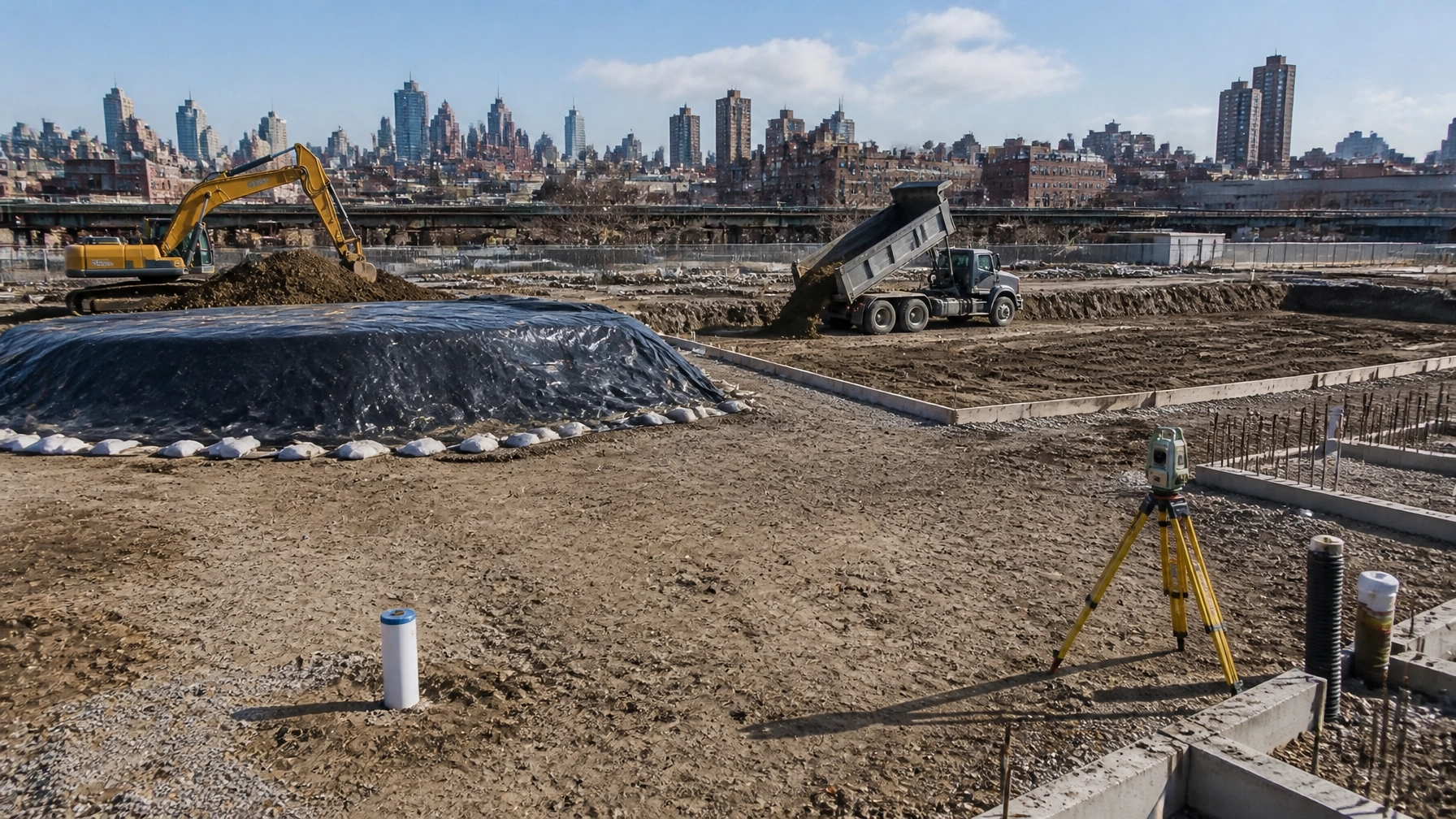
    Survey equipment and flood-elevation field controls on a New Jersey waterfront development site

    The Hudson County permit-readiness problem

    Jersey City, Hoboken, Bayonne, and Newark waterfront projects rarely involve one isolated environmental issue.

    A single redevelopment parcel may involve:

    • Tidal or fluvial flood hazard areas
    • Former industrial uses
    • Bulkheads and waterfront structures
    • Filled wetlands or mapped wetlands
    • Combined sewer and drainage constraints
    • Brownfield or site remediation obligations
    • Dense urban construction limits
    • Municipal stormwater requirements
    • Soil export and disposal requirements
    • Adjacent transportation, utility, or public infrastructure

    For a developer, these issues affect more than permitting. They affect acquisition risk, lender conditions, construction pricing, insurance assumptions, entitlement schedules, and projected delivery dates.

    A permit package that does not align the survey, flood analysis, civil design, environmental constraints, and stormwater strategy creates avoidable review comments.

    In practical terms, a Jersey City flood hazard permit consultant should be reviewing more than the flood map. The team should understand how flood elevations affect grading, finished floors, access, drainage, utility connections, construction sequencing, and the broader NJDEP submission.

    The same applies to projects in Hoboken, Bayonne, and Newark waterfront districts. A strong filing is coordinated across disciplines before it reaches the agency.

    Permit-by-registration and certification pathways are excluded

    The proposed extension does not cover every REAL-related authorization.

    The following are excluded from the proposed legacy extension:

    • New permits-by-registration
    • General permits-by-certification

    These pathways became subject to the REAL rules when the amendments took effect on January 20, 2026.

    That distinction matters. A developer cannot select a streamlined filing path and then assume the project receives the same legacy opportunity available to a qualifying full permit application.

    Before choosing a pathway, confirm:

    1. Which agency authorization the project actually requires.
    2. Whether the filing is an individual permit, general permit, verification, or another covered instrument.
    3. Whether the project qualifies for a permit-by-registration or general-permit-by-certification pathway.
    4. Which rule version NJDEP will apply.
    5. What completeness standard controls the deadline.
    6. Whether municipal approvals or other prerequisite documents must be in place.

    Build the package now, not in July 2027

    July 20, 2027 is not a reasonable target date for starting technical work.

    A responsible schedule should allow time for field investigations, design coordination, agency questions, revisions, and resubmission risk.

    Hudson County permit-readiness checklist

    Use this checklist to identify gaps before committing to a legacy strategy:

    • Confirm the exact property limits and tax lots.
    • Obtain a current boundary and topographic survey.
    • Establish applicable flood elevations and flood hazard areas.
    • Review FEMA mapping and NJDEP flood hazard requirements separately.
    • Complete or update wetlands delineation.
    • Identify tidal waters, riparian areas, transition areas, and coastal constraints.
    • Prepare existing and proposed grading plans.
    • Coordinate drainage and stormwater calculations with the civil design.
    • Identify soil, groundwater, vapor, and historical industrial concerns.
    • Review remediation obligations, engineering controls, and institutional controls.
    • Map utilities, outfalls, bulkheads, access points, and public infrastructure.
    • Confirm whether CAFRA, FHACA, FWPA, stormwater, or water quality approvals apply.
    • Select the correct permit pathway.
    • Prepare signed forms, fees, certifications, drawings, reports, and attachments.
    • Create a completeness tracker for every required submission item.
    • Establish an internal filing deadline well before July 20, 2027.
    • Verify the agency’s current position immediately before relying on legacy treatment.

    Unlabelled civil permit plan set showing survey layers, wetlands boundaries, flood contours, drainage design, and environmental constraints

    Proposal, legacy treatment, and final agency determination are different

    These three concepts should remain separate in every development schedule.

    Proposal

    The June 1, 2026 NJDEP rulemaking proposed extending the legacy period through July 20, 2027. A proposal is not the same as an adopted rule.

    Legacy treatment

    Legacy treatment is the potential application of specified pre-REAL standards to an eligible, complete application. It depends on the permit category, filing date, completeness determination, and applicable rule provisions.

    Final agency determination

    NJDEP makes the final determination about whether the application is complete and which standards apply. A consultant can prepare a defensible package and advise on risk, but no consultant should promise legacy treatment before NJDEP confirms the applicable status.

    For transaction teams, this distinction belongs in the diligence file. For lenders, it belongs in the permitting risk narrative. For attorneys, it belongs in the conditions precedent and closing analysis.

    How Envicon helps keep the path clear

    Envicon combines environmental permitting, civil and geotechnical engineering, flood resilience, stormwater planning, and field-level coordination under one senior-led team.

    Our NJDEP and environmental permitting services address permit applicability, application preparation, agency coordination, deficiency responses, and compliance strategy.
    Our civil and geotechnical engineering team coordinates surveys, grading, drainage, stormwater, flood resilience, subsurface conditions, and permit-ready design.

    From our Jersey City office, we support projects throughout Hudson County and the New Jersey waterfront, including Jersey City, Hoboken, Bayonne, and Newark.

    We do not hand you a report and leave you to reconcile the gaps. We connect the field conditions, drawings, environmental constraints, and agency requirements into one practical path forward.

    Takeaway for Hudson County developers

    The NJ REAL rules legacy deadline may provide additional time for eligible projects, but it does not remove the need for disciplined permitting.

    As of September 2026, the July 20, 2027 extension remains subject to the rulemaking process and current NJDEP implementation guidance. Verify the agency position before relying on it.

    If your project may benefit from legacy treatment:

    • Confirm the correct permit pathway.
    • Start the survey and technical studies now.
    • Coordinate flood, wetlands, grading, drainage, stormwater, and environmental constraints.
    • Build a complete submittal package before the deadline.
    • Leave time for agency questions and corrections.
    • Document the difference between proposed treatment and final agency determination.

    In Hudson County, the best permitting strategy is not the one that starts closest to the deadline. It is the one that gives NJDEP a complete, coordinated, technically defensible package while your project still has room to respond.

    Sources

    Talk with an Envicon engineer before the deadline becomes your schedule

    If you need a direct review of a Jersey City, Hoboken, Bayonne, Newark, or Hudson County waterfront project, start with the permit facts, not a generic checklist.

    Envicon Group official logo

  • NYC OER VCP and Brownfield Funding: A 2026 Pre-Application Checklist for Developers

    NYC OER VCP and Brownfield Funding: A 2026 Pre-Application Checklist for Developers

    DRAFT. Prepared for review. Not scheduled or published.

    For developers and attorneys working on contaminated or underused property in Manhattan, Brooklyn, Queens, the Bronx, and Staten Island, the cleanup path affects more than environmental compliance. It affects acquisition timing, lender confidence, construction financing, affordable housing commitments, and the value of the finished asset.

    The NYC Office of Environmental Remediation’s Voluntary Cleanup Program, or VCP, can provide a structured path from investigation to regulatory closure. It can also open access to Brownfield Incentive Grants, the NYC Clean Soil Bank, and hazardous-waste fee benefits.

    The important point for 2026 is timing. You should assemble the project record before the OER pre-application meeting, not after a financing deadline or closing condition exposes missing information.

    This NYC OER VCP developer checklist covers the documents and decisions your team should prepare now.

    Why the NYC OER VCP matters in the 2026 transaction market

    A property with an E-designation, historic industrial use, petroleum impacts, contaminated fill, or an unresolved environmental condition can remain technically developable while still creating a transaction problem.

    A lender may require:

    • A defensible environmental investigation
    • A clear remedial strategy
    • A realistic cost and schedule
    • Evidence of agency coordination
    • A path to a Notice of Completion or Notice of Satisfaction
    • Documentation supporting construction and occupancy approvals

    The VCP gives eligible NYC properties a formal process under OER oversight. OER states that a developer seeking to move promptly can often receive an approved remedy and enroll a property within approximately 45 days of the first meeting with OER, depending on project conditions and agency review.

    Enrollment also creates important protections. According to OER, NYSDEC generally does not plan to require more work at an enrolled site beyond implementation of the OER-approved remedy, provided the project complies with the City cleanup agreement.

    That is the difference between having an environmental report and having a cleanup path that a lender, investor, attorney, and construction team can understand.

    “We do not just deliver services. We help transform underused and contaminated properties into thriving assets.”

    Step 1: Confirm VCP eligibility before spending money on the application

    Any real property in New York City may be eligible for the VCP, subject to exclusions.

    OER identifies the following exclusions:

    • Properties already enrolled in the New York State Brownfield Cleanup Program
    • Sites subject to a cleanup order under the Navigation Law or Environmental Conservation Law
    • Sites designated by New York State as inactive hazardous waste sites
    • Sites listed on the federal National Priorities List

    Review the property’s regulatory history before you select the cleanup program. A site may have NYSDEC spill numbers, prior consent orders, petroleum records, or existing remedial obligations that affect eligibility.

    Start with:

    • Borough, block, and lot information
    • Current deed and title report
    • Prior ownership records
    • Existing E-designations or restrictive declarations
    • NYSDEC spill numbers
    • Prior Phase I and Phase II ESAs
    • Former site uses and tenant history
    • Existing agency correspondence
    • Current zoning and proposed zoning
    • Known groundwater, soil, vapor, or hazardous-material concerns

    Envicon’s brownfield remediation and cleanup services are designed to connect this early review with the investigation, remedial design, and closeout work that follows.

    Step 2: Build the pre-application file

    A strong NYC OER VCP pre-application package answers three questions:

    1. What is at the site?
    2. What will be built there?
    3. What does the project need from OER to reach construction and occupancy?

    Title and ownership

    Prepare documentation showing ownership, site control, or the applicant’s right to pursue enrollment.

    Include:

    • Recorded deed
    • Current title report
    • Purchase and sale agreement, if applicable
    • Development agreement or access agreement
    • Names of all entities with ownership or control
    • Authorized project representative
    • Contact information for counsel, lender, architect, and consultant

    If the property is under contract, clarify who will sign the VCP agreement and who will be responsible for remediation. The cleanup obligation should match the transaction documents.

    Current environmental records

    Do not rely on a ten-year-old Phase I ESA without checking whether site conditions, ownership, or the proposed development have changed.

    Collect:

    • Current Phase I ESA
    • Phase II ESA and sampling data
    • Soil, groundwater, and vapor laboratory reports
    • Tank removal or closure records
    • Waste profiles and disposal manifests
    • Prior remedial investigation reports
    • Existing site management plans
    • E-designation documentation
    • OER or NYSDEC letters and comments
    • Construction records that may have exposed or moved impacted soil

    A consultant should reconcile the historical records with current field conditions. That often prevents a remediation work plan from being built on incomplete assumptions.

    AI-generated field-office view of an NYC environmental project file with site plans, sample containers, and GIS mapping

    Step 3: Define the proposed end use and community benefit

    OER and BIG applications require more than a contamination summary. The proposed redevelopment matters because cleanup standards, engineering controls, soil management, and public participation must align with the future use.

    Document:

    • Residential, commercial, industrial, institutional, or mixed-use end use
    • Gross square footage
    • Number and type of residential units
    • Affordable or supportive housing component
    • Community facility space
    • Open space or public-realm improvements
    • Proposed basement and foundation depths
    • Utility corridors and planned excavation
    • Construction phasing
    • Anticipated soil export and import volumes

    Affordable housing and other community-supported projects may qualify for enhanced BIG grant treatment as Preferred Community Development Projects. OER’s current BIG materials identify affordable housing, Brownfield Opportunity Area-compliant developments, and community facility developments as categories that may receive larger grant limits when the required documentation is provided.

    Do not assume eligibility based only on a project description. Prepare the supporting material, which may include:

    • Evidence of affordable housing status
    • A redevelopment proposal
    • A letter of interest from a housing subsidy program
    • Documentation from a community planning organization
    • A BOA or community brownfield planning letter
    • A description of the community facility benefit

    Step 4: Prepare for EPIC and the VCP application

    OER requires project teams to submit a new project application through EPIC Environment. The applicant must create an EPIC account before submitting the project.

    The enrollment file generally includes:

    • VCP application
    • Remedial Investigation Report
    • Remedial Action Work Plan
    • VCP agreement
    • Proposed redevelopment information
    • Site ownership or control information
    • Existing environmental records
    • Applicable E-designation information
    • $1,000 VCP enrollment fee

    The RI should define the nature and extent of contamination. The RAWP should then explain the selected remedy, cleanup objectives, engineering controls, soil management, community protection measures, confirmation sampling, and closure documentation.

    OER’s VCP enrollment instructions should control the current submission process. Templates and technical requirements can change, so use the current EPIC materials rather than an old consultant template.

    Step 5: Account for public participation and the project schedule

    VCP projects include a public participation process. OER establishes a site contact list that may include adjacent property owners, schools, hospitals, day care centers, the local Community Board, and elected officials.

    The RAWP is generally subject to a 30-day public comment period. OER reviews comments before approving the RAWP and completing enrollment.

    Build this period into:

    • Purchase and sale agreement conditions
    • Construction loan closing
    • Remedial contractor procurement
    • Demolition and excavation
    • Foundation work
    • Affordable housing subsidy schedules
    • Lease-up and occupancy projections

    A consultant who treats public participation as an administrative step can create avoidable schedule risk. The community protection statement, site logistics, dust controls, truck routing, noise controls, and communication plan should be practical and consistent with the construction plan.

    Step 6: Plan BIG funding before the work is complete

    The NYC Brownfield Incentive Grant program can support eligible investigation, remediation, pre-development, insurance, and technical assistance costs, depending on project type and program rules.

    For Qualifying Brownfield Projects, OER’s current BIG materials identify:

    • Up to $5,000 for a pre-development grant
    • Up to $10,000 for an environmental investigation grant
    • Up to $25,000 for a cleanup grant
    • Potential bonus grants for qualifying Track One, strategic-site, or resilience projects

    Preferred Community Development Projects may qualify for higher limits, including projects involving affordable housing, nonprofit development, BOA consistency, or community facilities.

    The 2026 BIG deadline

    There is no universal citywide “2026 BIG deadline” that applies to every project.

    The current OER BIG application materials state that an enrollment grant application must be submitted no later than six months after OER issues the project’s Notice of Completion. Awards are also subject to program rules, available appropriations, and the applicable application process.

    That means your project has a deadline tied to its own NOC date. Do not wait until the six-month period is nearly over.

    Track:

    • OER Decision Document or NOC
    • RAWP approval date
    • Remediation completion date
    • Grant-eligible invoices
    • Vendor qualifications
    • Insurance certificates
    • Manifests and weight tickets
    • Project questionnaire
    • Applicant and co-applicant information
    • Required affordable housing or community documentation

    The official NYC BIG Grants page should be checked for current forms, funding status, eligible activities, and submission instructions.

    Step 7: Document insurance and costs before mobilization

    BIG reimbursement depends on documentation. Before field work begins, confirm that the consultant, contractors, subcontractors, truckers, and other qualified vendors carry the coverage required for the requested activities.

    Maintain:

    • Professional liability certificates
    • Commercial general liability certificates
    • Coverage dates matching field work and manifests
    • Vendor invoices on company letterhead
    • Written scopes and change orders
    • Disposal manifests
    • Weight tickets
    • Laboratory invoices
    • Field oversight records
    • Payment records

    A project may perform eligible work and still lose reimbursement value if the records do not demonstrate who performed the work, when it occurred, what it cost, and whether the required insurance was active.

    Step 8: Include the Clean Soil Bank in the soil-management plan

    The NYC Clean Soil Bank may allow eligible clean native soil from one project to be reused at another NYC project.

    OER states that generating sites pay for trucking but not disposal, while receiving sites may obtain qualifying soil from the City stockpile at no soil cost and pay for trucking.

    For a Manhattan, Brooklyn, Queens, Bronx, or Staten Island project, evaluate the Clean Soil Bank before excavation begins. The schedule may affect whether soil can be matched to a receiving site.

    Confirm:

    • Soil characterization
    • Applicable cleanup standards
    • Sampling data
    • Volume and availability dates
    • Receiving-site needs
    • Trucking logistics
    • OER notification and manifest procedures
    • Beneficial Use Determination requirements

    Use the official Clean Soil Bank guidance rather than treating clean soil as ordinary surplus material.

    AI-generated NYC remediation site showing organized clean-fill placement and engineered soil-cap construction

    Step 9: Capture hazardous-waste fee benefits correctly

    A VCP project that excavates and disposes of qualifying hazardous waste off site may be eligible for an exemption from certain New York State hazardous-waste fees.

    OER currently identifies savings of $130 per ton for the Hazardous Waste Program Fee and up to $27 per ton for the Special Assessment, subject to program requirements and agency determinations.

    The project must generally:

    • Be enrolled in the VCP
    • Have an OER-approved RAWP authorizing hazardous-waste removal
    • Have OER oversee the removal
    • Submit required information before shipment
    • Maintain generator, quantity, date, manifest, and disposal records

    Review the OER hazardous-waste fee exemption requirements before soil leaves the property. A late certification or incomplete manifest record can affect the exemption.

    Step 10: Plan the closeout and E-designation path

    The cleanup is not finished when excavation ends. The team must complete confirmation sampling, remedial action documentation, final reporting, and agency review.

    For VCP projects, the target is generally an OER Notice of Completion and associated Green Property Certification. The NOC can support regulatory closure and transfer of applicable protections to successors and assigns that comply with VCP requirements.

    For an E-designation, OER must approve the required environmental work before the project can obtain the applicable building or occupancy approvals. An E-designation may involve hazardous materials, air quality, or noise requirements.

    Review the property’s E-designation and restrictive declaration early. Confirm:

    • The exact E-designation type
    • Required investigation
    • Remedial plan approval
    • Construction-phase obligations
    • Required monitoring
    • Documentation needed for closeout
    • Whether a Notice of Satisfaction is required
    • Coordination with DOB and the project architect

    Envicon’s NYC environmental consulting team works across all five boroughs, including Manhattan E-designation projects, Brooklyn and Queens industrial redevelopment, Bronx manufacturing corridors, and Staten Island waterfront and North Shore sites.

    Final NYC OER VCP developer checklist

    Before the pre-application meeting, confirm that your team has:

    • Title, ownership, and site-control documents
    • Borough, block, lot, zoning, and E-designation information
    • Current Phase I and Phase II environmental records
    • NYSDEC spill and regulatory history
    • Proposed end use and construction phasing
    • Affordable housing or community-benefit documentation
    • Preliminary remedial investigation scope
    • Preliminary remedial action strategy
    • Soil export, import, and hazardous-waste assumptions
    • Clean Soil Bank opportunity review
    • BIG grant category and funding review
    • Insurance requirements
    • Cost records and vendor documentation plan
    • Agency correspondence and meeting history
    • Target dates for financing, construction, NOC, and grant submission

    The best time to test fundability is before enrollment. The best time to test the cleanup path is before closing.

    Sources and related resources

    CTA: Review your cleanup path and funding position before you apply

    If you’re acquiring, financing, or repositioning a contaminated property in Manhattan, Brooklyn, Queens, the Bronx, or Staten Island, Envicon can review the environmental record, proposed end use, OER pathway, BIG funding position, and project schedule.

    The objective is not another report. It is a fundable, buildable, regulator-ready path forward.

    Envicon Group logo

  • New York Asbestos Survey Before Closing: A Transaction Checklist for Commercial Property Buyers

    New York Asbestos Survey Before Closing: A Transaction Checklist for Commercial Property Buyers

    DRAFT

    Buying a commercial property in New York involves more than confirming title, rent rolls, and financing. If the building will be renovated, partially demolished, or repositioned after closing, asbestos can become a schedule and budget issue before construction starts.

    The practical question is not whether a building “looks old.” It is whether suspect building materials will be disturbed, whether the survey covers the planned work, and whether the transaction documents account for the result.

    This guide explains what buyers, lenders, attorneys, and developers should know about an asbestos survey for commercial property in New York, including Manhattan, Brooklyn, Queens, the Bronx, Staten Island, and Westchester County.

    Why order an asbestos survey before closing?

    Buyers typically order an asbestos survey for four reasons:

    • Renovation planning: Interior demolition, wall removal, mechanical upgrades, roofing work, and utility modifications may disturb asbestos-containing materials.
    • Lender due diligence: A lender may require a hazardous materials assessment, especially when the property needs substantial capital improvements.
    • Construction budgeting: Confirmed asbestos can affect abatement, air monitoring, waste handling, contractor sequencing, and project duration.
    • Risk allocation: The buyer needs clear transaction language addressing known materials, access limitations, seller disclosures, and post-closing obligations.

    An asbestos survey can also identify issues that affect the purchase price or closing conditions. A buyer may negotiate a credit, escrow, seller remediation, or a revised construction budget before committing to the property.

    The objective is simple: prevent a post-closing surprise from becoming a stop-work order, change order, or financing problem.

    An ASTM Phase I ESA does not replace an asbestos survey

    An ASTM E1527-21 Phase I Environmental Site Assessment and an asbestos survey answer different questions.

    A Phase I ESA evaluates environmental conditions involving hazardous substances and petroleum products through records review, site reconnaissance, interviews, and regulatory database research. ASTM E1527-21 does not include bulk sampling of building materials, and asbestos is treated as a non-scope consideration.

    That means a buyer can receive an ASTM-compliant Phase I ESA without receiving a formal asbestos assessment.

    For a complete transaction review, buyers often pair:

    • An ASTM E1527-21 Phase I ESA
    • A dedicated asbestos survey
    • A lead-based paint survey where appropriate
    • A property condition assessment
    • Targeted Phase II investigation when the Phase I identifies a recognized environmental condition

    See Envicon’s broader environmental assessment services for a coordinated due diligence scope.

    What New York Rule 56 means for commercial buyers

    New York State Department of Labor Industrial Code Rule 56, codified at 12 NYCRR Part 56, governs asbestos work in New York.

    For commercial properties, the owner or owner’s agent must arrange for an asbestos survey before renovation, demolition, remodeling, or repair work that may disturb building materials. Current NYSDOL guidance does not provide a broad exemption based only on a building’s construction date. If the required survey is not performed, affected materials may need to be presumed to contain asbestos and handled under the applicable asbestos project requirements.

    The survey should be performed by an appropriately New York State-certified asbestos inspector. It should address the areas affected by the proposed work. For full demolition, the survey scope generally needs to address the entire structure.

    Review the NYSDOL asbestos survey requirements and Industrial Code Rule 56 before finalizing a demolition or renovation schedule.

    NYC adds a DOB and DEP filing layer

    In New York City, asbestos compliance also connects to the Department of Buildings and Department of Environmental Protection.

    Depending on the scope and findings:

    • ACP-5 may document that planned work is not an asbestos project.
    • ACP-7 may be required when planned work meets the definition of an asbestos project.
    • ACP-21 and other closeout documentation may be needed after abatement.
    • The project may require coordination through DEP’s Asbestos Reporting and Tracking System.

    NYC DOB will not treat asbestos documentation as an afterthought when it is tied to a construction, alteration, or demolition permit. Review the current NYC DOB asbestos project requirements, asbestos abatement permit guidance, and NYC DEP asbestos forms.

    Building age is a screening factor, not a complete answer

    Building age helps the consultant identify likely materials and construction systems. Older commercial buildings may contain asbestos in:

    • Floor tile and associated mastic
    • Sheet flooring
    • Pipe, boiler, and duct insulation
    • Spray-applied fireproofing
    • Plaster and joint compound
    • Roofing felts and mastics
    • Exterior caulking and glazing compounds
    • Transite panels
    • Elevator components
    • Electrical equipment and fire doors

    But age alone does not determine whether a survey is required. A newer building can contain asbestos-containing materials, and a renovated older building may still contain original materials in concealed areas.

    The survey should include a material inventory that identifies:

    • Material description
    • Location
    • Approximate quantity
    • Condition
    • Homogeneous area
    • Sample identification
    • Laboratory result
    • Whether the material will be disturbed by the planned work

    Gloved technician collecting a bulk sample from layered commercial building materials

    Bulk sampling and laboratory analysis

    Visual observations are useful, but they do not confirm whether a suspect material contains asbestos.

    A proper survey typically uses representative bulk samples from homogeneous materials. Samples are documented, packaged, transported under chain-of-custody procedures, and analyzed by an accredited laboratory using appropriate methods such as polarized light microscopy. Additional transmission electron microscopy may be appropriate in certain circumstances.

    Sampling should be coordinated with the design documents. If the buyer plans to remove a ceiling, relocate a restroom, replace a roof, or open a chase, the survey must account for the materials that construction will actually disturb.

    A report that samples only visible flooring while ignoring mastic, wall systems, pipe insulation, or concealed fireproofing may not provide enough information for bidding or permitting.

    Inaccessible areas require clear assumptions

    No building survey can inspect areas that cannot be safely or reasonably accessed. Locked rooms, occupied tenant spaces, concealed wall cavities, active mechanical systems, fragile ceilings, and areas blocked by stored materials can limit the inspection.

    That limitation should appear clearly in the report.

    Ask the consultant to identify:

    • Areas not accessed
    • Why access was unavailable
    • Materials presumed to contain asbestos
    • Additional sampling needed before construction
    • Whether destructive access is recommended
    • How the limitation affects the budget and schedule

    Environmental inspector examining an inaccessible pipe chase and suspended ceiling cavity

    For a buyer, this distinction matters. “No asbestos observed” is not the same as “all affected materials were inspected and sampled.”

    Project notifications, abatement, and air monitoring

    If the survey identifies asbestos-containing material that planned work will disturb, the next step is not simply to tell the general contractor to “be careful.”

    The project may require:

    • A regulated asbestos abatement contractor
    • Certified asbestos workers and supervisors
    • A written work plan
    • NYSDOL or NYC DEP project notification
    • Occupant notification
    • Containment and negative-pressure controls
    • Waste packaging and disposal documentation
    • Personal or area air monitoring
    • Final visual inspection and clearance
    • Agency closeout documentation before general construction proceeds

    In NYC, DEP guidance generally treats work disturbing more than 10 square feet or 25 linear feet of asbestos-containing material as an asbestos project. The exact classification depends on the applicable rules and project conditions.

    Notification deadlines also affect a transaction schedule. NYSDOL project notifications commonly require advance filing, and NYC project notifications may require filing through ARTS before work begins. Do not set a demolition date until the survey, abatement scope, contractor licensing, notification timing, and clearance requirements are confirmed.

    How asbestos affects the acquisition budget

    A survey should do more than identify positive and negative samples. It should help the acquisition team understand the next financial decision.

    Budget categories may include:

    • Supplemental destructive sampling
    • Abatement design and contractor pricing
    • Containment and air monitoring
    • General contractor coordination
    • Waste transportation and disposal
    • Tenant protection measures
    • Temporary relocation
    • Permit and notification costs
    • Clearance testing
    • Schedule contingency

    Do not treat an asbestos allowance as a generic percentage of construction cost. The quantity, material type, access conditions, work method, occupancy, and regulatory classification all influence the actual cost.

    Envicon’s asbestos and lead survey service provides certified inspection, bulk sampling, laboratory analysis, and project documentation for commercial properties.

    Transaction documents buyers should request

    Before closing, request and review:

    • Prior asbestos surveys
    • Abatement specifications and work plans
    • Laboratory reports
    • ACP-5, ACP-7, ACP-21, or related NYC records
    • NYSDOL project notifications
    • Air monitoring and clearance results
    • Waste manifests
    • Open permit records
    • Contractor invoices and warranties
    • Tenant notices
    • Capital improvement plans
    • Architectural and mechanical drawings
    • Seller representations regarding hazardous materials

    The buyer’s attorney should decide how survey findings appear in the purchase and sale agreement. The environmental consultant should provide the technical facts, limitations, and recommended next steps.

    Commercial transaction due diligence materials, sampling map, plans, and sealed sample containers

    Step-by-step buyer checklist

    Use this checklist for an asbestos inspection before buying commercial property in NYC or Westchester:

    1. Confirm the intended post-closing work. Obtain demolition, renovation, mechanical, roofing, and utility plans.
    2. Order the Phase I ESA and asbestos survey early. Do not wait until the construction permit process.
    3. Confirm inspector qualifications. Use a properly certified asbestos professional for the required survey.
    4. Review building age and past renovations. Original materials may remain behind newer finishes.
    5. Map suspect materials to the work area. The survey must address materials that contractors will disturb.
    6. Document inaccessible areas. Establish assumptions and identify supplemental sampling needs.
    7. Obtain laboratory results and the material inventory. Keep the technical record with the transaction file.
    8. Price abatement before closing. Get enough information for a realistic allowance or contractor bid.
    9. Confirm notification and clearance requirements. Coordinate NYSDOL, NYC DEP, NYC DOB, and local building requirements.
    10. Put findings into the deal documents. Address credits, escrow, access, responsibility, and post-closing obligations.

    Local considerations across New York’s commercial markets

    Manhattan

    Manhattan office, retail, hotel, multifamily, and adaptive reuse projects often involve dense tenant occupancy and complicated mechanical systems. Coordinate asbestos sampling with existing conditions, DOB filings, and phased construction plans. See Envicon’s Manhattan environmental assessment coverage.

    Brooklyn

    Warehouse conversions, industrial properties, and redevelopment sites in Brooklyn may contain layered flooring, fireproofing, roofing materials, and older utility systems. Historic building conditions can make inaccessible areas and selective demolition especially important. See Brooklyn environmental services.

    Queens

    Commercial and industrial properties in Queens frequently combine older structures with additions and partial renovations. Survey each planned work area instead of relying on one building-wide visual review. See Queens environmental services.

    The Bronx

    South Bronx industrial corridors and mixed-use redevelopment projects may require close coordination between environmental due diligence, demolition planning, and construction oversight. See Bronx environmental services.

    Staten Island

    North Shore redevelopment and commercial properties on Staten Island may involve older structures, additions, and phased site work. Confirm the survey scope against the full construction plan. See Staten Island environmental services.

    Westchester County

    Westchester commercial properties include suburban offices, medical facilities, warehouses, schools, and mixed-use buildings with varied construction histories. Rule 56 applies to commercial renovation and demolition work in Westchester, just as it does elsewhere in New York State. See Westchester County environmental services.

    Prevent the post-closing surprise

    An asbestos survey is not a substitute for a Phase I ESA, and a Phase I ESA is not an asbestos survey. They are separate tools that protect different parts of the transaction.

    The right survey gives you more than a list of laboratory results. It gives your lender, attorney, architect, contractor, and investment committee a shared understanding of what the building contains, what the work will disturb, and what must happen next.

    Envicon works directly with buyers, lenders, attorneys, architects, and contractors across New York. Our team combines transaction due diligence with field-level technical review, clear documentation, and practical next steps.

    Sources

    Stop before you close. Know what the building contains.

    If you’re buying a commercial property in Manhattan, Brooklyn, Queens, the Bronx, Staten Island, or Westchester, send Envicon the property address, building age, transaction date, and planned work. We’ll help you determine whether you need an asbestos survey, a Phase I ESA, or both.

    Envicon Group logo

  • New York’s Environmental Justice Siting Law: What Developers Must Know

    New York’s Environmental Justice Siting Law: What Developers Must Know

    New York’s Environmental Justice Siting Law (EJSL), also known as the state’s Cumulative Impacts Law, changes how developers must evaluate environmental burdens before securing approvals.

    The law does more than ask whether a proposed project meets ordinary emissions, discharge, or construction standards. It asks a broader question:

    Will this project add a disproportionate pollution burden to a disadvantaged community that already carries significant environmental or public health risks?

    That question now affects SEQRA review, environmental impact statements, permit applications, project schedules, and site feasibility across New York.

    For developers working in New York City, the Hudson Valley, Long Island, or upstate industrial corridors, EJSL analysis should begin during site selection: not after the project has already been designed.

    What the Environmental Justice Siting Law does

    New York enacted the EJSL through Chapter 840 of the Laws of 2022, as amended by Chapter 49 of the Laws of 2023.

    The law amended portions of:

    • Environmental Conservation Law Article 8, which governs SEQRA
    • Environmental Conservation Law Article 70, which governs environmental permitting
    • Related environmental review and permitting procedures administered by NYSDEC and other lead agencies

    The law requires agencies to consider existing pollution and other environmental burdens in disadvantaged communities (DACs) when reviewing certain projects.

    New York’s definition of a disadvantaged community considers environmental burdens, climate vulnerability, health risks, and socioeconomic conditions. The state’s framework identifies DACs using multiple indicators rather than relying on a single demographic or pollution metric. The statutory definition is available through New York Environmental Conservation Law §75-0101.

    The practical result is straightforward: a project’s environmental review must account for the conditions already present around the site.

    The 2026 SEQRA amendments are now effective

    The SEQRA provisions of the EJSL took effect on December 30, 2024. NYSDEC later finalized amendments to 6 NYCRR Part 617, the regulations implementing SEQRA.

    According to NYSDEC’s Statewide Notice of Adoption, the amended regulations became effective June 12, 2026.

    The amended regulations add environmental justice considerations to the SEQRA process, including:

    • New questions in the Short and Full Environmental Assessment Forms
    • Consideration of whether a project may cause or increase a disproportionate pollution burden
    • Use of the Disadvantaged Community Assessment Tool, or DACAT
    • Additional attention to air impacts, climate risk, and resiliency
    • Updated procedures for evaluating project impacts on DACs
    • Certain revisions to the Type II action list, including limited housing-related exemptions

    NYSDEC now provides the operative 6 NYCRR Part 617 SEQR regulations.

    Projects that received a determination of significance or had an accepted draft EIS before the effective date may qualify for transition treatment under the amended regulations. That determination is project-specific. Developers should not assume that an older filing automatically avoids the new requirements.

    What is a disproportionate pollution burden?

    The EJSL focuses on cumulative impacts, not just the pollution generated by the proposed project.

    NYSDEC’s interim guidance describes a disproportionate pollution burden as:

    “A pollution burden within an affected disadvantaged community that is, or would be, significantly greater than that same burden in comparable non-disadvantaged communities, as a result of the proposed action.”

    That means a technically compliant project may still require additional analysis if it would add air emissions, truck traffic, noise, wastewater discharges, contaminated soil movement, or other environmental burdens to an already overburdened area.

    The analysis depends on the project and its approval path. Relevant issues may include:

    • Existing permitted air emissions
    • Industrial or commercial facilities nearby
    • Legacy soil and groundwater contamination
    • Traffic and diesel truck activity
    • Waste handling or transfer operations
    • Combined sewer or stormwater concerns
    • Flooding and climate vulnerability
    • Exposure pathways affecting nearby residents
    • Construction dust, vapor, noise, and temporary air impacts
    • The project’s proposed controls, offsets, alternatives, and mitigation measures

    This is where a standard Phase I ESA is not enough. A Phase I identifies recognized environmental conditions and other property risks. An EJSL review requires a wider look at the community and surrounding environmental burden.

    Environmental sampling equipment, monitoring well cap, sample vials, and a technical site plan at an urban redevelopment site

    The half-mile screening area matters

    NYSDEC’s SEQRA materials identify a general study area of one-half mile for the disadvantaged community assessment.

    The project team should determine:

    1. Whether the site is located within a DAC
    2. Whether any project component is within one-half mile of a DAC
    3. Whether project impacts could reach a DAC located farther away
    4. What existing pollution burdens and sensitive receptors are present
    5. Whether the project may increase an existing disproportionate burden

    The one-half-mile screen is a starting point, not a substitute for professional judgment. Air emissions, truck routes, groundwater migration, stormwater discharges, vapor pathways, and utility corridors may require a larger or differently defined study area.

    For a New York City project, the CEQR Technical Manual chapter on Effects on Disadvantaged Communities provides additional context for local environmental review.

    Permit denial is a real project risk

    The EJSL also affects certain environmental permits administered by NYSDEC.

    For applicable permits, applicants may need to prepare an existing burden report describing pollution and other environmental burdens affecting the relevant disadvantaged community. The report supports DEC’s review of whether the proposed project would add to a disproportionate burden.

    The law includes a critical standard: DEC generally cannot issue an applicable permit for a new project if it determines that the project would cause or contribute more than a de minimis amount of pollution to a disproportionate pollution burden in a disadvantaged community.

    “De minimis” does not mean that every project with an environmental impact will be denied. It does mean that developers need to identify the issue early, document the existing conditions, and show how the project avoids, reduces, or mitigates the additional burden.

    A late-stage discovery can create serious consequences:

    • Redesign of mechanical or process systems
    • Additional air modeling
    • Expanded community engagement
    • New alternatives analysis
    • Supplemental soil or groundwater investigation
    • More detailed construction controls
    • Delayed agency review
    • Financing and closing uncertainty
    • Increased legal and consulting costs

    How developers should prepare

    The most effective EJSL strategy is a front-end screening process tied to site acquisition and preliminary design.

    Before committing to a development schedule, your team should:

    1. Screen the site and surrounding area

    Review DAC mapping, land use, nearby facilities, environmental databases, public health information, and climate vulnerability indicators.

    Use DEC’s environmental justice resources and DAC assessment materials as an initial screen. Then verify the findings against current site and neighborhood conditions.

    2. Build an existing burden profile

    Document the environmental conditions that already exist around the property. This may include:

    • Air permits and emissions sources
    • Brownfield and hazardous waste sites
    • Soil and groundwater contamination
    • Waste, recycling, and transfer facilities
    • Major roadways and freight routes
    • Flood zones and heat vulnerability
    • Existing stormwater and sewer constraints
    • Schools, residences, parks, and other sensitive receptors

    3. Coordinate EJ analysis with engineering

    Environmental justice review should not sit in a separate report that arrives after the design is complete.

    Integrate the findings into:

    • Site layout
    • Equipment selection
    • Truck routing
    • Utility and drainage design
    • Stormwater controls
    • Soil handling plans
    • Vapor mitigation
    • Air monitoring
    • Construction sequencing
    • Remedial design
    • Long-term operations

    A project may reduce its regulatory risk through practical design changes, but those changes are much easier and less expensive before drawings, permits, and contractor pricing are finalized.

    4. Plan community engagement early

    Meaningful involvement is part of environmental justice. A project team should be prepared to communicate clearly about site conditions, construction controls, emissions, truck traffic, schedules, and mitigation.

    That requires more than a public meeting at the end of the process. Developers should coordinate with the lead agency, environmental attorneys, design professionals, and community stakeholders early enough for feedback to influence the project.

    Environmental consultant and civil engineer reviewing a site plan at an urban construction site near existing residential buildings

    Why local technical coordination matters

    EJSL compliance sits at the intersection of environmental science, civil engineering, permitting, construction, and public communication.

    A developer needs more than a generic regulatory memo. You need a team that can connect the existing burden analysis to the actual conditions of the site and the project’s design.

    At Envicon Group, we work across:

    • Phase I and Phase II Environmental Site Assessments
    • Soil, groundwater, and vapor investigation
    • Brownfield redevelopment
    • Remedial design and implementation oversight
    • Air monitoring and construction oversight
    • Soil and groundwater management
    • SWPPP and stormwater compliance
    • Civil and site engineering
    • NYSDEC and NYC agency coordination

    Our team works directly with developers, attorneys, architects, contractors, and public agencies across New York and New Jersey. We give clients a clear path from screening to design, permitting, construction, and closure.

    That direct coordination matters. Large firms often separate the person who performs the fieldwork from the person who explains the result to the regulator. Envicon keeps accountability close to the site and the decision-makers.

    “Collaboration is not a buzzword: it’s how we work.”

    The goal is not to produce a longer report. The goal is to identify the regulatory risk early, solve it with defensible technical work, and keep your project moving.

    Aerial view of an urban industrial corridor beside a dense residential neighborhood, with a redevelopment parcel and stormwater buffer

    The developer’s takeaway

    New York’s Environmental Justice Siting Law makes community burden part of project feasibility.

    If your site requires SEQRA review, a DEC permit, or both, evaluate DAC status and cumulative pollution impacts before finalizing your acquisition, design, and construction strategy. The 2026 Part 617 amendments make that expectation more explicit and more operational.

    Your action list:

    • Screen the site against current DAC mapping
    • Define the appropriate study area
    • Inventory existing environmental and public health burdens
    • Identify project-related pollution pathways
    • Coordinate mitigation with civil and environmental design
    • Prepare for updated EAF and EIS requirements
    • Engage the lead agency and community early
    • Document the analysis in a clear, regulator-ready format

    The right environmental justice strategy can protect more than permit approval. It can protect your schedule, financing, community relationships, and the long-term value of the asset.

    Envicon helps developers turn complex environmental requirements into buildable decisions. We solve environmental and engineering challenges with precision, speed, and trust.

    Talk with Envicon Group

    Envicon Group logo

  • GHG Mandatory Reporting: New Compliance Burdens for NY/NJ Facilities

    GHG Mandatory Reporting: New Compliance Burdens for NY/NJ Facilities

    As of August 17, 2026

    Facilities across New York and New Jersey are facing a more complicated greenhouse gas reporting landscape. The obligation may come from federal reporting rules, state-specific methane and refrigerant requirements, RGGI, or more than one program at the same time.

    The mistake is treating GHG reporting as a single annual form. It isn’t. Applicability depends on your facility type, source categories, emissions profile, equipment, fuel use, and reporting jurisdiction.

    For owners, operators, developers, and industrial users, the practical question is simple:

    Which GHG reporting requirements apply to your facility, what data must you collect, and when is each report due?

    The federal baseline: EPA’s GHGRP under 40 CFR Part 98

    The federal Greenhouse Gas Reporting Program (GHGRP) applies to certain direct emitters, upstream suppliers, and facilities involved in carbon dioxide injection or sequestration.

    For many covered source categories, the principal threshold is 25,000 metric tons of carbon dioxide equivalent (MT CO₂e) per year. That threshold is not a universal exemption. Some source categories have different applicability tests, and some require reporting regardless of whether a facility exceeds 25,000 MT CO₂e.

    Covered facilities can include:

    • Fossil-fuel-fired boilers, turbines, engines, and process heaters
    • Electric generating units
    • Petroleum and natural gas systems
    • Municipal and industrial landfills
    • Industrial wastewater treatment facilities
    • Chemical, cement, steel, glass, and other manufacturing operations
    • Suppliers of fossil fuels, industrial gases, and certain fluorinated gases
    • Facilities involved in underground CO₂ injection or geologic sequestration

    EPA requires reporters to use the calculation and monitoring methods specified in the applicable Part 98 subpart. Depending on the source, that can require fuel quantity and heating value data, production records, process measurements, landfill gas information, equipment data, or direct monitoring.

    EPA’s 2026 final action extends the deadline for Reporting Year 2025 emissions from March 31, 2026, to October 30, 2026. The extension applies specifically to RY2025. The standard federal deadline remains March 31 for annual reports covering the prior calendar year unless EPA changes it. See the EPA final rule extending the RY2025 deadline and the eCFR text for 40 CFR Part 98.

    “The Greenhouse Gas Reporting Program … applies to certain industrial facilities that emit GHGs, upstream suppliers of fossil fuels and industrial GHGs, and industries that capture and sequester CO₂.” : EPA

    The federal program also includes electronic reporting through EPA’s e-GGRT system, recordkeeping requirements, and EPA data verification. A report that technically gets submitted can still create problems if the underlying calculations, source records, or QA/QC documentation do not hold up.

    Continuous emissions monitoring equipment and environmental engineer reviewing facility data

    New York: Part 253 begins collecting 2026 emissions data

    New York’s mandatory GHG reporting program under 6 NYCRR Part 253 creates a separate state reporting obligation.

    The first emissions year is 2026, covering January 1 through December 31, 2026. The first reports are due to NYSDEC by June 1, 2027.

    Under the NYSDEC Mandatory Greenhouse Gas Reporting Program, a New York facility generally becomes a Reporting Entity if it:

    • Emits 10,000 MT CO₂e or more during an emissions year; or
    • Operates as a CO₂ Budget Source under New York’s RGGI rules in Part 242

    That 10,000 MT CO₂e threshold is substantially lower than the common federal 25,000 MT CO₂e threshold. A facility that does not report under EPA’s GHGRP may still have a New York reporting obligation.

    Part 253 is designed as a data collection program. It does not, by itself, function as an emissions cap or an authorization to emit. That distinction matters, but it does not make the reporting exercise minor. Facilities still need a defensible emissions inventory and records that support the numbers submitted to NYSDEC.

    New York’s program may affect:

    • Power plants and other RGGI-covered sources
    • Large stationary combustion facilities
    • Landfills and waste-to-energy operations
    • Natural gas and infrastructure facilities
    • Wastewater and anaerobic digestion operations
    • Other facilities meeting the state’s reporting criteria

    New York facilities should also evaluate separate obligations under 6 NYCRR Part 494, which addresses hydrofluorocarbon standards and reporting. Part 494 can create reporting and recordkeeping requirements for suppliers, reclaimers, and owners or operators of covered commercial refrigeration equipment.

    Part 253 and Part 494 are not interchangeable. One focuses on facility-wide GHG emissions data. The other focuses on regulated HFC substances, equipment, supply, leak management, and related records.

    New Jersey: methane, refrigerants, utilities, and RGGI

    New Jersey’s requirements operate through several programs, including the Greenhouse Gas Monitoring and Reporting Rule, emission statement requirements, N.J.A.C. 7:27E, and the RGGI rules at N.J.A.C. 7:27F.

    The NJDEP GHG Monitoring and Reporting Rule addresses reporting gaps involving methane and halogenated gases.

    NJDEP states that the rule:

    “require[s] sources of methane with a potential to emit 100 tons or more annually to report their emissions.”

    Methane emission reporting

    Facilities with the potential to emit 100 tons per year or more of methane may need to submit an annual emission statement. Examples include:

    • Municipal solid waste landfills
    • Wastewater treatment facilities
    • Natural gas infrastructure
    • Other significant stationary methane sources identified by NJDEP

    The annual reporting process generally uses NJDEP’s RADIUS emissions reporting software and electronic submission through NJDEPonline. The annual emission statement deadline is generally May 15 for the preceding calendar year.

    This is a potential-to-emit threshold, not simply a question of whether a facility believes its actual methane emissions are low. Applicability should be evaluated using permit information, source design, operating conditions, control equipment, and the applicable NJDEP rules.

    High-GWP refrigerant reporting

    New Jersey also regulates certain non-residential refrigeration systems and chillers containing 50 pounds or more of high-GWP refrigerant charge.

    Covered facilities can include:

    • Grocery and distribution facilities
    • Industrial refrigeration operations
    • Refrigerated warehouses
    • Ice rinks
    • Chemical industry facilities
    • Commercial and industrial chiller operations

    Annual facility refrigeration system reports are generally due April 1 through NJDEPonline. Required information can include the refrigerant type, global warming potential, system size, refrigerant purchases, servicing, and usage information.

    Industrial chiller and refrigeration system with refrigerant monitoring equipment

    Gas public utilities

    New Jersey gas public utilities face additional reporting requirements under N.J.A.C. 7:27E, including pipeline modernization reporting for defined reporting periods beginning in 2026.

    The reporting process can require information about gas mains and service lines owned, leased, or controlled by the utility. NJDEP implementation materials identify an annual submission deadline of June 15 and an annual fee associated with this report.

    RGGI-covered electric generating units

    RGGI reporting is separate from the broader GHG Monitoring and Reporting Rule. Covered electric generating units must continue to comply with RGGI requirements, applicable air permits, and NJDEP submission procedures.

    Typical RGGI deadlines include:

    • Quarterly reports due April 30, July 30, October 30, and January 30
    • Annual reports due March 1
    • Compliance certification reports according to the applicable RGGI control period

    RGGI-covered facilities should not assume that a federal GHGRP submission satisfies every New Jersey obligation. The programs may use overlapping data, but they have different regulatory purposes, forms, calculations, and deadlines.

    Why data management matters more than the form

    The report is the final step. The real compliance burden sits in the data collection that comes before it.

    A facility may need to reconcile:

    • Natural gas, fuel oil, diesel, coal, or other fuel consumption
    • Meter readings and utility invoices
    • Fuel heating values and operating hours
    • Production quantities and process inputs
    • Landfill gas collection and destruction data
    • Methane source calculations
    • Refrigerant purchases, servicing, and leak records
    • RGGI monitoring information
    • Prior submissions and permit records
    • Calculation methodologies and emission factors

    A missing month of fuel data or inconsistent refrigerant records can trigger questions long after the report is submitted. EPA and state agencies may compare reported emissions against permit data, prior-year submissions, production levels, and other available records.

    That is why a spreadsheet assembled days before a deadline is not a compliance strategy.

    A practical NY/NJ GHG reporting readiness checklist

    Facility owners and operators should begin with an applicability and data audit:

    1. Identify every regulated source category.
      List combustion units, process sources, landfill or wastewater operations, natural gas systems, refrigeration equipment, and RGGI units.

    2. Calculate both federal and state thresholds.
      Do not stop at the federal 25,000 MT CO₂e threshold. New York’s Part 253 threshold can apply at 10,000 MT CO₂e, while New Jersey uses source-specific requirements such as 100 tons per year of methane and 50 pounds of high-GWP refrigerant charge.

    3. Build a source-level data matrix.
      Assign each data stream to a responsible person. Track fuel, production, process, refrigerant, methane, and monitoring records throughout the year.

    4. Separate reporting programs by deadline.
      Create a calendar for EPA GHGRP, NYSDEC Part 253, NYSDEC Part 494, NJDEP emission statements, NJDEP refrigeration reporting, utility reporting, and RGGI.

    5. Document calculation methods and QA/QC.
      Preserve source records, assumptions, emission factors, meter data, revisions, and review signoffs.

    6. Confirm portal access early.
      e-GGRT, NJDEPonline, RADIUS, and RGGI submission systems each require account access and facility-specific information.

    How Envicon helps facilities stay ahead

    GHG mandatory reporting is not just an air compliance assignment. It connects facility operations, environmental permitting, equipment management, engineering judgment, and regulatory communication.

    Envicon Group helps owners and operators evaluate applicability, organize source data, prepare emissions calculations, and coordinate reporting requirements across New York and New Jersey. Our team also supports air quality permitting and reporting, environmental compliance audits, facility documentation, and real-time compliance tracking.

    Our approach is field-first and regulator-facing. We do not hand you a report and leave you to interpret it. We connect the numbers to the equipment, the permit, the site conditions, and the agency expectation.

    That includes:

    • Direct review by experienced environmental professionals
    • Facility-specific applicability screening
    • Data collection and source documentation plans
    • Emissions calculation and QA/QC support
    • Coordination with operations, facility managers, attorneys, and regulators
    • Digital dashboards for schedule, deliverable, and compliance visibility

    Large firms often place this work into separate departments: one person reviews the regulation, another builds the spreadsheet, and someone else handles the submission. Envicon keeps ownership connected from the first applicability question through final reporting.

    The goal is not to produce more paperwork. The goal is to give you a clear, defensible path through the requirements.

    Summary: act before the next reporting deadline

    The NY/NJ GHG reporting environment now includes multiple overlapping programs:

    • EPA GHGRP under 40 CFR Part 98, commonly involving the 25,000 MT CO₂e threshold
    • EPA RY2025 reporting due October 30, 2026
    • New York Part 253 reporting for 2026 emissions, with first reports due June 1, 2027
    • New York Part 494 HFC requirements
    • New Jersey methane reporting for sources with potential emissions of 100 TPY or more
    • New Jersey high-GWP refrigerant reporting for systems with 50 pounds or more of charge
    • New Jersey gas utility and RGGI reporting obligations

    If you wait until a report is due, you are already behind. Start with an applicability screen, build the data trail, and confirm which agency requirements apply to your facility.

    Solve environmental and engineering challenges with precision, speed, and trust.

    Need help with GHG reporting compliance?

    Envicon Group logo

  • NJDEP Historic Fill Investigation in Jersey City and Newark: Sampling, Soil Management, and Reuse

    NJDEP Historic Fill Investigation in Jersey City and Newark: Sampling, Soil Management, and Reuse

    A suspected historic fill layer can change the cost, schedule, and regulatory path for a development project in Jersey City, Newark, Hudson County, Bergen County, or elsewhere in Northern New Jersey.

    The issue is not simply whether fill is present. You need to know what it contains, where it ends, how it may affect groundwater, and whether the material can remain in place, move within the site, or leave the property.

    This guide explains the current NJDEP framework for a historic fill investigation in Jersey City, historic fill soil management in Newark, NJ, and related redevelopment projects across the region.

    “Historic fill material is generally deposited to raise the topographic elevation of the site, which was contaminated prior to emplacement.”
    Source: NJDEP Historic Fill Material Technical Guidance

    What is historic fill?

    Under N.J.A.C. 7:26E-1.8, historic fill means non-indigenous material placed to raise site elevation. The material was contaminated before placement and was not connected to operations at the location where it was placed.

    Examples can include:

    • Construction and demolition debris
    • Brick, concrete, and cinders
    • Dredge spoils
    • Incinerator residue
    • Fly ash
    • Non-hazardous solid waste
    • Imported soil mixed with ash or rubble

    Historic fill is not the same as a municipal solid waste landfill. It also does not include material substantially composed of chromate chemical production waste, other chemical production waste, or waste from processing metal or mineral ores, residues, slag, or tailings. Those materials require separate investigation as distinct areas of concern.

    NJDEP identifies historic fill as an area of concern, or AOC. If the fill is contaminated, it must be addressed under the applicable Site Remediation Program requirements.

    Why urban fill can contain metals, PAHs, VOCs, and PFAS

    Historic fill was often placed before modern material controls, analytical testing, and environmental regulations existed. Industrial waterfronts and low-lying urban properties were frequently raised with whatever material was available.

    Typical contaminants include:

    • Metals: arsenic, lead, mercury, chromium, copper, and zinc
    • PAHs: compounds associated with coal, ash, asphalt, petroleum, and combustion
    • Petroleum hydrocarbons: including extractable petroleum hydrocarbons, or EPH
    • VOCs: such as benzene, toluene, ethylbenzene, xylenes, chlorinated solvents, or other compounds associated with a separate historical release
    • PCBs, pesticides, and other SVOCs: where site history or fill composition supports the concern
    • Emerging contaminants: including PFOS, PFOA, PFNA, and GenX chemicals when required by current NJDEP rules or supported by the site history

    Metals and PAHs are common historic fill indicators. VOCs and PFAS are more site-specific. Their detection may indicate that another AOC, an operational release, or a migration pathway exists in addition to the historic fill.

    Under current N.J.A.C. 7:26E-2.1, when contaminants are unknown or poorly documented, the analytical program may need to address broader contaminant lists, including TCL plus tentatively identified compounds, TAL metals, hexavalent chromium, EPH, and specified PFAS compounds.

    The current NJDEP rules were amended on June 15, 2026. Always verify the applicable rule, standards, and guidance before relying on a sampling or reuse pathway.

    How to distinguish historic fill from native soil

    A focused field investigation starts with the physical profile. Fill often has an abrupt contact with native material and may contain visible foreign material, inconsistent textures, or multiple layers.

    Field indicators include:

    • Brick, glass, ash, cinders, concrete, metal, or demolition debris
    • Dark gray, black, reddish, or mottled soil inconsistent with surrounding native deposits
    • Abrupt changes in texture or color
    • Mixed sand, silt, gravel, and debris in a poorly sorted layer
    • Strong odors, staining, or elevated PID or FID readings
    • A fill layer that does not follow natural geologic bedding
    • A transition to relatively uniform native soil, meadow mat, glacial deposits, or bedrock

    NJDEP’s Historic Fill Material Technical Guidance recommends advancing borings, test pits, or trenches through the suspected fill and approximately two feet into the underlying material to establish the vertical contact. Field teams should document soil type, debris, odors, instrument readings, groundwater depth, and evidence of product.

    The investigation must also remain alert for materials that do not qualify as historic fill. For example, a discrete solvent source, underground storage tank release, or chemical production waste must be investigated independently.

    Field sampling at an urban test pit showing historic fill above lighter native soil

    NJDEP historic fill guidance and sampling requirements in New Jersey

    NJDEP provides two basic approaches when historic fill is confirmed under N.J.A.C. 7:26E-3.12.

    Option 1: Assume the fill is contaminated

    The responsible party may assume that historic fill exceeds applicable soil remediation standards and that associated groundwater is contaminated above applicable groundwater standards.

    This approach avoids analytical sampling of the historic fill itself, but it does not eliminate the need to:

    • Determine the horizontal and vertical extent of the fill
    • Characterize the physical material
    • Evaluate groundwater and receptors
    • Investigate other AOCs independently
    • Design and document a protective remedy

    Option 2: Sample the fill and groundwater

    The responsible party may collect samples to determine whether the material exceeds applicable standards.

    The 2013 NJDEP guidance recommends:

    • At least two historic fill sample locations per acre, with a minimum of two locations per site
    • One discrete sample from a six-inch interval in each homogeneous fill type
    • One discrete sample from a six-inch interval within each recognizable fill stratum
    • Analysis for TCL PAHs and TAL metals
    • EPH analysis on 25 percent of samples, with at least one sample per stratum or fill type
    • Complete TCL/TAL and EPH analysis for a representative portion of the dataset

    For remedial investigation purposes, the guidance recommends at least four borings, test pits, or trenches per acre, with a minimum of four locations per site. The current rule requires sufficient investigation to determine the horizontal and vertical extent and physical characteristics of the fill. The exact number and placement of locations must reflect site conditions and professional judgment.

    Groundwater evaluation

    If groundwater is encountered, the investigation should determine whether the fill is affecting groundwater quality.

    The 2013 guidance recommends at least one groundwater sample within the fill area. If that is not practical, the sample may be collected downgradient and within approximately 10 feet of the fill area, based on the site’s hydrogeology.

    Current requirements may differ based on the site, contamination, and applicable regulatory pathway. Groundwater flow direction, nearby surface water, wetlands, utility corridors, and potential potable wells must be considered.

    Field sampling workflow

    A defensible historic fill sampling investigation in NJ generally follows this sequence:

    1. Review historical records
      Examine aerial photographs, Sanborn maps, topographic maps, prior reports, municipal records, NJGS historic fill mapping, and available facility records.

    2. Develop a conceptual site model
      Identify suspected fill areas, potential sources, groundwater flow, planned excavations, building footprints, utilities, and receptors.

    3. Prepare the sampling plan
      Establish boring or test pit locations, sample intervals, analytes, field screening methods, laboratory requirements, quality controls, and health and safety procedures.

    4. Complete the field investigation
      Advance borings or test pits through the fill and into native material. Log the stratigraphy and document visible debris, odors, staining, PID/FID readings, and groundwater conditions.

    5. Collect discrete samples
      Do not use composite samples for a standard site investigation under N.J.A.C. 7:26E-3.4. Collect representative discrete intervals based on fill type and stratigraphy.

    6. Analyze and validate the data
      Use appropriate NJDEP-certified laboratory methods, chain-of-custody procedures, data deliverables, and data usability review.

    7. Update the site model
      Compare results to current NJDEP standards and determine whether additional AOCs, groundwater impacts, vapor concerns, or ecological receptors require evaluation.

    8. Prepare an action-based report
      The report should connect the data to excavation limits, soil handling, caps, disposal, reuse, deed notices, permits, and construction sequencing.

    Historic fill soil management in Newark, NJ and Northern New Jersey

    Historic fill can affect a project long before remediation begins. Excavation for foundations, utilities, garages, stormwater systems, and elevators can generate large volumes of regulated material.

    A soil management plan should address:

    • Expected fill thickness and excavation limits
    • On-site stockpile locations and cover requirements
    • Dust, odor, runoff, and tracking controls
    • Soil segregation by material type and analytical profile
    • Trucking, manifests, bills of lading, and disposal facilities
    • Clean fill specifications for backfill and caps
    • Dewatering and groundwater treatment
    • Confirmation sampling and as-built documentation

    Soil containing debris may be regulated as solid waste under N.J.A.C. 7:26-1.6(a)6. NJDEP’s Understanding Regulatory Requirements for Soil and Fill Recyclable Materials explains that soil and fill with debris generally cannot be repurposed or redeposited without an authorized pathway.

    NJDEP alternate fill approval and reuse

    Historic fill reuse is not automatic.

    For an SRP site, the current fill requirements are found in N.J.A.C. 7:26E-5.2 and the NJDEP Fill Material Guidance for SRP Sites.

    Off-site alternative fill may be used without prior written NJDEP approval only when the material:

    1. Does not introduce a contaminant that is not already present above the applicable standard at the receiving AOC.
    2. Does not contain an individual contaminant above the 75th percentile of concentrations at the receiving AOC.
    3. Does not exceed the volume needed to restore the receiving area to its pre-remediation topography and elevation.

    If any condition is not met, the responsible party must obtain prior written NJDEP approval of the fill use plan before bringing the material to the site.

    Additional review may apply when:

    • The receiving area is otherwise uncontaminated
    • The fill would raise site elevation above original grade
    • The material contains non-soil debris
    • The material is being used outside an SRP remedial action
    • A beneficial use determination or Certificate of Authority to Operate is required

    A licensed site remediation professional should compare the donor and receiving areas, evaluate groundwater impact, confirm the material does not undermine the remedy, and document the decision.

    Controlled historic fill stockpiles, geomembrane staging, excavation equipment, and stormwater controls at an urban redevelopment site

    Decision tree for historic fill projects

    Use this as a planning framework, not a substitute for site-specific regulatory review.

    1. Is fill suspected?

      • No: document the basis and continue the standard PA or SI.
      • Yes: review records and complete physical delineation.
    2. Does the material meet the NJDEP definition of historic fill?

      • No: investigate the material as a separate AOC.
      • Yes: proceed under N.J.A.C. 7:26E-3.12 and 4.7.
    3. Will you assume contamination or collect samples?

      • Assume: proceed to RI, groundwater evaluation, and remedy design.
      • Sample: use discrete sampling and current NJDEP standards.
    4. Are soil or groundwater standards exceeded?

      • No: document the results and evaluate other AOCs.
      • Yes: delineate, evaluate receptors, and select a remedy.
    5. Will the fill remain in place?

      • Yes: evaluate caps, deed notices, soil remediation permits, CEAs, and long-term inspection requirements.
      • No: prepare excavation, disposal, treatment, or approved reuse plans.
    6. Will the material be reused?

      • On-site or at an SRP receiving AOC: complete the required fill use evaluation.
      • Off-site or non-soil reuse: determine whether prior NJDEP approval, CAO, BUD, or a permitted facility is required.

    Technical GIS-style plan showing donor and receiving areas, sampling grids, groundwater wells, property boundaries, and cap limits

    Historic fill remediation in Jersey City, Newark, and Hudson County

    Waterfront and urban redevelopment projects often have tight construction schedules. The right investigation can prevent two costly mistakes:

    • Removing material that could have remained safely under an engineered cap
    • Moving contaminated material without the approvals, documentation, or receiving-site compatibility analysis required by NJDEP

    Envicon combines field investigation, soil management, remediation design, LSRP oversight, and construction coordination. Our brownfield remediation and redevelopment team develops practical paths from characterization through closure.

    For projects requiring NJDEP oversight, our NJ LSRP services include PA/SI, RI, RAWP preparation, deed notices, CEAs, fill use planning, regulatory coordination, and RAO strategy.

    Our Jersey City environmental consulting team supports waterfront, Journal Square, Downtown, Bergen-Lafayette, Newark-adjacent, and broader Hudson County projects with local field access and direct senior-level coordination.

    Key takeaway

    Historic fill is manageable when it is investigated early and connected directly to the construction plan.

    The goal is not to produce another report. The goal is to establish a defensible path for:

    • What stays
    • What moves
    • What gets capped
    • What requires disposal
    • What may qualify for approved reuse
    • What must be documented for NJDEP and future property owners

    NJDEP guidance and standards change. Before relying on a historic fill, alternate fill, or reuse pathway, verify the current rules and obtain project-specific advice from a qualified LSRP.

    Take the next step

    If your Jersey City, Newark, Hudson County, Bergen County, or Northern New Jersey project may contain historic fill:

    Official NJDEP sources:

    Envicon Group logo

  • NY ‘Qualified Actions’ Explained: Faster Paths to Site Cleanup

    NY ‘Qualified Actions’ Explained: Faster Paths to Site Cleanup

    New York’s Qualified Action pathway can remove a major procedural delay from certain housing projects: formal review under the State Environmental Quality Review Act (SEQRA) and, in New York City, City Environmental Quality Review (CEQR).

    That can help a project move faster. But it does not eliminate environmental due diligence, hazardous materials controls, site remediation, or NYSDEC requirements.

    The distinction matters. A Qualified Action Determination may streamline environmental review. It does not make contamination disappear.

    What Is a Qualified Action?

    A Qualified Action is a qualifying housing-related action that may receive an exemption from SEQRA and CEQR when it meets specific statutory and agency requirements.

    In New York City, the process generally involves a Qualified Action Determination (QAD) from the applicable lead agency, such as the NYC Department of City Planning (DCP) or the NYC Department of Housing Preservation and Development (HPD).

    The determination addresses the environmental review process. It does not replace:

    • A Phase I Environmental Site Assessment
    • Hazardous materials investigation
    • Phase II sampling when warranted
    • E-designation requirements
    • NYSDEC remediation programs
    • Building, zoning, coastal, historic preservation, or other applicable approvals
    • Soil, groundwater, or soil vapor management during construction

    New York State Department of Environmental Conservation (NYSDEC) separately defines a remedial program under 6 NYCRR § 375-1.2 as activities undertaken to investigate, design, remove, control, or monitor health and environmental hazards.

    That work continues even when SEQRA or CEQR review is streamlined.

    “A Qualified Action Determination does not exempt a project from other environmental and land use regimes.”

    That principle is reflected in New York City’s Qualified Action Guidance for Housing Actions.

    Which Projects May Qualify?

    The exact determination depends on the action, agency, location, and supporting documentation. For housing projects, the principal screening criteria generally include the following.

    1. The action must support housing

    The Qualified Action pathway is intended for actions connected to the construction of housing. Depending on the agency and application, the action may involve zoning, land use, public financing, acquisition or disposition of property, or other discretionary approvals.

    A project team should define the proposed action clearly before relying on the exemption. A housing component alone does not guarantee eligibility.

    2. The site must be previously disturbed

    A qualifying site generally must have been substantially altered by an occupied, formerly occupied, or demolished building, improvement, or prior use at least two years before the application.

    This is not a box to check with a short narrative. Agencies may expect supporting evidence such as:

    • Historic aerial photographs
    • Sanborn Fire Insurance Maps
    • Building and demolition records
    • Prior site plans
    • Property records
    • Tax or land-use documentation
    • Historical environmental reports
    • Photographs and current site observations

    The goal is to show that the property is not an undisturbed or newly converted natural or agricultural site.

    3. Water and sewer service must be available

    The site generally must be served by existing public water and sewer systems when residents begin occupying the project.

    This requirement connects the Qualified Action pathway to infrastructure capacity and public health. Your team should confirm service availability early, not after the environmental package is submitted.

    4. Agricultural and coastal restrictions apply

    The site generally cannot be currently used for agriculture or have been used for agricultural purposes during the relevant lookback periods. The project also cannot be located in a Coastal Erosion Hazard Area.

    These conditions require more than a desktop assumption. The project record should address current and historic land use, mapping, and applicable geographic constraints.

    A Qualified Action Still Requires Environmental Due Diligence

    A Qualified Action is not a substitute for a Phase I ESA.

    For a zoning action in New York City, DCP guidance requires an up-to-date Phase I site investigation. The assessment should follow the applicable ASTM standard and evaluate recognized environmental conditions (RECs), historical uses, adjacent properties, and potential contaminant sources.

    Environmental professional documenting soil sampling and chain of custody at an urban brownfield investigation

    A strong Phase I should identify potential concerns such as:

    • Former manufacturing or industrial operations
    • Petroleum bulk storage or underground storage tanks
    • Historic fill
    • Dry cleaners, auto repair, or printing operations
    • Chemical storage and waste handling
    • Spill records
    • Vapor intrusion concerns
    • Off-site releases that may have migrated onto the property

    If the Phase I identifies a REC or another concern, the next step may include targeted sampling of soil, groundwater, soil vapor, indoor air, or other media.

    That is where the schedule often succeeds or fails. A generic Phase I that simply lists concerns without a practical investigation plan leaves the developer with the same unanswered questions.

    Envicon’s approach is to connect the Phase I findings to the actual redevelopment plan: proposed building footprints, excavation depths, utility corridors, basement levels, stormwater infrastructure, and construction sequencing. The objective is not just to produce a report. It is to define the path to a buildable site.

    For a practical starting point, review Envicon’s Phase I ESA checklist.

    How E-Designations Fit Into the Process

    In New York City, an environmental E-designation can impose hazardous materials requirements on a development site.

    An E-designation may require the applicant to complete specific environmental work before construction. Depending on the site, that may include:

    1. Phase I environmental site investigation
    2. OER review of the Phase I
    3. A sampling protocol
    4. Soil, groundwater, or soil vapor investigation
    5. Phase II ESA
    6. Remediation or engineering controls
    7. Construction-period monitoring
    8. Documentation acceptable to the NYC Office of Environmental Remediation (OER)

    The NYC E-designation rule provides the regulatory framework for these controls.

    A Qualified Action Determination may remove the SEQRA/CEQR review requirement, but it does not cancel an E-designation. The hazardous materials condition still has to be satisfied.

    Technical redevelopment plan with GIS utility layers, site boundaries, and environmental review documentation

    This is why early coordination matters. If the Phase II investigation begins after design documents are substantially complete, contamination can force redesign, additional excavation, revised utility routes, disposal changes, or construction delays.

    How NYSDEC Part 375 and the Brownfield Cleanup Program Apply

    Some sites may also fall under a NYSDEC remedial program, including the:

    • Brownfield Cleanup Program (BCP)
    • State Superfund Program
    • Environmental Restoration Program
    • Petroleum remediation oversight
    • Other NYSDEC Division of Environmental Remediation programs

    Under 6 NYCRR Part 375 and DER-10 Technical Guidance, a remedial program can include:

    • Site characterization and remedial investigation
    • Interim remedial measures
    • Remedial design
    • Excavation and off-site disposal
    • Soil treatment or stabilization
    • Groundwater collection and treatment
    • Vapor mitigation
    • Engineering and institutional controls
    • Site management
    • Long-term monitoring and operation and maintenance

    A BCP enrollment, Brownfield Cleanup Agreement, remedial investigation, remedial action work plan, or Certificate of Completion is a separate regulatory track from a Qualified Action Determination.

    The two tracks may support the same redevelopment, but they do different jobs:

    Project issue Qualified Action pathway NYSDEC remedial pathway
    Environmental review May exempt the action from SEQRA/CEQR Does not replace SEQRA/CEQR
    Site contamination Requires hazardous materials evaluation Investigates and remediates contamination
    Agency role DCP, HPD, or another lead agency NYSDEC Division of Environmental Remediation
    Typical documents QAD package, Phase I, site eligibility evidence RI, RAWP, remedial design, FER, SMP
    Long-term obligations Depends on project conditions May include institutional controls, engineering controls, and periodic reviews

    A Practical Qualified Action Workflow

    For a New York or NYC housing redevelopment, we recommend this sequence:

    Step 1: Confirm the action and lead agency

    Determine whether the proposed zoning, financing, land-use, or development action is eligible for the Qualified Action process. Confirm whether DCP, HPD, or another agency will make the determination.

    Step 2: Document previous disturbance

    Build the historical record before submitting the application. Do not rely on a single aerial image or a general statement about prior development.

    Step 3: Complete the Phase I early

    The Phase I should be current, technically defensible, and aligned with the proposed construction plan.

    Step 4: Decide whether Phase II work is needed

    If the Phase I identifies RECs, use targeted field investigation to answer specific redevelopment questions. Soil borings, groundwater sampling, soil vapor testing, and geophysical surveys may all be appropriate depending on site history and geology.

    Step 5: Coordinate E-designation or OER requirements

    Where an E-designation applies, confirm the sampling protocol and agency review sequence before mobilizing the field team.

    Step 6: Separate environmental review from cleanup scheduling

    A QAD may shorten one approval track. It does not shorten the time required to investigate contamination, obtain agency concurrence, manage contaminated soil, or complete remedial documentation.

    Step 7: Track the project in real time

    Use a shared schedule showing agency submissions, fieldwork, laboratory data, design decisions, waste characterization, construction milestones, and open issues. That visibility is especially important when multiple parties: developers, attorneys, architects, contractors, and regulators: share responsibility for the outcome.

    Why the Team Behind the Determination Matters

    The fastest path is not always the shortest report. It is the path that answers the agency’s questions the first time and connects environmental findings to construction decisions.

    Envicon is a New York and New Jersey firm providing environmental consulting, civil engineering, remediation oversight, and construction monitoring for complex development projects. We work directly with NYC OER, NYSDEC, NJ DEP, NYC Parks, attorneys, architects, contractors, and public agencies.

    Our role is practical:

    • Identify the regulatory path early
    • Produce clean, decision-ready documentation
    • Coordinate directly with reviewers and project stakeholders
    • Manage soil, groundwater, vapor, and construction risks
    • Keep the schedule visible through project reporting tools
    • Stay involved from investigation through closeout

    “We don’t sell reports. We sell cleared paths.”

    The Takeaway

    A New York Qualified Action Determination can create a faster path through SEQRA and CEQR for eligible housing projects on previously disturbed sites.

    It does not waive environmental responsibility.

    Your project may still require a Phase I ESA, Phase II investigation, E-designation compliance, OER coordination, NYSDEC remediation, soil management, vapor controls, construction monitoring, and long-term site management.

    The right strategy is to screen the project early, document eligibility carefully, and run the environmental and construction work as one coordinated plan.

    Ready to evaluate your site?

    Envicon Group logo

  • Wastewater Cybersecurity: New Federal and State Requirements for NY/NJ Utilities

    Wastewater Cybersecurity: New Federal and State Requirements for NY/NJ Utilities

    Wastewater cybersecurity is no longer only an IT issue. For utilities across New York and New Jersey, SCADA systems, programmable logic controllers (PLCs), remote-access tools, network architecture, incident reporting, and emergency response plans now sit directly inside the regulatory conversation.

    The requirements are not identical from one jurisdiction to the next. Some are legally binding. Others are federal guidance that regulators increasingly use as the baseline for reasonable controls.

    The practical takeaway is straightforward: your utility needs to know which rules apply, who receives an incident report, and whether your OT environment can be restored safely if a system is compromised.

    “Both the ability to supply water and manage wastewater are considered National Critical Functions.” : CISA, Water and Wastewater Systems Sector

    The federal baseline: EPA, CISA, AWIA, and CIRCIA

    There is not yet one standalone EPA cybersecurity regulation that applies uniformly to every wastewater facility in the United States. Instead, federal expectations come from several overlapping programs.

    EPA cybersecurity guidance

    EPA’s Guidance on Improving Cybersecurity at Drinking Water and Wastewater Systems is voluntary. EPA specifically states that the guidance does not impose legally binding requirements.

    That does not make it irrelevant.

    The guidance is built around the CISA Cybersecurity Performance Goals and identifies priority practices for water and wastewater systems, including:

    • Maintaining a current inventory of IT and OT assets, reviewed at least quarterly.
    • Eliminating unnecessary public-facing services and direct internet connections to OT.
    • Changing default passwords and requiring multifactor authentication for remote access.
    • Segmenting IT and OT networks through firewalls, jump boxes, or demilitarized zones.
    • Backing up PLC logic, network configurations, engineering drawings, and critical records.
    • Collecting and protecting system and network logs.
    • Developing and exercising a cybersecurity incident response and recovery plan.
    • Providing annual cybersecurity awareness training.

    Utilities can use EPA’s Water Cybersecurity Assessment Tool to identify gaps and create a mitigation plan.

    AWIA applies to certain drinking water systems

    Section 1433 of the Safe Drinking Water Act, as amended by the America’s Water Infrastructure Act, applies to community water systems serving more than 3,300 people. It requires a Risk and Resilience Assessment (RRA) and Emergency Response Plan (ERP).

    The RRA must address “electronic, computer, or other automated systems,” including the security of those systems. The ERP must incorporate strategies and resources for cybersecurity.

    This requirement applies to covered drinking water systems, not standalone wastewater-only utilities. However, many combined water and wastewater utilities operate shared networks, staff, vendors, or remote-access platforms. In those cases, the cyber risk assessment should account for the full operational environment.

    CIRCIA is coming, but timing matters

    The Cyber Incident Reporting for Critical Infrastructure Act of 2022 will establish mandatory federal reporting requirements for covered entities. The Water and Wastewater Systems Sector is one of the critical infrastructure sectors included in the law.

    The commonly discussed reporting windows are:

    • 72 hours to report a covered cyber incident after the entity reasonably believes it occurred.
    • 24 hours to report a ransomware payment.

    As of August 17, 2026, the final CIRCIA rule is not yet in effect. Utilities should monitor CISA’s CIRCIA page and prepare for the expected reporting structure, but should not describe the federal 72-hour or 24-hour CIRCIA deadlines as currently operative.

    That distinction matters. New York already has its own enforceable wastewater incident reporting requirements.

    Wastewater PLC cabinet, industrial Ethernet switches, firewall appliance, and managed fiber connections

    New York: immediate reporting duties and 2027 POTW controls

    New York has moved faster than most states by adding wastewater cybersecurity requirements to its SPDES program.

    All SPDES permittees: report incidents within 24 hours

    Under 6 NYCRR 750-2.7(h), all SPDES permittees must report cybersecurity incidents affecting systems or data relevant to SPDES-regulated activities.

    The requirements include:

    • An oral report to the DEC Regional Water Engineer as soon as possible, and no later than 24 hours after becoming aware of the incident.
    • A written follow-up report within 30 days.
    • Information such as the discovery date and time, affected systems, incident description, and known or suspected impacts, to the extent known.

    The incident reporting requirement took effect on March 26, 2026. It applies to municipal, industrial, and other SPDES permittees: not only publicly owned treatment works.

    Review the NYSDEC wastewater cybersecurity resources and your facility’s SPDES permit conditions before an incident occurs. A reporting process that exists only in someone’s memory is not a reliable compliance process.

    POTWs: ERP and cybersecurity incident response plans

    Publicly Owned Treatment Works have additional obligations under 6 NYCRR 750-2.9.

    POTWs must maintain an Emergency Response Plan that addresses wastewater emergencies and incorporates cybersecurity response. The cybersecurity Incident Response Plan must be integrated into the overall ERP rather than maintained as a disconnected IT document.

    The required controls include:

    • Written access control and authentication procedures.
    • Vulnerability management procedures.
    • A written description of secure network architecture and external connections.
    • An incident response plan coordinated with the ERP.
    • Controls addressing OT, IT, remote access, and operational continuity.

    These requirements take effect on March 11, 2027, with the first annual certification of compliance due on or before March 28, 2027.

    POTWs with a design flow of 10 million gallons per day or more also face network monitoring and logging requirements for relevant OT and SCADA environments.

    New York’s rules also connect cybersecurity to operator training. Certified wastewater treatment plant operators must complete cybersecurity-related continuing education within the existing certification renewal framework.

    Aerial view of a Northeastern wastewater treatment plant with abstract protected network zones connecting SCADA, pumps, and sensors

    New Jersey: know whether the utility falls under BPU jurisdiction

    New Jersey’s requirements depend heavily on the utility’s regulatory status.

    BPU-regulated water and wastewater utilities

    The New Jersey Board of Public Utilities Cyber Security Program Order, Docket AO16030196, applies to regulated water and wastewater utilities and covers two categories of critical systems:

    • Industrial control systems, including SCADA.
    • Customer information systems containing personal information.

    The order requires a formal Cyber Security Program with:

    • Defined executive oversight and accountability.
    • An annual inventory of critical systems.
    • An annual cyber risk assessment.
    • Risk-based administrative, technical, physical, and compensating controls.
    • Monitoring of critical-system logs and threat information.
    • Timely vulnerability and patch management.
    • Cyber incident reporting through the New Jersey Cybersecurity and Communications Integration Cell (NJCCIC).
    • A Cyber Security Incident Response Plan covering identification, response, and recovery.
    • A plan exercise at least once every 24 months.
    • Security awareness and role-specific training.
    • Annual executive-level certification of compliance.

    For specified ICS events, the BPU order requires reporting through NJCCIC within six hours of detection. Utilities should confirm their current reporting contacts, submission format, and internal escalation procedure rather than relying on an outdated copy of the order.

    WQAA applies primarily to drinking water systems

    The New Jersey Water Quality Accountability Act applies to public community water systems with more than 500 service connections. It requires a cybersecurity program aligned with NJCCIC requirements and recognized frameworks such as NIST, CIS Controls, or the ISO/IEC 27000 family.

    The WQAA is directed at drinking water purveyors. It should not automatically be treated as a wastewater-only requirement. However, if a utility operates both drinking water and wastewater systems: or shares control networks, vendors, or personnel: the programs should be coordinated.

    Review the NJDEP Water Quality Accountability Act resources and confirm whether the utility is also subject to BPU jurisdiction.

    What a defensible 2026–2027 program looks like

    A wastewater utility in New York or New Jersey should be able to answer these questions without opening a dozen disconnected files:

    • What PLCs, HMIs, servers, sensors, VPNs, and remote-access tools connect to the OT environment?
    • Which systems can affect treatment, pumping, disinfection, discharge monitoring, or alarm functions?
    • Is OT separated from business IT and the public internet?
    • Who can access the system, from where, and with what authentication?
    • Which vendor accounts remain active?
    • Where are backups of PLC logic, configurations, and network diagrams stored?
    • Who contacts DEC, NJCCIC, CISA, law enforcement, insurers, and management?
    • When was the incident response plan last exercised?
    • Can operators run the facility safely in manual mode if SCADA becomes unavailable?

    Utility professionals reviewing wastewater cybersecurity compliance documents and an incident-response flow diagram

    Do not treat cybersecurity as a separate binder

    The strongest programs connect cybersecurity to operations, engineering, compliance, and capital planning.

    That means documenting the actual plant: not a generic template. It means coordinating with operators, IT personnel, automation vendors, engineers, attorneys, and regulators. It also means updating the plan when a pump station, PLC, telemetry connection, or remote monitoring platform changes.

    This is where a field-first, regulator-facing approach matters. Envicon Group helps clients coordinate complex environmental, civil, compliance, and infrastructure work across New York and New Jersey. We bring direct project leadership, clean documentation, regional agency familiarity, and real-time project visibility rather than sending your facility into a national consultant’s queue.

    For utilities planning upgrades, permit work, emergency planning, or infrastructure improvements, cybersecurity should be built into the project from the start: not added after the design is complete.

    The takeaway

    For NY/NJ wastewater utilities, the compliance path is already moving:

    • EPA guidance establishes the federal technical baseline.
    • AWIA requires cybersecurity consideration for covered community drinking water systems.
    • CIRCIA is expected to create mandatory federal reporting after its final rule becomes effective.
    • New York requires 24-hour oral and 30-day written reporting for all SPDES permittees.
    • New York POTWs must implement integrated ERP, incident response, network, and cybersecurity controls by March 2027.
    • New Jersey BPU-regulated water and wastewater utilities must maintain formal cybersecurity programs for SCADA, ICS, and customer information systems.

    The goal is not to produce another oversized report. The goal is to know what controls exist, who owns each decision, and how the facility keeps operating when technology fails.

    Secure systems support compliant operations. Clear ownership keeps projects moving.

    Sources and regulatory references

    Talk with Envicon Group

    Visit the Envicon Group website to learn how our environmental, civil engineering, compliance, and infrastructure teams help NY/NJ clients resolve complex project risks.

    Call Envicon Group at (917) 764-2171 to speak with our team.

    Request a free consultation and start building a clear compliance and project path.

    Envicon Group logo

  • NJ Asbestos Inspection Before Demolition or Renovation: Permit and Safety Requirements

    NJ Asbestos Inspection Before Demolition or Renovation: Permit and Safety Requirements

    A commercial demolition or renovation project in New Jersey should not begin with a demolition crew. It should begin with a documented asbestos inspection.

    For most commercial, industrial, institutional, and larger residential projects, the inspection determines whether asbestos-containing material (ACM) is present, whether it will be disturbed, and what permits, notifications, controls, and abatement steps apply.

    The primary rule is straightforward: identify asbestos before construction activity can disturb it.

    This guide explains the New Jersey requirements for an asbestos inspection NJ project, including municipal permits, N.J.A.C. 5:23 coordination, bulk sampling, regulated asbestos-containing material, abatement, air monitoring, clearance, and worker protection.

    “Prior to the demolition of any structure, the owner or owner’s agent must provide documentation” regarding proper asbestos abatement.
    Source: New Jersey Department of Community Affairs asbestos guidance

    When do you need an asbestos inspection in New Jersey?

    You should arrange a professional asbestos inspection before:

    • Demolishing a commercial or industrial building
    • Removing structural walls, ceilings, floors, roofs, or mechanical systems
    • Renovating a pre-1980 building
    • Cutting, drilling, grinding, sanding, or abrading suspect materials
    • Replacing boilers, piping, ductwork, roofing, siding, or insulation
    • Applying for a demolition permit where the local construction official requires asbestos documentation
    • Starting work in a school, public building, daycare, or other facility subject to the New Jersey Asbestos Hazard Abatement Subcode

    Federal asbestos NESHAP requires the owner or operator to thoroughly inspect the affected facility or portion of the facility before demolition or renovation begins. The inspection must consider both Category I and Category II nonfriable ACM.

    See the EPA overview of the Asbestos NESHAP.

    New Jersey’s rules add state requirements for licensing, worker permits, construction permits, notifications, air monitoring, and disposal.

    NJ asbestos survey and municipal demolition permits

    New Jersey does not use the phrase “asbestos survey” in every section of N.J.A.C. 5:23. The practical requirement is still clear. Before a demolition permit can be issued, the owner or agent must document compliance with federal asbestos requirements and confirm that friable ACM, or ACM that will become friable during demolition, has been or will be properly abated.

    The key provisions include:

    • N.J.A.C. 5:23-2.17(e): requires documentation that 40 C.F.R. Part 61, Subpart M has been or will be met before demolition or removal.
    • N.J.A.C. 5:23-8: establishes the Asbestos Hazard Abatement Subcode, including construction permits, inspections, reports, air monitoring, and enforcement.
    • N.J.A.C. 5:23-2: governs the municipal construction permit process, including demolition permits.

    The local construction official issues the demolition permit. The official does not perform the asbestos survey. The owner, developer, contractor, or authorized agent must submit appropriate documentation prepared by qualified asbestos professionals.

    That documentation may include:

    • A survey report identifying ACM and non-ACM materials
    • Laboratory analytical results
    • A no-asbestos certification, when supported by the inspection
    • An abatement scope or plan
    • A licensed contractor’s documentation
    • NESHAP notification records
    • Air monitoring and final clearance results, when abatement occurs

    Requirements vary by municipality and project type. Confirm the submission package with the local construction office before filing.

    What a commercial asbestos survey in New Jersey includes

    A proper commercial asbestos survey is not a visual walk-through alone. Asbestos cannot be identified reliably by appearance. Suspect materials must be sampled and analyzed by an accredited laboratory.

    The inspection typically includes:

    1. Review of building age, use, renovation history, and available plans.
    2. A visual inspection of all areas affected by demolition or renovation.
    3. Identification of homogeneous areas where similar materials appear to have the same composition.
    4. Collection of representative bulk samples.
    5. Laboratory analysis, commonly using Polarized Light Microscopy (PLM).
    6. Additional TEM analysis when required by the material, result, or applicable rule.
    7. Mapping and quantification of ACM by room, floor, system, surface area, linear footage, or volume.
    8. A written report that connects the findings to the planned construction scope.

    Common suspect materials include:

    • Thermal system insulation
    • Pipe and boiler insulation
    • Sprayed fireproofing
    • Plaster and joint compound
    • Textured ceiling coatings
    • Vinyl asbestos tile and mastic
    • Roofing and siding materials
    • Cement board and transite panels
    • Gaskets, packing, and mechanical components
    • Caulking, glazing, and sealants

    Asbestos inspector collecting a wet bulk sample from layered building material

    Bulk sampling and regulated asbestos-containing material

    New Jersey defines ACM as material containing more than 1% asbestos by weight. A material may be nonfriable when intact but become regulated asbestos-containing material (RACM) when construction activity will sand, grind, cut, abrade, crumble, pulverize, or reduce it to powder.

    RACM generally includes:

    • Friable asbestos material
    • Category I nonfriable ACM that has become friable
    • Category I ACM that will be sanded, ground, cut, or abraded
    • Category II ACM with a high probability of becoming crumbled or pulverized during the work

    For renovations, federal NESHAP work-practice and notification requirements generally apply when the combined quantity of RACM to be disturbed reaches any of these thresholds:

    • 260 linear feet on pipes
    • 160 square feet on other facility components
    • 35 cubic feet where the material cannot be measured by length or area

    Demolition projects require careful review even when the quantity appears small. All demolition operations require notification under NESHAP, and local permit officials still require asbestos compliance documentation.

    The NJDEP asbestos guidance explains material classifications, notification requirements, waste transportation, disposal, and ID 27A asbestos waste management.

    Inspection versus asbestos abatement

    An inspection and abatement are different services.

    An asbestos inspection or survey

    The inspection identifies:

    • Where ACM is located
    • What type of material is present
    • Whether the material is friable or nonfriable
    • How much material is present
    • Whether the planned work will disturb it
    • Whether further abatement or controls are required

    Asbestos abatement

    Abatement controls, removes, encloses, encapsulates, or repairs ACM. It requires a separate work plan and, when applicable, an asbestos abatement construction permit.

    In New Jersey, contractors performing asbestos application, enclosure, encapsulation, repair, or removal generally must hold a license issued by the New Jersey Department of Labor and Workforce Development. Workers and supervisors must hold the required performance permits.

    Review the New Jersey Asbestos Control and Licensing Act before selecting an abatement contractor.

    An inspection firm should not be treated as a substitute for a licensed abatement contractor. The owner should also understand who will perform the work, who will monitor it, and who will issue final clearance.

    Abatement planning, air monitoring, and clearance

    When abatement is required, the project team must coordinate the construction scope with the asbestos work plan. The plan should address:

    • Work area boundaries
    • Critical barriers and isolation
    • Negative pressure enclosures, when required
    • HEPA-filtered equipment
    • Decontamination procedures
    • Wet removal methods
    • Worker entry and exit
    • Waste packaging and labeling
    • Emergency procedures
    • Air monitoring locations and frequency
    • Final visual inspection and clearance

    Technical illustration of a contained New Jersey renovation work area with negative-pressure HEPA filtration and perimeter air monitoring

    Air monitoring may occur inside the work area, at the perimeter, or both, depending on the project scope and regulatory requirements. Phase Contrast Microscopy (PCM) is commonly used for air samples. Transmission Electron Microscopy (TEM) may be required for certain larger projects or confirmation analyses.

    For smaller abatement actions, New Jersey rules identify a clearance criterion of 0.01 fibers per cubic centimeter (f/cc) or less for each applicable PCM sample. Larger projects may require TEM clearance under the applicable regulations.

    The work area should not be released for reoccupancy based on appearance alone. A proper closeout includes:

    • A thorough visual inspection
    • Completion of cleaning
    • Required clearance air sampling
    • Laboratory results
    • Waste shipment and disposal records
    • Final project documentation

    Worker protection and waste disposal

    OSHA worker protection requirements apply to employees who may be exposed to asbestos. Employers must address respiratory protection, exposure assessment, protective clothing, regulated areas, training, medical surveillance, and work practices.

    See OSHA’s asbestos construction standard for worker protection requirements.

    NJDEP regulates the management, transportation, and disposal of asbestos-containing waste. Waste must be:

    • Kept adequately wet during applicable handling
    • Sealed in leak-tight containers or wrapping
    • Properly labeled
    • Transported by an appropriately registered hauler
    • Sent to a facility authorized to accept the waste
    • Supported by required waste shipment or origin and disposal records

    Do not place suspect asbestos waste into a normal construction dumpster. A disposal error can create a second compliance problem after the original material has already been removed.

    Local requirements across Northern New Jersey

    Jersey City and Hudson County

    Jersey City projects often involve older industrial buildings, mixed-use conversions, waterfront properties, and dense occupied neighborhoods. A developer may need to coordinate the asbestos inspection with demolition permits, utility shutdowns, tenant protection, construction logistics, and environmental due diligence.

    If you are searching for an asbestos inspector Jersey City, start by confirming that the inspector can cover the full demolition or renovation footprint and provide a report suitable for the local construction official, lender, architect, and contractor.

    Envicon’s Jersey City environmental consulting team works from its local headquarters and coordinates environmental assessment, permitting, and redevelopment scopes.

    Newark and Essex County

    Newark properties frequently include older commercial structures, former manufacturing sites, warehouses, and adaptive reuse projects. The asbestos survey should be coordinated with the construction drawings so that hidden materials behind walls, above ceilings, and around mechanical systems are addressed before mobilization.

    A survey limited to visible surfaces may not be enough when the renovation will expose concealed materials.

    Bergen County

    Bergen County demolition and renovation work may involve commercial buildings, multifamily properties, schools, public facilities, and suburban redevelopment. Local construction officials may request a clear asbestos certification package before releasing a demolition permit.

    Confirm whether the project also requires soil erosion and sediment control approval when demolition will disturb 5,000 square feet or more of land.

    Northern New Jersey

    Across Northern New Jersey, the same state framework applies, but municipal submittal procedures can differ. Build time into the schedule for:

    • Inspection access
    • Laboratory analysis
    • Survey revisions
    • Contractor selection
    • Abatement permitting
    • Ten-day notifications, where required
    • Air monitoring
    • Clearance testing
    • Municipal review

    Permit-readiness checklist

    Before filing for demolition or beginning renovation, confirm that you have:

    • A defined demolition or renovation scope
    • A complete inspection of affected areas
    • A qualified or accredited asbestos building inspector
    • Bulk sampling and laboratory analysis
    • A material inventory with quantities and locations
    • RACM determination based on the construction methods
    • A written asbestos compliance certification
    • Local demolition or renovation permit requirements
    • An asbestos abatement permit, if required
    • A New Jersey licensed asbestos contractor, if abatement is required
    • Valid worker and supervisor permits
    • Required NJDOL and NJDOH notifications
    • NESHAP notification, when applicable
    • An air monitoring plan
    • A clearance testing plan
    • Waste packaging, transporter, and disposal arrangements
    • Final project records for the owner and construction file

    New Jersey construction permit review with demolition plans, sampling containers, and environmental documentation

    Frequently asked questions

    Is an asbestos survey required before demolition in New Jersey?

    For commercial, industrial, institutional, and covered multifamily properties, a thorough pre-demolition inspection is required under federal NESHAP and is functionally necessary to support New Jersey demolition permit documentation.

    Does every renovation require asbestos abatement?

    No. Renovation requires abatement when the work will disturb ACM in a manner that triggers applicable state or federal requirements. The inspection and construction scope determine the next step.

    Can a general contractor remove asbestos?

    Generally, asbestos removal must be performed by a New Jersey licensed asbestos contractor unless a narrow exemption applies. Confirm the exception with NJDOL or NJDOH before work begins.

    What is the difference between ACM and RACM?

    ACM contains more than 1% asbestos. RACM is friable ACM or nonfriable ACM that has become, or will likely become, friable through demolition or renovation methods.

    How long does an NJ asbestos inspection take?

    The field inspection may take several hours or longer depending on building size, access, and scope. Laboratory analysis and report preparation determine the final delivery date. Envicon’s asbestos and lead survey service advertises typical report delivery in 3 to 5 days, subject to site conditions and laboratory requirements. See the asbestos and lead survey service page.

    What happens if asbestos is found after demolition begins?

    Stop the affected work, secure the area, prevent further disturbance, and contact qualified asbestos professionals. Unexpected ACM should not be handled as ordinary demolition debris.

    The takeaway

    An asbestos inspection is not a paperwork exercise. It is the control point between your construction plan and the material conditions inside the building.

    For New Jersey projects, the reliable sequence is:

    1. Define the work.
    2. Inspect the affected areas.
    3. Sample suspect materials.
    4. Quantify ACM and RACM.
    5. Coordinate N.J.A.C. 5:23, NESHAP, NJDOL, NJDOH, and municipal requirements.
    6. Abate and monitor where required.
    7. Complete clearance and document the closeout.

    Envicon provides asbestos and lead surveys, environmental due diligence, regulatory coordination, and remediation planning for projects across Jersey City, Newark, Bergen County, Hudson County, and Northern New Jersey. When asbestos findings connect to broader site or redevelopment risks, our environmental assessment services and remediation and brownfield services keep the next step clear.

    Get your NJ asbestos project ready

    Envicon Group logo