Category: Industry Insight

  • NJ Environmental Due Diligence for Multifamily Acquisition: ISRA, Historic Fill, and Phase II Risk in Hudson County

    NJ Environmental Due Diligence for Multifamily Acquisition: ISRA, Historic Fill, and Phase II Risk in Hudson County

    A multifamily acquisition in Jersey City, Hoboken, Bayonne, Newark, Bergen County, Hudson County, or Essex County can look straightforward on the surface. The building may be occupied. The zoning may support residential use. The lender may already have a property condition report.

    That does not answer the environmental questions that can affect your closing, financing, construction budget, or future liability.

    A defensible NJ environmental due diligence multifamily acquisition strategy coordinates the Phase I ESA, Phase II investigation, NJDEP screening, ISRA review, building surveys, and construction planning before you commit to the deal.

    The objective is not to produce another report. It is to know what you are buying and what it will take to move the property forward.

    Why multifamily acquisitions in Hudson County require more than a standard Phase I

    A Phase I Environmental Site Assessment under ASTM E1527-21 is the starting point for commercial real estate due diligence. It reviews historical records, regulatory databases, site conditions, interviews, and recognized environmental conditions, or RECs.

    For a former industrial, warehouse, auto, dry-cleaning, utility, or manufacturing property, a Phase I may identify concerns involving:

    • Historic fill used to raise low-lying land.
    • Former or active underground storage tanks.
    • Petroleum, chlorinated solvents, metals, PCBs, or other hazardous substances.
    • Soil vapor and potential vapor intrusion.
    • Active or incomplete NJDEP remediation cases.
    • Industrial operations that may trigger ISRA.
    • Contamination that could affect excavation, dewatering, or disposal.

    The Phase I should answer a practical question: What needs to happen next before the lender, buyer, attorney, and development team can make a decision?

    Envicon’s Phase I ESA service is structured around that decision. We review the transaction driver, lender requirements, proposed redevelopment, and closing date before recommending a scope.

    ISRA due diligence in Hudson County

    The Industrial Site Recovery Act applies to qualifying industrial establishments. A multifamily property is not automatically subject to ISRA simply because it is being converted to apartments. The key issue is often the property’s prior use and whether the site meets the definition of an industrial establishment.

    A prior industrial use may involve operations within covered Standard Industrial Classification categories and the generation, handling, storage, treatment, or disposal of hazardous substances or hazardous waste.

    An ISRA due diligence Hudson County review should address:

    • Whether the prior or current use qualifies as an industrial establishment.
    • Whether the transaction is a transfer of ownership or operations.
    • Whether a General Information Notice is required.
    • Whether a Negative Declaration, Remedial Action Workplan, remediation agreement, certification, or other pathway applies.
    • Whether an existing NFA, RAO, deed notice, or remedial action permit covers the entire site.
    • Whether the proposed residential redevelopment changes the regulatory analysis.
    • Whether remediation funding or financial assurance is required.

    Under the NJDEP Industrial Site Recovery Act statute, qualifying transfers require the parties to address remediation obligations through the applicable statutory process. That does not mean every transaction must wait for a full cleanup. It means the closing path must be identified and documented.

    This is where an LSRP needs to be involved early. A general environmental consultant may identify contamination. An NJDEP LSRP can evaluate the regulatory pathway, prepare the required submissions, coordinate with NJDEP, and issue an RAO when the remediation supports that outcome.

    For an NJDEP LSRP apartment property purchase, do not wait until the purchase agreement is signed to determine whether an LSRP is needed.

    Historic fill is a budget issue, not just a soil description

    Historic fill is common in older waterfront and urban redevelopment areas. It may contain brick, ash, coal, cinders, glass, construction debris, petroleum impacts, and metals. It may also vary significantly across the parcel.

    That matters when you plan to build an apartment building with:

    • A deep basement.
    • Structured parking.
    • New foundations.
    • Utility corridors.
    • Stormwater facilities.
    • Elevator pits.
    • Below-grade waterproofing.
    • Extensive grading or soil export.

    The phrase historic fill apartment development Newark often signals a construction and disposal risk. The same applies across Jersey City, Hoboken, Bayonne, and older industrial sections of Bergen, Hudson, and Essex Counties.

    Historic fill can affect:

    • Soil excavation quantities.
    • Clean fill and disposal requirements.
    • Cap and cover design.
    • Soil management plans.
    • Worker protection.
    • Groundwater investigation.
    • Vapor evaluation.
    • Construction sequencing.
    • Final regulatory controls.

    NJDEP’s Historic Fill Guidance provides a framework for investigating and managing historic fill at sites undergoing remediation. The LSRP should determine whether the fill is a source of contamination, a regulated medium, or a material that can remain in place under an engineered control.

    The answer should be reflected in the acquisition model before closing.

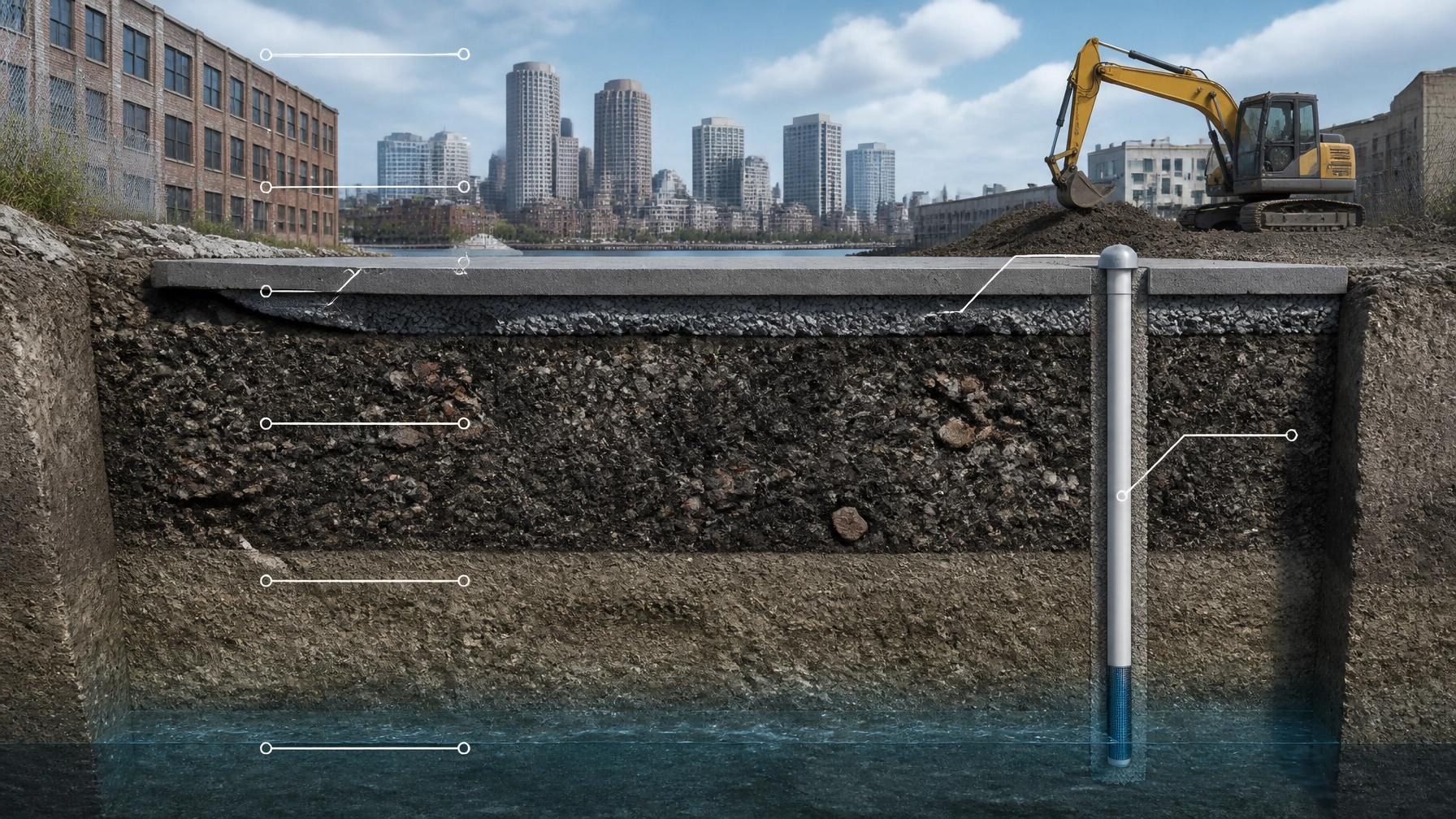
    Geotechnical drill rig with soil cores showing historic fill layers, brick fragments, and sampling equipment

    When a Phase II ESA is necessary

    A Phase II ESA should resolve specific questions raised by the Phase I. It should not be a generic grid of borings selected without regard to the property’s history.

    A targeted Phase II ESA multifamily Jersey City scope may include:

    • Soil borings in former tank, loading, process, or waste storage areas.
    • Groundwater sampling where the water table, contamination history, or construction plans warrant it.
    • Soil vapor or sub-slab sampling near former dry cleaners, service stations, industrial operations, or solvent users.
    • Field screening with a photoionization detector.
    • Temporary or permanent monitoring wells.
    • Laboratory analysis for petroleum, VOCs, SVOCs, metals, PCBs, PFAS, or other site-specific contaminants.
    • Utility clearance and ground-penetrating radar before drilling.
    • Data validation and comparison with applicable NJDEP standards.

    PFAS should be evaluated at sites undergoing remediation. Testing depends on the site history, suspected sources, media, and professional evaluation. Dioxin is not a universal default analyte. It should be considered when site history or other evidence suggests a potential source.

    The scope should also match the planned development. A shallow soil investigation may not answer the question if the project includes a two-level cellar and extensive dewatering.

    Envicon’s Phase II ESA service connects the sampling plan to the RECs, lender questions, purchase-price negotiations, and construction design. The deliverable should state whether the data supports closure, further delineation, remediation, or a defined cost and schedule contingency.

    USTs, vapor, asbestos, and lead

    Older multifamily and mixed-use properties often carry building-related risks that a Phase I does not fully resolve.

    Underground storage tanks may be present even when no tank appears on a current site plan. Tank records, historical fire insurance maps, former fuel systems, fill ports, vent lines, abandoned piping, and staining can guide a UST screen.

    Ground-penetrating radar cart and environmental engineer scanning a former urban redevelopment parcel for USTs and buried utilities

    Soil vapor is another critical pathway. Contamination beneath a building or adjacent property can migrate through soil gas and enter occupied space. The need for vapor sampling or mitigation depends on contaminants, geology, building conditions, utilities, and the proposed design.

    Asbestos and lead require separate building surveys. They are not replaced by a Phase I or Phase II ESA. If the acquisition includes demolition, renovation, or substantial interior work, include:

    • Asbestos inspection and bulk sampling.
    • Lead-based paint evaluation.
    • Lead in dust or construction materials where appropriate.
    • Hazardous building material review.
    • Pre-demolition specifications and contractor controls.

    A coordinated team keeps these scopes on one schedule instead of allowing each consultant to discover the same transaction deadline separately.

    Dewatering and SWPPP can change the construction budget

    Many Hudson County apartment projects excavate below the groundwater table. That can turn an environmental issue into a permit, treatment, and schedule issue.

    Before closing, estimate:

    • Excavation depth and footprint.
    • Seasonal groundwater conditions.
    • Expected pumping rate and duration.
    • Discharge location.
    • Potential contaminants in groundwater.
    • Treatment requirements.
    • Disposal or discharge costs.
    • Temporary discharge and water allocation permits.

    NJDEP’s construction-related dewatering guidance states that requirements are site and project specific. It addresses well permits, water allocation thresholds, and temporary dewatering permits. For example, pumping rates above 70 gallons per minute can trigger regulation, while diversion exceeding 100,000 gallons per day may require a different permit pathway depending on duration and conditions.

    A construction SWPPP and stormwater compliance scope should be coordinated with the civil design, erosion and sediment controls, soil management plan, and construction schedule.

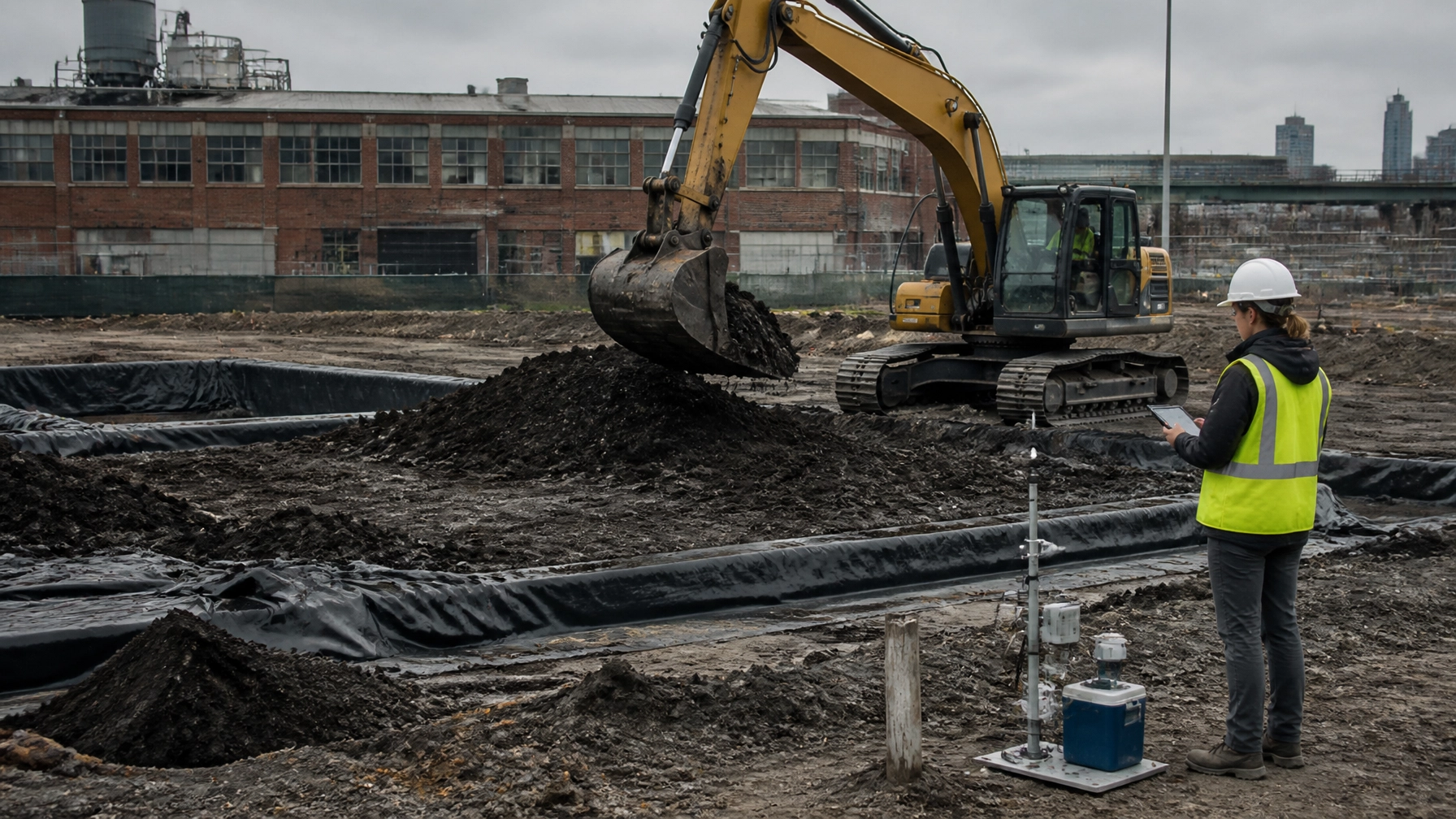
    Urban apartment foundation excavation with dewatering treatment tanks, sediment controls, and environmental field oversight

    Acquisition protections to address before signing

    Environmental diligence is most useful before the purchase agreement becomes difficult to change.

    Your attorney should consider protections such as:

    • Seller representations about known contamination, tanks, regulatory notices, and prior environmental reports.
    • Access rights for Phase II sampling and building surveys.
    • A termination right if results exceed agreed thresholds.
    • Purchase-price adjustment procedures.
    • Escrow or holdback for defined environmental costs.
    • Indemnity language tied to known conditions.
    • Responsibility for pre-closing discharges and regulatory obligations.
    • Closing conditions tied to ISRA documentation or NJDEP approvals.
    • Cooperation requirements for LSRP access and submissions.
    • A mechanism for allocating soil export, dewatering, vapor mitigation, and cap costs.

    Technical diligence does not replace legal advice. It gives counsel and the acquisition team facts they can use.

    A practical NJ multifamily diligence workflow

    Stage Core action Transaction decision
    1. Deal intake Review address, prior uses, development plan, lender scope, and closing date Set the right diligence level
    2. Phase I and regulatory screen Complete ASTM E1527-21 review, NJDEP file search, ISRA screen, and historic-use analysis Identify RECs and regulatory triggers
    3. Field planning Select borings, vapor points, UST screening, building surveys, and utility clearance Confirm the Phase II answers the actual risk
    4. Phase II investigation Collect soil, groundwater, and soil-gas data with NJDEP-compatible methods Quantify contamination and cost exposure
    5. LSRP and permit review Evaluate PA/SI, RAO, ISRA, vapor, dewatering, and SWPPP pathways Establish the closing and redevelopment path
    6. Contract and underwriting Convert findings into contingencies, escrow, schedule, and budget Decide whether to proceed, renegotiate, or exit
    7. Closing and implementation Complete required documents and carry the plan into construction Keep the project moving after acquisition

    Closing timeline: start earlier than you think

    A standard Phase I may fit inside a normal diligence period. A coordinated Phase I, Phase II, ISRA, LSRP, building survey, and lender review may not.

    A practical sequence is:

    • Weeks 1 to 2: Phase I, records review, transaction screen, and lender coordination.
    • Weeks 2 to 4: Phase II planning, utility clearance, drilling, sampling, and building surveys.
    • Weeks 4 to 6: Laboratory results, data interpretation, cost model, and purchase agreement strategy.
    • Weeks 6 and beyond: LSRP submissions, remediation planning, dewatering design, permit coordination, or closing documentation.

    For a known contaminated site subject to direct oversight, NJDEP’s Pre-Purchase Administrative Consent Order guidance states that the agreement must be fully executed before closing. The guidance recommends allowing at least two months for the process in many cases.

    The takeaway is simple: environmental diligence belongs at the front of the acquisition timeline, not in the final week before closing.

    The Envicon approach

    Large consultants often separate the Phase I, Phase II, LSRP, civil, and construction scopes across departments. You receive multiple reports, multiple project managers, and no single person accountable for the transaction path.

    Envicon brings the work together. Our New Jersey team works from our Jersey City office and Hudson County location, with direct access to senior engineers and LSRPs. We connect the findings to your lender, attorney, architect, contractor, and closing schedule.

    That is the difference between buying a report and buying clarity.

    Request an acquisition risk review

    If you are evaluating an apartment or mixed-use property in Jersey City, Hoboken, Bayonne, Newark, Bergen County, Hudson County, or Essex County, send us the address, prior use, proposed redevelopment, lender requirements, and target closing date.

    The right diligence process does more than identify contamination. It gives you a defensible path to price the risk, protect the transaction, and transform an environmentally challenged property into a buildable asset.


    Envicon corporate logo

  • NYC Multifamily SEQRA Exemption 2026: Phase I ESA and Hazardous Materials Checklist for Developers

    NYC Multifamily SEQRA Exemption 2026: Phase I ESA and Hazardous Materials Checklist for Developers

    New York’s SEQRA reforms took effect on May 26, 2026. They create a potential exemption for certain multifamily housing projects classified as “qualified housing actions.”

    That does not mean every NYC housing project qualifies. It means developers now have a defined screening path.

    The project still needs the right unit count, zoning, site history, infrastructure, environmental documentation, and agency confirmation. A SEQRA exemption also does not erase hazardous materials obligations, E-Designation requirements, construction controls, or lender due diligence.

    For developers planning multifamily housing in Manhattan, Brooklyn, Queens, the Bronx, or Staten Island, the first question is not simply, “Do we have enough units?”

    The real question is:

    Can we document that the entire project fits the exemption criteria before the environmental review path becomes a schedule problem?

    “Projects that meet these criteria are potentially eligible for an exemption from SEQRA/CEQR subject to HPD’s approval.”
    Source: NYC Department of Housing Preservation and Development

    What the NYC multifamily SEQRA exemption does

    A qualified housing action may be treated as exempt from SEQRA and CEQR when it satisfies the applicable criteria.

    That can eliminate the need for an Environmental Assessment Statement and avoid a longer environmental review process. It does not eliminate the need to comply with:

    • NYC zoning and building requirements
    • NYC Department of Buildings approvals
    • NYC Department of Environmental Protection requirements
    • Hazardous materials controls
    • E-Designation obligations, where applicable
    • Flood and climate resilience requirements
    • Federal environmental review tied to HUD or other funding
    • Lender, investor, and counsel due diligence
    • Construction-phase environmental controls

    HPD’s current guidance identifies the core NYC screening criteria. Developers should review the official HPD Environmental Review guidance and the NYC Qualified Action Guidance for Housing Actions before relying on the exemption.

    NYC unit and nonresidential thresholds

    The 2026 framework uses incremental project scope. Existing units and proposed units should not be blended casually. Your environmental consultant, land-use counsel, architect, and lead agency need to agree on what the action creates.

    At a high level, NYC projects are screened against these thresholds:

    • Up to 250 incremental dwelling units in low-density zoning districts.
    • Up to 500 incremental dwelling units in medium- and high-density zoning districts.
    • No more than 50,000 incremental gross square feet of nonresidential, nonindustrial use.
    • No industrial floor area facilitated by the action.
    • No project located in an M2 or M3 zoning district under HPD’s stated criteria.

    The 250-unit and 500-unit limits are not a planning shortcut. A project at 249 units still needs to satisfy every other criterion. A 300-unit project in a low-density district cannot become eligible simply because the site has an existing building.

    The project team should prepare a clear area and unit matrix showing:

    • Existing dwelling units
    • New dwelling units
    • Replacement or demolished units
    • Incremental units created by the action
    • Residential gross floor area
    • Community facility and commercial floor area
    • Industrial floor area, if any
    • Zoning district and applicable height controls

    That matrix becomes part of the qualification record.

    Previously disturbed site: the key eligibility issue

    The site must generally qualify as a previously disturbed site.

    For NYC housing actions, HPD describes a site that was substantially altered by an occupied, formerly occupied, or demolished building, or by another improvement or use, at least two years before submission of the HPD funding application.

    The site also cannot:

    • Be currently used for agriculture
    • Have been used for agriculture during the immediately preceding two years
    • Have been used for agriculture during three of the preceding five years
    • Be located within a Coastal Erosion Hazard Area

    A vacant parcel is not automatically a previously disturbed site. A site with old pavement is not automatically eligible either. The lead agency may need evidence showing the nature, timing, and extent of prior disturbance.

    For a previously disturbed site in Queens, Brooklyn, or the Bronx, gather:

    • Historic aerial photographs
    • Sanborn maps and city directories
    • Demolition and building permit records
    • Property tax and assessment records
    • Prior site plans
    • Utility and paving records
    • Historical occupancy information
    • Photographs showing prior improvements
    • Documentation of agricultural use history
    • Coastal hazard mapping

    The standard is fact-specific. Do not describe a parcel as eligible before the lead agency confirms the record.

    Technical planning table with architectural plans, zoning envelope, utility maps, aerial history sheets, and an environmental assessment binder

    Public water and sewer must be documented

    Public or community water and sewer connections are an important part of the state-level qualified housing framework. For typical NYC multifamily development, the project should document how the building will connect to existing DEP systems.

    Review:

    • Existing water service
    • Existing sewer service
    • Proposed connection points
    • Capacity and connection requirements
    • Any private wells or septic systems
    • Combined sewer or stormwater considerations
    • Whether utility upgrades are required before occupancy

    A public water and sewer connection does not resolve environmental risk. It addresses one eligibility screen. The development still needs a site-specific Phase I ESA and a hazardous materials strategy.

    For projects in Westchester, Nassau, or Suffolk County, the infrastructure analysis may be more complex. Municipal systems, private wells, septic systems, and local approval requirements vary. Do not apply the NYC framework mechanically outside the five boroughs.

    Phase I ESA and AAI certification

    A qualified housing action may be exempt from SEQRA and CEQR while still requiring environmental due diligence.

    A current Phase I Environmental Site Assessment should evaluate:

    • Recognized environmental conditions
    • Historic industrial and commercial uses
    • Underground storage tanks
    • Petroleum releases
    • Dry cleaning and solvent use
    • Historic fill
    • Manufacturing operations
    • Spills and regulatory cases
    • Vapor intrusion concerns
    • Adjacent-property sources
    • Existing E-Designations
    • Data gaps and limitations

    Where a lender, investor, acquisition agreement, or liability protection strategy requires All Appropriate Inquiries, the Phase I should follow ASTM E1527-21 and applicable federal requirements under 40 CFR Part 312.

    AAI certification and NYC environmental review are related but not identical. An AAI-compliant Phase I can support a transaction and liability analysis. It does not automatically satisfy every HPD, OER, lender, or agency requirement.

    If the Phase I identifies a REC, the next step may include:

    • Phase II soil sampling
    • Groundwater investigation
    • Soil vapor or sub-slab sampling
    • UST testing or removal
    • Waste characterization
    • Vapor mitigation design
    • Remedial planning
    • NYC OER coordination

    The objective is not to create a defensive report. It is to identify the condition early enough to price it, design around it, and keep the project moving.

    Hazardous materials and E-Designation

    NYC’s hazardous materials requirements do not disappear because a project is treated as a qualified action.

    Depending on the site and action, the project may require a Phase I ESA, subsurface testing, remedial measures, or an E-Designation. The 2025 CEQR Technical Manual hazardous materials chapter explains the City’s current approach to hazardous materials review and E-Designations.

    An E-Designation can establish enforceable requirements for:

    • Phase I and Phase II investigations
    • Soil, groundwater, and soil vapor testing
    • Remediation
    • Vapor barriers or sub-slab depressurization systems
    • Construction health and safety planning
    • Air monitoring
    • NYC OER review and sign-off

    Developers should check the current zoning map, historical CEQR documents, and property records before finalizing the environmental scope.

    If an E-Designation already exists, treat it as a project obligation. Do not assume it is outdated because the property changed ownership or the proposed use changed.

    Envicon’s NYC environmental consultant team works directly with developers, architects, attorneys, contractors, NYC OER, NYC DEP, and other reviewing agencies. That coordination matters because a report sitting in isolation does not resolve an E-Designation.

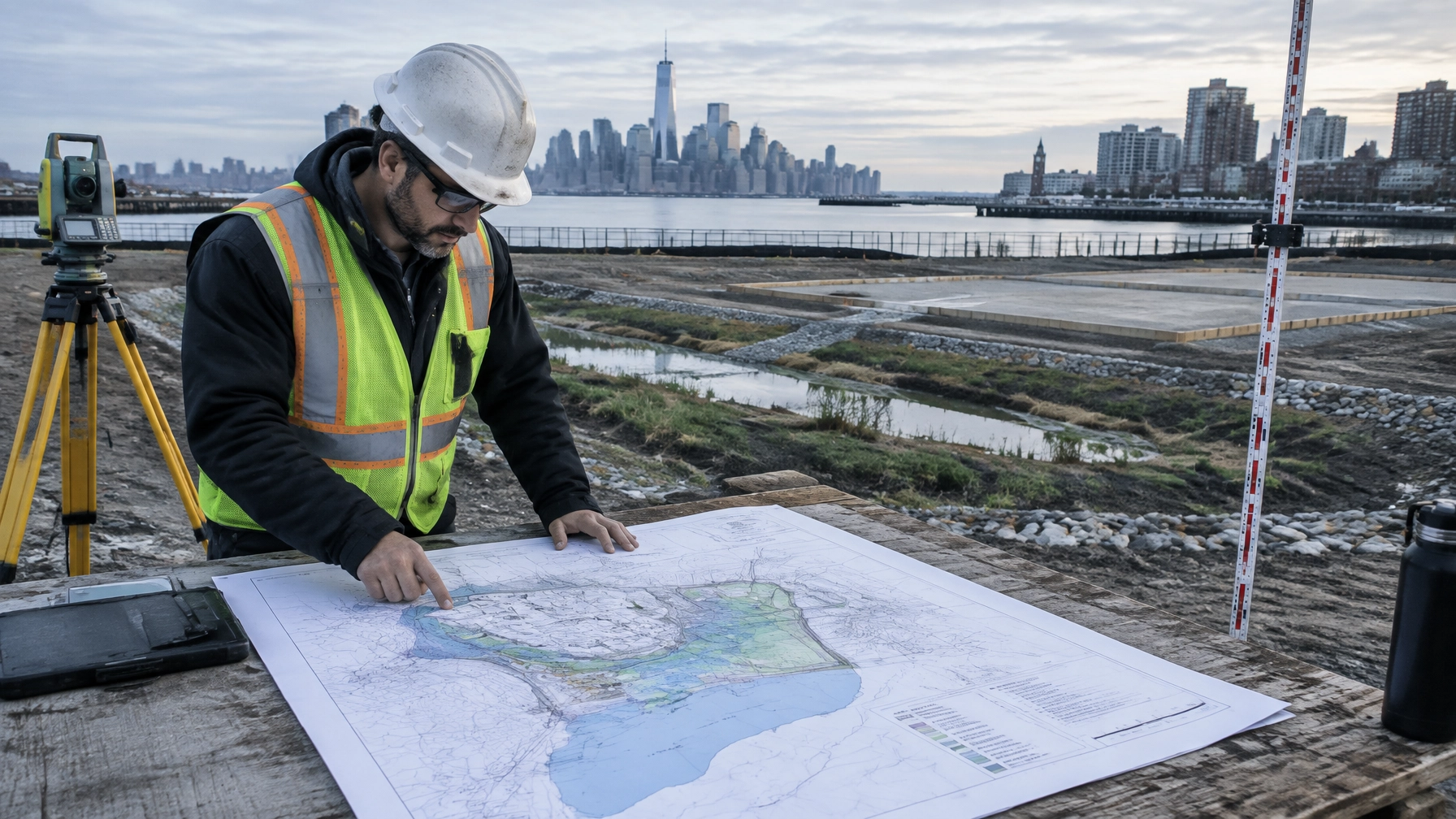
    Environmental professional inspecting a monitoring well and soil boring location at a dense Queens redevelopment parcel

    DAC and climate screening still belongs in the early plan

    A SEQRA exemption is not a reason to skip climate and environmental justice screening.

    Review whether the project is located in or near:

    • A disadvantaged community
    • A flood hazard area
    • A storm surge zone
    • A heat-vulnerability area
    • A coastal resilience planning area
    • A community with cumulative air quality burdens
    • An area with limited open space or infrastructure capacity

    The exemption may change the formal environmental review path. It does not change the site’s physical conditions or the developer’s responsibility to design a safe, resilient building.

    Flood elevation, stormwater, drainage, utility capacity, indoor air, ventilation, and construction controls can still affect cost and schedule. The project team should screen these issues before acquisition or final design.

    Construction obligations continue after qualification

    Once the project moves into construction, environmental obligations become field obligations.

    Depending on the site, the construction plan may need to address:

    • Soil handling and disposal
    • Imported fill documentation
    • Dust and odor control
    • Community air monitoring
    • Worker protection
    • Excavation water and dewatering
    • Vapor barrier installation
    • Cap or engineering control installation
    • Spill prevention
    • Waste manifests
    • Confirmation sampling
    • Agency inspections
    • Construction closeout documentation

    Field engineer reviewing vapor barrier, engineered soil cap, stormwater controls, and utility work during multifamily construction

    This is where many projects lose time. The environmental report is complete, but no one owns the field coordination. The contractor encounters unexpected fill. The vapor barrier detail changes. The agency requests documentation that was never assigned.

    A field-first consultant keeps the environmental scope connected to construction.

    NYC multifamily SEQRA exemption qualification checklist

    Before presenting a project for agency confirmation, assemble:

    • Zoning district and height-control documentation
    • Incremental dwelling unit calculation
    • Nonresidential gross floor area calculation
    • Confirmation that no industrial floor area is facilitated
    • M2 and M3 zoning screen
    • Previously disturbed site documentation
    • Agricultural use history
    • Coastal Erosion Hazard Area screen
    • Public water and sewer documentation
    • Flood and climate hazard screen
    • Current Phase I ESA
    • ASTM and AAI requirements, where applicable
    • E-Designation search and review
    • Phase II scope, if the Phase I identifies RECs
    • Hazardous materials and construction controls
    • HPD, NYC OER, or lead-agency confirmation
    • Separate federal review screen if public funding is involved

    What developers should do next

    Do not build your schedule around an assumed exemption.

    Start with the site history, zoning, unit program, utility connections, and environmental records. Then have the lead agency confirm the pathway.

    The best time to identify a disqualifying condition is before you commit to the acquisition timeline, financing structure, or construction start.

    Envicon can help you move from a qualification question to a documented path forward. We provide Phase I and Phase II ESAs, E-Designation support, brownfield remediation, hazardous materials planning, agency coordination, and construction oversight across NYC, Westchester, Nassau, and Suffolk County.

    A faster review path only helps when the project is properly screened from the start.

    Frequently Asked Questions

    Does every NYC multifamily project qualify for the 2026 SEQRA exemption?

    No. The project must satisfy all applicable criteria, including unit limits, zoning restrictions, nonresidential floor area limits, previously disturbed site requirements, and environmental conditions. HPD or the appropriate lead agency must confirm the exemption pathway.

    Does a SEQRA exemption eliminate the need for a Phase I ESA?

    No. NYC housing guidance continues to address hazardous materials and environmental standards for projects that qualify for the exemption. A Phase I ESA may also be required by lenders, investors, counsel, HPD, OER, or an existing E-Designation.

    What does “previously disturbed site” mean?

    At a high level, it means the site was substantially altered by a building, demolished building, improvement, or prior use at least two years before the relevant application. The project team must document the site history, and the lead agency makes the final determination.

    Can a project in an M2 or M3 district qualify?

    HPD’s current NYC guidance excludes projects located in M2 or M3 zoning districts. A project also cannot facilitate industrial floor area under the stated criteria.

    Does the exemption eliminate E-Designation requirements?

    No. Existing or newly imposed E-Designation requirements may still require investigation, remediation, vapor controls, air monitoring, or OER approval.

    Should developers screen DAC and climate risks if the project is exempt?

    Yes. Flood, heat, stormwater, environmental justice, and infrastructure conditions can affect design, permitting, financing, and construction even when a formal SEQRA or CEQR review is not required.

    Ready to verify your site?

    Envicon corporate logo

  • NJDEP Historic Fill Guidance: Soil Sampling, Reuse, and Disposal for Newark and Jersey City Brownfields

    NJDEP Historic Fill Guidance: Soil Sampling, Reuse, and Disposal for Newark and Jersey City Brownfields

    DRAFT

    Primary keyword: NJDEP historic fill
    Updated: September 9, 2026
    Service focus: Historic fill investigation, soil management, remediation, and NJDEP LSRP oversight
    Primary market: Newark and Jersey City, New Jersey

    Historic fill is common beneath redevelopment sites in Newark, Jersey City, Hoboken, Bayonne, Bergen County, Hudson County, and Essex County. It can support a practical redevelopment strategy, but it can also create unexpected sampling, disposal, cap, and schedule requirements.

    The decision is not simply whether soil looks clean. The decision depends on the material’s origin, physical composition, analytical results, groundwater conditions, planned reuse, receiving area, and current New Jersey Department of Environmental Protection guidance.

    For a project involving brownfield remediation and site cleanup, the objective is clear: characterize the material early, document every movement, and choose a reuse or disposal path before excavation begins.

    What is historic fill in New Jersey?

    Under N.J.A.C. 7:26E-1.8, historic fill is non-indigenous material placed to raise a site’s elevation. It was contaminated before placement and was not connected to operations at the location where it was placed.

    Historic fill may include:

    • Construction and demolition debris
    • Dredge spoils
    • Incinerator residue
    • Fly ash
    • Brick, ash, and soil mixtures
    • Non-hazardous solid waste

    NJDEP’s definition does not include material that is substantially chromate chemical production waste, chemical production waste, ore-processing waste, slag, tailings, or a municipal solid waste landfill.

    That distinction matters in Hudson County. A fill layer associated with general waterfront placement may be historic fill. A layer connected to a former chemical manufacturing operation may represent a separate area of concern that requires independent investigation.

    NJDEP’s Historic Fill Material Technical Guidance states:

    “Historic fill material is material generally deposited to raise the topographic elevation of the site.”

    In practice, the definition must be supported by historical research, site observations, boring logs, test pits, maps, aerial photographs, and the conceptual site model.

    Why historic fill is common in Newark and Jersey City

    Large portions of the Newark Bay, Passaic River, Hackensack River, Hudson River, and Meadowlands industrial corridors were altered through grading, dredging, filling, and redevelopment.

    Historic fill is especially relevant to:

    • Former industrial parcels in Newark and the Ironbound
    • Waterfront and rail-adjacent properties in Jersey City
    • Journal Square and Bergen-Lafayette redevelopment areas
    • Former manufacturing properties in Hoboken and Bayonne
    • Industrial and commercial properties in Bergen and Essex Counties
    • Parcels with undocumented elevation changes or buried structures

    A historic fill investigation should not rely on a map alone. NJDEP’s current rules require the person responsible for remediation to determine whether historic fill is present and to investigate other areas of concern independently.

    Build the conceptual site model before sampling

    A conceptual site model, or CSM, connects the site history to the field conditions and potential exposure pathways.

    For historic fill, the CSM should address:

    • When and why the site was raised
    • The likely source and composition of the fill
    • The thickness and lateral extent of each fill layer
    • Native soil, meadow mat, bedrock, and groundwater conditions
    • Former tanks, drains, process areas, and waste handling areas
    • Potential migration to groundwater
    • Exposure pathways under the proposed future use
    • Excavation areas for foundations, utilities, garages, and stormwater systems
    • Whether the fill extends beyond the property boundary

    The CSM also determines whether historic fill is the only issue. Elevated photoionization detector readings, petroleum odors, free product, stained soil, buried tanks, or operational evidence may indicate separate VOC, petroleum, or source-related areas of concern.

    What contaminants should be tested?

    Historic fill is commonly associated with metals and polycyclic aromatic hydrocarbons, or PAHs. That does not mean every site has the same contaminant profile.

    Depending on site history and current NJDEP requirements, the analytical program may include:

    • TAL metals, including lead, arsenic, mercury, chromium, and nickel
    • PAHs
    • VOCs
    • SVOCs
    • Extractable petroleum hydrocarbons, or EPH
    • PCBs
    • Pesticides
    • Cyanide or phenolics for specific industrial histories
    • PFAS compounds when the site history, regulatory requirements, or data gaps warrant evaluation

    NJDEP’s current Technical Requirements at N.J.A.C. 7:26E-2.1 identify PFAS compounds including PFOA, PFOS, PFNA, GenX chemicals, and other analytes for consideration when contaminants are unknown or not well documented.

    PFAS should not be added to every historic fill program automatically. The scope should reflect the site history, regulatory pathway, intended use, prior reports, and current NJDEP guidance.

    NJDEP historic fill sampling options

    Under N.J.A.C. 7:26E-3.12, the investigator generally has two paths:

    1. Assume the historic fill is contaminated above applicable standards and proceed with the required remedial investigation.
    2. Sample the historic fill and groundwater to determine whether contamination is present above applicable standards.

    If sampling is selected, the investigation must be designed to represent the fill’s physical and chemical variability. Different strata should not be treated as one uniform material without technical support.

    Urban historic fill test pit showing stratified soil, brick fragments, ash-like material, and field sampling equipment

    NJDEP historic fill guidance has historically recommended:

    • Test pits, trenches, or borings through the fill and into underlying native material
    • Field screening and detailed stratigraphic logging
    • Documentation of fill depth, thickness, color, odor, ash, brick, and debris
    • Sampling that accounts for distinct fill layers
    • Groundwater evaluation where required by site conditions

    The current rule and guidance should control the final sampling design. Older sample frequencies should not be copied into a new work plan without checking the applicable requirements and discussing the approach with the project LSRP.

    Caps, deed notices, and engineering controls

    Complete removal is not automatically required for historic fill. Under N.J.A.C. 7:26E-5.4, New Jersey has a rebuttable presumption that historic fill contamination can be addressed through engineering and institutional controls.

    Common controls include:

    • Asphalt or concrete caps
    • Clean soil covers
    • Building slabs
    • Geotextile or visible contamination boundary markers
    • Deed notices
    • Soil remedial action permits
    • Groundwater classification exception areas
    • Site Management Plans
    • Long-term inspection and maintenance

    A cap must match the proposed use. A parking lot, landscaped area, utility corridor, crawl space, and residential play area do not present the same exposure conditions.

    The remedial design should show:

    • Cap materials and thickness
    • Subgrade preparation
    • Drainage and erosion controls
    • Utility trench details
    • Construction quality assurance
    • Inspection and maintenance requirements
    • As-built documentation
    • Deed notice limits and institutional controls

    A cap is not a paperwork substitute. If excavation or utility work later penetrates the control, the project team must know what lies below and how to manage it.

    Excavation and stockpiling requirements

    The lowest-risk approach is to make soil management decisions before excavation. Once historic fill is mixed into a stockpile, the material becomes harder to characterize and more expensive to route.

    Before excavation, establish:

    • Excavation limits
    • Expected soil volumes
    • Stockpile locations
    • Impervious staging surfaces
    • Covers and stormwater controls
    • Dust and odor controls
    • Sampling and segregation procedures
    • Trucking and disposal requirements
    • Clean fill import requirements
    • Daily field documentation

    Keep soil from separate areas of concern segregated. Do not mix material simply to reduce the number of stockpiles. Mixing can increase disposal volumes, obscure contaminant patterns, and create a more difficult waste classification problem.

    Stockpiled material should be covered and managed to prevent runoff, fugitive dust, odors, leaching, and tracking. Disposal facilities may also impose their own sampling and acceptance requirements.

    Historic fill soil reuse versus disposal

    Reuse depends on current NJDEP guidance, analytical results, and site approvals. There is no universal approval based only on the label “historic fill.”

    Clean fill

    Clean fill meets all applicable soil remediation standards, site-specific alternative standards, or interim standards. It must not contain extraneous debris, solid waste, or free liquids.

    Clean fill still requires documentation of:

    • Source
    • Quantity
    • Analytical results
    • Origin and destination
    • Bills of lading
    • Placement location
    • Field verification

    Alternative fill

    Alternative fill contains contaminants above applicable standards but may be used as part of a remedial action if the requirements of N.J.A.C. 7:26E-5.2 are met.

    The current rule addresses whether the material:

    • Contains contaminants already present at the receiving area of concern
    • Exceeds the receiving area’s 75th percentile for an individual contaminant
    • Exceeds the volume needed to restore pre-remediation grade and elevation
    • Requires prior NJDEP written approval

    The receiving area’s LSRP must evaluate the data and document the decision in the fill use plan and remedial action documentation.

    The NJDEP Fill Material Guidance for SRP Sites should be reviewed with the current rule before moving material.

    Non-soil historic fill and debris

    Historic fill containing substantial debris, such as trash, lumber, plastics, roofing materials, insulation, or mixed demolition waste, may be regulated as solid waste.

    Non-soil historic fill may require a Certificate of Authority to Operate or Beneficial Use Determination, commonly called a CAO/BUD. It may also need to go to a permitted solid waste facility.

    Do not assume that an LSRP approval alone authorizes unrestricted reuse of debris-rich material.

    Technical illustration of covered stockpiling, clean fill placement beneath a cap, and licensed disposal routing for managed soil

    Soil decision tree for Newark and Jersey City projects

    Use this as a screening framework. The project LSRP must confirm the final path.

    Historic fill suspected
            |
            v
    Confirm definition and extent through records, borings, test pits, and logs
            |
            v
    Is the material connected to a separate operational area of concern?
            | yes                         | no
            v                            v
    Investigate separately       Characterize or assume contamination
            |                            |
            v                            v
    Determine contaminants,       Are results below applicable standards?
    waste status, and remedy      | yes                  | no
                                         v                     v
                                  Potential reuse        Evaluate remedy
                                  with documentation     and fill use plan
                                                               |
                                                               v
                                         Can it meet alternative fill criteria?
                                         | yes                  | no
                                         v                      v
                                  LSRP-documented reuse   Obtain approval, BUD,
                                  under approved remedy  or dispose at permitted facility
    

    How LSRP oversight protects the schedule

    An LSRP should be involved before acquisition or construction mobilization, not after a stockpile has been created.

    For Newark, Jersey City, Hoboken, Bayonne, and nearby Hudson, Bergen, and Essex County projects, early LSRP involvement can align:

    • Due diligence findings
    • Remedial investigation
    • Geotechnical borings
    • Foundation and utility plans
    • Cap and deed notice requirements
    • Soil export and import routes
    • NJDEP submissions
    • Construction sequencing
    • Confirmation sampling
    • Remedial Action Reports and RAOs

    Envicon’s NJ LSRP services combine regulatory coordination, field investigation, remedial design, soil management, and construction oversight. The benefit is not another report sitting in a project folder. It is one accountable team connecting the data to the construction plan.

    Practical acquisition checklist

    Before closing on a brownfield with suspected historic fill, request:

    • Historical maps and aerial photographs
    • Existing Phase I and Phase II ESA reports
    • Boring logs and laboratory data
    • Deed notices and remedial action permits
    • Site Management Plans
    • Groundwater CEA information
    • Prior soil disposal or reuse records
    • NJDEP correspondence
    • Planned grading and excavation quantities
    • Future-use plans, including residential or child care components

    Then compare the environmental findings against the actual construction design. A site may appear manageable until a proposed basement, underground garage, deep utility trench, or stormwater basin changes the exposure and soil-handling requirements.

    Frequently asked questions

    Can historic fill be reused in Jersey City?

    Potentially. Reuse depends on the material’s analytical results, physical composition, groundwater protection, receiving area conditions, proposed use, and current NJDEP requirements. Approval by an LSRP may be sufficient in some remedial contexts, while other materials or uses require prior NJDEP approval or a CAO/BUD.

    Does historic fill always require excavation?

    No. Containment and exposure controls are often the practical remedy. Excavation may still be necessary for foundations, utilities, basements, underground structures, groundwater work, or areas with separate source contamination.

    Does historic fill automatically mean the site has a discharge?

    Not necessarily. Historic fill must be evaluated under the applicable remediation rules. If contaminated historic fill is identified, the site still requires appropriate investigation and remediation. The LSRP should determine the reporting and regulatory pathway.

    Should PFAS be included in every historic fill investigation?

    No. PFAS scope should reflect current NJDEP requirements, site history, prior uses, data quality, and the applicable remedial program. The absence of PFAS from an older report does not prove the site has no PFAS concern.

    What is the difference between historic fill and clean fill?

    Historic fill is defined by origin and placement history. Clean fill is defined by its analytical and physical characteristics. Historic fill may contain contaminants and debris. Clean fill must meet applicable standards and contain no extraneous debris or solid waste.

    Takeaway

    NJDEP historic fill is a site-management issue, not just a soil-description issue.

    For a Newark or Jersey City brownfield, the right sequence is:

    1. Confirm the definition and extent.
    2. Build a defensible conceptual site model.
    3. Investigate separate areas of concern independently.
    4. Characterize metals, PAHs, VOCs, PFAS, petroleum, and other contaminants as appropriate.
    5. Decide early whether material will remain under a cap, be reused as alternative fill, be imported as clean fill, or be disposed.
    6. Document every soil movement under LSRP oversight.
    7. Align the remedy with acquisition, design, permitting, and construction milestones.

    The fastest project is not the one that moves soil first. It is the one that makes the soil decision before the excavator arrives.

    Official NJDEP sources

    Talk with Envicon about your site

    Historic fill decisions affect acquisition risk, construction cost, regulatory closure, and the date your project can mobilize.

    Envicon corporate logo

  • NJ Brownfield Redevelopment Cost Newark: Budgeting Historic Fill, PFAS, USTs, and Soil Disposal

    NJ Brownfield Redevelopment Cost Newark: Budgeting Historic Fill, PFAS, USTs, and Soil Disposal

    A brownfield acquisition in Newark, Jersey City, Hoboken, Bayonne, Hudson County, Bergen County, or Essex County rarely fails because the buyer overlooked the purchase price.

    It fails because the buyer underestimated the environmental work required after closing.

    That work may include historic fill management, PFAS and dioxin testing, UST closure, soil disposal, groundwater treatment, vapor controls, LSRP oversight, ISRA compliance, civil design, and construction monitoring. Each item can affect the acquisition model, lender approval, construction schedule, and long-term operating obligations.

    There is no responsible single price for New Jersey brownfield redevelopment. The right approach is to identify the cost drivers early, place them into planning categories, and update the budget as the site data improves.

    What drives NJ brownfield redevelopment cost in Newark?

    The first budget should not pretend to know the final remedy. It should show what is known, what is probable, and what still needs investigation.

    For a Newark industrial property, the main cost categories usually include:

    • Due diligence: Phase I ESA, regulatory file review, historical research, lender requirements, and transaction support.
    • Site characterization: Phase II ESA work, soil borings, groundwater monitoring wells, soil vapor sampling, and laboratory analysis.
    • Contaminant-specific investigation: PFAS, dioxins, petroleum compounds, metals, volatile organic compounds, and other analytes selected based on historical use and NJDEP requirements.
    • UST work: Tank locating, closure assessment, removal, soil sampling, disposal, and follow-up remediation if a release is identified.
    • Remedial design: Excavation plans, caps, vapor barriers, groundwater systems, dewatering controls, soil management plans, and engineering documents.
    • Regulatory oversight: LSRP services, remedial action work plans, remedial action permits, deed notices, ISRA coordination, and agency communication.
    • Construction implementation: Excavation, hauling, disposal or reuse, import material, field documentation, air monitoring, water management, and contractor oversight.
    • Civil integration: Grading, drainage, utilities, stormwater controls, foundations, and site design that must work with the environmental remedy.
    • Contingency: Unknown tanks, buried structures, unexpected soil classifications, groundwater impacts, weather delays, and changes to the construction sequence.

    The earlier these categories are separated, the easier it becomes to compare acquisition scenarios.

    Historic fill can change the soil disposal budget

    Historic fill is common across older urban and industrial areas of New Jersey. It may contain ash, brick, concrete, cinders, dredge material, demolition debris, or other non-native material placed before the current redevelopment.

    The key question is not simply whether historic fill exists. The key questions are:

    1. How deep is it?
    2. How much of it will construction disturb?
    3. What contaminants are present?
    4. Can it remain beneath an engineered cap?
    5. Can portions be reused on site under an approved soil management approach?
    6. What volume must leave the property?
    7. What waste classification will the receiving facility assign?

    A site that can manage historic fill in place may have a very different budget from a site that requires broad excavation and off-site disposal. That difference affects trucking, tipping fees, replacement fill, traffic control, dewatering, and schedule.

    This is why historic fill disposal cost in New Jersey should never be estimated from acreage alone. Soil volume, depth, moisture, classification, haul distance, receiving facility requirements, and reuse options all matter.

    New Jersey’s brownfield framework recognizes historic fill as a distinct condition. The New Jersey Brownfields and Contaminated Site Remediation Act and NJDEP’s Brownfields and Contaminated Site Remediation Program provide the regulatory context for evaluating these sites.

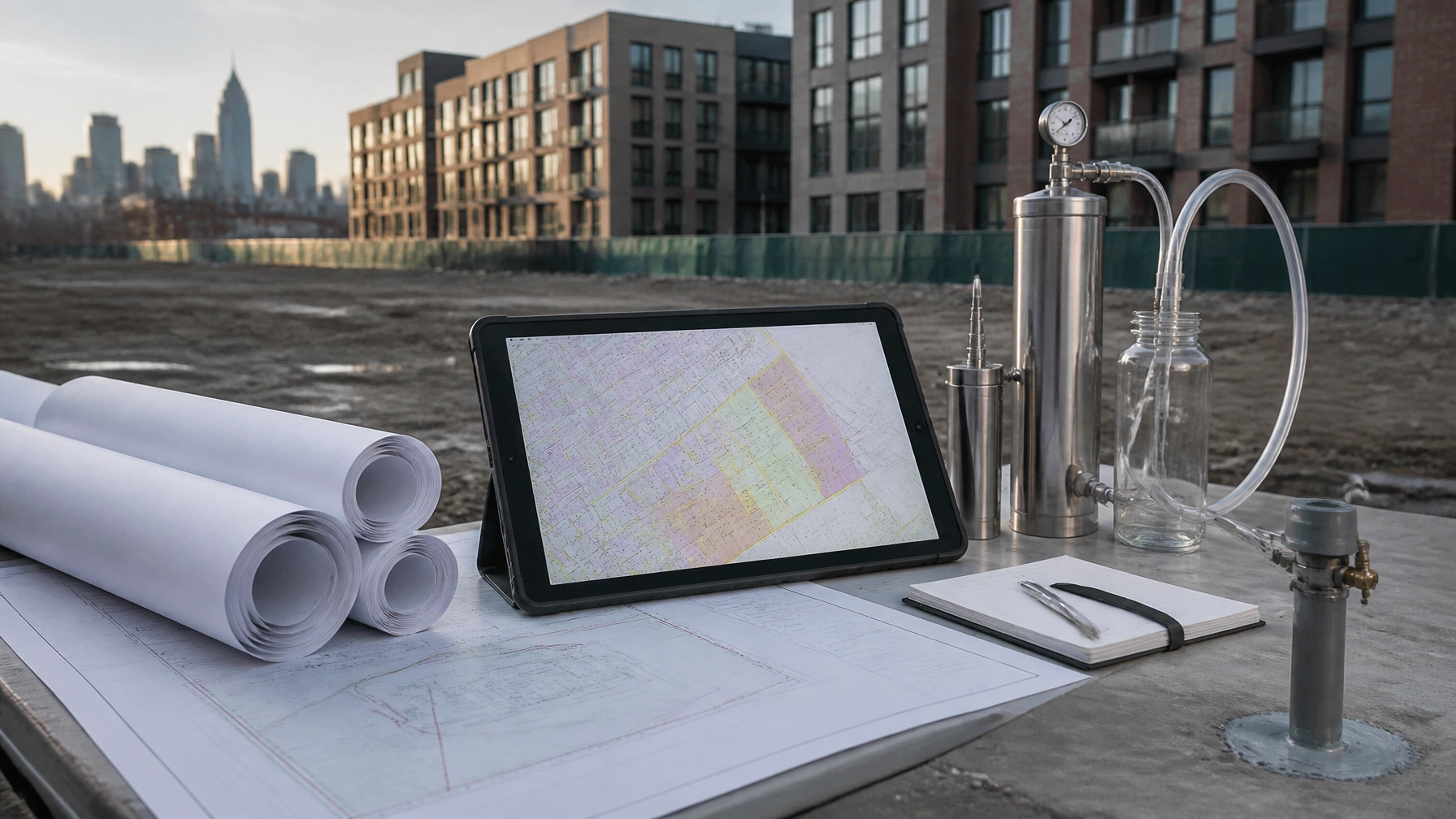
    Environmental due diligence tools including soil sampling equipment, laboratory vials, and a groundwater monitoring well

    PFAS and dioxin testing can expand the scope quickly

    PFAS and dioxin are not automatic findings at every brownfield. They are potential cost drivers that should be evaluated based on site history, surrounding properties, fill composition, industrial processes, and regulatory direction.

    PFAS may affect:

    • Soil and groundwater sampling plans.
    • Laboratory methods and reporting limits.
    • Disposal or treatment options.
    • Groundwater treatment design.
    • Long-term monitoring.
    • Lender and purchaser risk requirements.

    Dioxin concerns may arise at properties with historical combustion, ash, waste handling, or certain industrial uses. The cost impact depends on the number of samples, the depth and distribution of impacts, laboratory requirements, and whether the results change the selected remedy.

    For a buyer searching for PFAS cleanup cost in Newark industrial property, the important point is that sampling cost is only one part of the budget. The larger question is whether PFAS affects excavation, groundwater management, disposal, treatment, or long-term controls.

    A Phase II ESA should answer the questions that matter to the transaction. It should not become a generic sampling exercise disconnected from the planned redevelopment.

    UST closure is both an environmental and construction issue

    Underground storage tanks can create direct costs and schedule risk.

    A tank may be abandoned, partially removed, undocumented, or located beneath an active structure or paved area. Closure can require:

    • Utility and geophysical locating.
    • Tank removal or closure in place where allowed.
    • Soil sampling beneath and around the tank.
    • Product removal and tank cleaning.
    • Disposal of tank contents and impacted soil.
    • Additional delineation.
    • Confirmatory sampling.
    • LSRP reporting and regulatory coordination.

    A UST discovery during excavation is more expensive than a UST identified during acquisition due diligence. The work may require remobilization, temporary shoring, traffic changes, additional disposal, and a revised construction sequence.

    For this reason, UST review should be connected to the planned foundation, utility, parking, and stormwater design. A tank located beneath a proposed building footprint carries a different risk from a tank in an undisturbed corner of the property.

    See Envicon’s UST closure services and Phase II ESA services.

    Decision table: how to budget a New Jersey brownfield

    Planning condition Typical budget pressure Questions to resolve before acquisition
    Limited soil impacts with no groundwater concern Lower Are lender and regulatory requirements satisfied?
    Historic fill beneath a planned cap Moderate What cap, deed notice, or engineering control will be required?
    Historic fill requiring excavation Moderate to high What volume leaves the site, and where can it go?
    UST with confirmed petroleum release Moderate to high Is additional delineation or active remediation required?
    PFAS in soil or groundwater High and uncertain Will treatment, special disposal, or long-term monitoring be needed?
    Dioxin or other persistent contaminants High and uncertain Does the result change the remedy or reuse plan?
    Groundwater within the excavation zone High Will dewatering require treatment, discharge approval, or off-site disposal?
    Vapor intrusion concern Moderate to high Is a vapor barrier, sub-slab system, monitoring, or building redesign needed?
    ISRA-triggered transaction Variable Does the industrial establishment require a separate compliance path?
    Dense urban construction in Newark or Hudson County Higher implementation cost How will trucks, utilities, neighbors, and active operations affect the work?

    These are planning categories, not bids. A credible budget should include assumptions, exclusions, unit-cost placeholders, and a contingency that reflects the quality of the available site data.

    LSRP, ISRA, RAP, and engineering controls belong in the first model

    New Jersey brownfield redevelopment often requires an LSRP to manage the remediation process and certify work completed under the state’s Site Remediation Reform Act framework.

    An LSRP may support:

    • Site investigation and delineation.
    • Remedial investigation reports.
    • Remedial action work plans.
    • Soil and groundwater management plans.
    • Deed notices.
    • Remedial Action Permits.
    • Engineering and institutional controls.
    • Regulatory submissions and response coordination.
    • Long-term monitoring and certification.

    The NJDEP Site Remediation Program should be reviewed alongside the project’s intended reuse. A residential redevelopment, warehouse, manufacturing facility, and mixed-use project may require different controls and documentation.

    If the property is an industrial establishment, ISRA may create additional obligations when the facility is sold, closed, or transferred. ISRA should not be treated as a last-minute legal item. It can affect transaction timing, responsibility allocation, financial security, and the work plan.

    Envicon provides New Jersey LSRP services that connect regulatory requirements to field conditions and construction decisions.

    Engineered soil cap, vapor barrier detail, treatment piping, and field engineers reviewing remediation installation

    Do not forget groundwater, vapor, dewatering, and civil design

    Soil is only one part of the redevelopment budget.

    If groundwater enters an excavation, the project may need temporary wells, pumps, treatment tanks, discharge controls, laboratory testing, water hauling, or permit coordination. If volatile contaminants are present, soil vapor may affect the building design through vapor barriers, sub-slab depressurization, utility sealing, or indoor air monitoring.

    Civil design also affects remediation cost. A deeper basement, new utility corridor, underground parking area, or altered grading plan can disturb more impacted soil than the original concept assumed.

    This is where environmental and civil teams need to work together. Collaboration is not a buzzword. It is how the project avoids designing a remedy that conflicts with the foundation, stormwater system, or construction sequence.

    How to build a defensible acquisition budget

    For NJ brownfield acquisition due diligence cost, start with a decision-focused scope.

    Ask your consultant to provide:

    • A clear Phase I ESA scope and report timeline.
    • A Phase II investigation tied to historical operations and planned use.
    • A contaminant and analyte rationale.
    • A preliminary soil volume estimate.
    • Potential disposal and reuse pathways.
    • UST and vapor risk assumptions.
    • Groundwater and dewatering considerations.
    • LSRP and ISRA requirements.
    • Likely engineering controls.
    • Construction oversight needs.
    • Lender-specific deliverables.
    • A written list of exclusions and contingency triggers.

    Do not bury these assumptions in a long report. Put them in a cost-driver matrix that your acquisition, finance, legal, design, and construction teams can use.

    That is the difference between receiving environmental information and making an informed investment decision.

    Envicon’s approach to brownfield cost planning

    Envicon works with developers, investors, attorneys, contractors, lenders, and public agencies across Newark, Jersey City, Hoboken, Bayonne, Hudson County, Bergen County, and Essex County.

    We connect Phase I and Phase II findings to remediation strategy, LSRP requirements, civil design, disposal planning, and construction oversight. Our role is not to hand you a report and leave you to interpret the risk.

    We help you understand what the site needs, what the remedy may cost, what the regulator will expect, and what must happen next.

    For projects in Hudson County, see our Jersey City environmental consulting location page. For broader brownfield planning, review our remediation and brownfield redevelopment services.

    The takeaway

    Brownfield redevelopment cost in Newark and northern New Jersey is driven by conditions below the surface and decisions above it.

    Historic fill, PFAS, dioxin, USTs, groundwater, vapor, disposal classification, ISRA, RAPs, engineering controls, civil design, and construction sequencing all belong in the acquisition conversation.

    The strongest budgets do not claim false precision. They identify the cost drivers, test the highest-risk assumptions, and show how additional information will change the model.

    Ready to review your brownfield cost drivers?

    Request a brownfield cost-driver review before you finalize your acquisition or construction budget.

    Solve environmental and engineering challenges with precision, speed, and trust.

    Envicon corporate logo

  • New York SEQRA EIS Deadlines 2026: 120-Day, One-Year, and Two-Year Milestones for NYC Development Teams

    New York SEQRA EIS Deadlines 2026: 120-Day, One-Year, and Two-Year Milestones for NYC Development Teams

    As of September 2026, New York development teams need to track more than the traditional SEQRA process. May 2026 statutory amendments and June 2026 revisions to 6 NYCRR Part 617 created new exemption pathways, new environmental justice considerations, and defined timing frameworks for projects that remain subject to review.

    The key dates are:

    • 120 days for an agency to determine whether a qualifying action is exempt, where the statutory exemption applies.
    • One year for the lead agency to determine whether an Environmental Impact Statement, or EIS, is required.
    • Two years for the applicable agency to complete the draft EIS framework after a positive declaration, subject to statutory exceptions, completeness, written extensions, and project-specific facts.

    These are statutory timing frameworks. They are not guaranteed approval dates. A complete application, coordinated technical studies, lead agency action, public review, and agency-specific requirements still control the critical path.

    For teams working in New York City, Westchester, Nassau, and Suffolk, the practical question is not simply, “What is the deadline?” It is, “What must be complete before the clock can run?”

    What changed in May and June 2026?

    The May 2026 budget legislation amended Article 8 of the New York Environmental Conservation Law. It created new statutory exemptions for certain “qualified actions,” including qualifying housing, infrastructure, parks, trails, and other project categories.

    The June 2026 NYSDEC amendments to 6 NYCRR Part 617 also revised the SEQR framework. The amendments address:

    • Disproportionate pollution burdens on disadvantaged communities.
    • Updated environmental assessment forms.
    • New Type II categories for certain small multifamily housing projects.
    • Expanded documentation expectations during significance determinations and EIS preparation.

    The statutory exemptions and regulatory Type II classifications are not interchangeable. A Type II action does not require further SEQR review. A qualifying action exemption depends on the project meeting the specific statutory conditions.

    Early classification matters. A project that qualifies for an exemption may avoid a full SEQRA process. A project that does not qualify still needs a defensible review strategy, a complete technical record, and a schedule that accounts for agency and public participation.

    The New York SEQRA timeline at a glance

    Milestone Timing framework What it means What can affect the timing
    Qualified action exemption determination 120 days Agency determines whether the project qualifies for a statutory exemption after receiving the applicable permit or authorization application Application completeness, applicant changes, agency documentation, circumstances outside the parties’ control
    Lead agency establishment Project-specific Agencies coordinate and designate the lead agency Multiple agencies, disputed lead agency status, incomplete project information
    EIS requirement determination No later than one year after lead agency establishment Lead agency determines whether an EIS is required Completeness, agency coordination, technical information, project revisions
    Draft EIS completion and availability Two-year framework after a positive declaration for applicable permit-related actions Agency completes and makes the DEIS available, subject to statutory exceptions and written extensions Scope changes, missing studies, applicant delays, complex impacts, written extension
    DEIS public review Generally at least 30 days Agencies and the public review the draft EIS Public hearing, comment volume, substantive revisions
    FEIS and findings Later process stages Lead agency completes the final EIS and issues findings before final approval Comments, mitigation, alternatives, unresolved impacts, required permits

    The table is a planning tool, not a substitute for reviewing the statute, regulations, agency procedures, or project-specific facts. Read the current NYSDEC SEQR materials before relying on a date in a purchase agreement, financing document, or construction schedule.

    1. The 120-day SEQRA determination for qualifying actions

    The 120-day rule applies to a specific question: whether a project qualifies for a statutory exemption as a qualified action.

    It does not mean every New York project receives a SEQRA exemption decision within 120 days. It also does not mean the project receives zoning approval, site plan approval, building permits, or financing clearance within that period.

    For a qualifying housing project in New York City, the exemption analysis may involve factors such as:

    • Whether the site is a previously disturbed site.
    • Connection to existing public or community water and sewer systems.
    • Dwelling unit count.
    • Zoning district and permitted building height.
    • Non-residential floor area.
    • Industrial zoning restrictions.
    • Flood, coastal, hazardous materials, and other site conditions.

    Outside New York City, the thresholds and conditions can differ. Westchester, Nassau, and Suffolk projects may involve municipal review, county-level infrastructure issues, local zoning, wetlands, coastal resources, and separate agency approvals.

    The first practical step is a documented qualification screen. That screen should compare the project against the statutory criteria and identify any fact that could disqualify the exemption.

    A complete Phase I ESA can help establish site history and prior disturbance. It can also identify recognized environmental conditions that may require Phase II investigation, remediation planning, or agency coordination. Envicon’s Phase I ESA service supports this early due diligence work for lenders, counsel, developers, and public agencies.

    2. The one-year EIS determination

    For actions that remain subject to SEQRA, the lead agency must determine whether an EIS is required no later than one year after the lead agency is established under the 2026 statutory framework.

    That determination may result in:

    • A negative declaration.
    • A conditioned negative declaration, where legally available.
    • A positive declaration requiring preparation of a DEIS.

    The one-year period should not be treated as a one-year entitlement to a negative declaration. It is a deadline for the agency’s determination. The quality and completeness of the record still matter.

    A lead agency cannot make a reliable determination without understanding the project’s likely environmental impacts. Depending on the site and proposed action, the technical record may include:

    • Soil and groundwater conditions.
    • Soil vapor and indoor air pathways.
    • Traffic and transportation.
    • Stormwater and drainage.
    • Flood risk and sea-level rise.
    • Wetlands and habitat.
    • Historic and cultural resources.
    • Air quality and noise.
    • Construction-period impacts.
    • Utilities and wastewater capacity.
    • Community character and public health.
    • Disadvantaged community impacts.

    For a project in Brooklyn, Queens, the Bronx, or another NYC borough, the environmental review may also intersect with NYC OER, NYSDEC, NYCDEP, NYCDOB, and City Planning requirements. In Westchester, Nassau, and Suffolk, the responsible agencies and local review sequence can look different.

    That is why an NYC environmental impact statement timeline cannot be copied from a suburban project schedule. The agency structure, approval path, technical scope, and public process are not the same.

    GIS-style environmental review map showing flood exposure, drainage, soil investigation points, and disadvantaged community screening

    3. The two-year EIS completion framework

    For applicable permit-related actions where a positive declaration requires an EIS, the 2026 amendments establish a two-year framework for completing and making the draft EIS available.

    This is the point that requires the most care.

    The two-year framework does not mean:

    • Final project approval is guaranteed within two years.
    • The FEIS must be complete within two years in every case.
    • Public comments, hearings, findings, or permits disappear from the schedule.
    • An incomplete application starts a fixed, unconditional countdown.
    • The agency loses discretion to address new information or material project changes.

    The DEIS must address the identified environmental issues in enough detail for agency and public review. If the applicant changes the project, submits critical information late, or fails to complete a required technical study, the schedule can move.

    The statute also allows limited extensions in writing after consultation with the applicant. The extension should be documented. Development teams should request the written schedule, the reason for the extension, and the specific milestone affected.

    A DEIS is not the end of SEQRA. After the draft is available, the project enters public review. The lead agency must evaluate comments, revise the environmental analysis where necessary, complete the FEIS, and issue findings before final approval.

    DACAT, DEIJ, and climate risk screening now belong on the critical path

    The June 2026 Part 617 revisions formalize the need to consider whether an action may cause or increase a disproportionate pollution burden on a disadvantaged community.

    This does not mean every project affecting a disadvantaged community automatically requires an EIS. It does mean that agencies must address the issue in the significance determination and, where applicable, in the EIS.

    Development teams should complete DACAT and DEIJ screening early. The screening should be consistent with the current project footprint, land use, emissions, construction activities, truck routes, stormwater strategy, and proposed mitigation.

    Climate risk should be handled with the same discipline. In NYC and on Long Island, that may include coastal flooding, storm surge, extreme precipitation, drainage capacity, and building access. In Westchester, site topography, watershed conditions, slope stability, and stormwater discharge may control the technical scope.

    A late climate or environmental justice analysis can force redesign. A clear early analysis gives the lead agency a usable record and gives the applicant a better chance to address concerns before public review.

    How consultants keep the SEQRA schedule moving

    Environmental consultants support the critical path in four ways:

    1. Classify the action early.
      Determine whether the project may qualify as a Type II action, a statutory qualified action, or a project requiring a full SEQRA review.

    2. Build a complete technical record.
      Coordinate Phase I and Phase II ESAs, soil vapor work, groundwater sampling, flood analysis, stormwater studies, climate screening, and other required investigations.

    3. Coordinate the agencies.
      Keep the lead agency, involved agencies, architect, civil engineer, traffic consultant, attorney, and developer working from the same project description.

    4. Track decisions in real time.
      Maintain a schedule that records application completeness, lead agency designation, study status, agency comments, public review, extensions, and required revisions.

    This is where a regional, field-first team has an advantage over a large consultant with multiple handoffs. The person reviewing the field data should understand how it affects the EIS, the permit path, the budget, and the construction sequence.

    Envicon provides compliance and permitting support and works across environmental, civil, and regulatory scopes. Our NYC environmental consulting team supports developers and public agencies throughout the five boroughs, with additional coverage across Westchester, Nassau, and Suffolk.

    What development teams should do in September 2026

    Before relying on a 120-day, one-year, or two-year milestone, confirm:

    • The responsible and lead agencies.
    • Whether the application is complete.
    • Whether the project qualifies as a Type II action or statutory qualified action.
    • Whether the site meets the previously disturbed site definition.
    • Whether a Phase I ESA or other environmental certification is required.
    • Whether DACAT and DEIJ screening is complete.
    • Whether climate risk and flood exposure have been evaluated.
    • Whether all technical studies match the current site plan.
    • Whether the agency has documented any extension in writing.
    • Whether the schedule includes DEIS public review, FEIS preparation, findings, and permits.

    The 2026 reforms create more structure. They do not eliminate project risk. A deadline only helps when the project team knows what starts the clock, what pauses it, and what work must be ready before the agency can act.

    Request a SEQRA schedule review

    If your NYC, Westchester, Nassau, or Suffolk project is approaching lead agency designation, a qualified action determination, or a positive declaration, Envicon can review the schedule and identify the technical work that controls the next milestone.

    The goal is not to produce another report that sits in a queue. The goal is to build a defensible path from environmental review to approval, financing, and construction.

    Environmental and civil engineering team reviewing a coordinated SEQRA milestone plan and site map

    3D GIS model of a New York redevelopment site showing drainage, groundwater, climate, and environmental review layers

    Envicon corporate logo

  • NJDEP PFAS Remediation Standards 2026: What Developers Need to Change in Phase II Scope

    NJDEP PFAS Remediation Standards 2026: What Developers Need to Change in Phase II Scope

    On June 15, 2026, the New Jersey Department of Environmental Protection formally adopted remediation standards for PFNA, PFOA, PFOS, and GenX. The rule also amended the Technical Requirements for Site Remediation to require analysis for those PFAS compounds and 2,3,7,8-TCDD when contaminants in an area of concern are unknown or not well documented.

    For developers, lenders, attorneys, and contractors, this changes how certain Phase II investigations need to be scoped.

    The issue is not simply adding five names to a laboratory quote. PFAS requirements can affect sampling design, laboratory coordination, soil management, groundwater evaluation, transaction budgets, and construction schedules.

    The regulatory facts below come from NJDEP’s June 15, 2026 announcement and the Department’s June 24, 2026 rule adoption notice. Project-specific recommendations still require review by the environmental professional and, where applicable, the New Jersey Licensed Site Remediation Professional, or LSRP.

    What NJDEP adopted on June 15, 2026

    NJDEP adopted amendments to three regulatory areas:

    • Ground Water Quality Standards under N.J.A.C. 7:9C
    • Soil Remediation Standards under N.J.A.C. 7:26D
    • Technical Requirements for Site Remediation under N.J.A.C. 7:26E

    The rule formalizes interim standards that had been in place since 2022 and 2023. The adopted standards address:

    • Perfluorononanoic acid, or PFNA
    • Perfluorooctanoic acid, or PFOA
    • Perfluorooctane sulfonate, or PFOS
    • GenX chemicals, including HFPO-DA and its ammonium salt

    The rule also adds PFNA, PFOA, PFOS, GenX chemicals, and 2,3,7,8-tetrachlorodibenzo-p-dioxin, commonly called 2,3,7,8-TCDD, to the analytical list in N.J.A.C. 7:26E-2.1(c)1ii.

    That means these compounds must be analyzed in all relevant media when contaminants in an area of concern are unknown or not well documented.

    This is a regulatory requirement under the specified conditions. It is not a recommendation to add every possible analyte to every private transaction scope.

    The adopted PFAS standards developers need to understand

    The adopted values address different exposure and migration pathways. The table below summarizes the values identified in NJDEP’s remediation standards materials. Confirm the current version of the NJDEP Soil and Soil Leachate Remediation Standards comparison tables before finalizing a sampling and analysis plan.

    Compound Residential soil ingestion-dermal Non-residential soil ingestion-dermal Soil leachate migration to groundwater Groundwater quality standard
    PFNA 0.047 mg/kg 0.67 mg/kg 0.26 µg/L 0.013 µg/L
    PFOA 0.13 mg/kg 1.8 mg/kg 0.28 µg/L 0.014 µg/L
    PFOS 0.11 mg/kg 1.6 mg/kg 0.26 µg/L 0.013 µg/L
    GenX 0.23 mg/kg 3.9 mg/kg 0.40 µg/L 0.02 µg/L

    The soil migration-to-groundwater standard may be site-specific. The applicable value depends on the regulatory pathway, groundwater classification, site conditions, and the current NJDEP standards and guidance.

    The numbers also show why a simple soil-only approach can miss the project risk. A result that does not exceed a direct-contact soil standard may still require evaluation for migration to groundwater.

    “With the formal adoption of these site remediation standards, the Sherrill Administration is delivering on its mission to protect public health, provide clean drinking water to the public, and restore the environment from decades of PFAS pollution across the state.”

    NJDEP, June 15, 2026

    What changes in a New Jersey Phase II scope

    A Phase II ESA usually responds to recognized environmental conditions identified during a Phase I. In New Jersey, the investigation may also function as part of a Preliminary Assessment, Site Investigation, or broader NJDEP remediation case.

    The first scope question is now more important:

    Are contaminants in the area of concern known and well documented?

    If the answer is no, the amended Technical Requirements call for analysis of:

    • PFNA
    • PFOA
    • PFOS
    • GenX chemicals
    • 2,3,7,8-TCDD

    The analysis applies across all relevant media under the rule. Depending on the area of concern and exposure pathways, that may include soil, groundwater, soil leachate, soil gas, sediment, surface water, or other media that require evaluation.

    That does not mean a consultant should order every matrix without reviewing site history. It means the scope must address the amended requirement directly and document why each medium is included or excluded.

    A defensible Phase II scope should identify:

    1. The area of concern and the basis for investigating it.
    2. What historical records establish about past chemicals and site operations.
    3. Whether the contaminant profile is known, partially documented, or unknown.
    4. The sample locations and depths for each medium.
    5. The PFAS analytical method and laboratory reporting limits.
    6. Whether 2,3,7,8-TCDD analysis is included under the amended requirement.
    7. How results will be compared with current NJDEP standards.
    8. How non-detects, estimated results, and data usability will be handled.

    PFAS laboratory sample preparation bench with groundwater vials and chain-of-custody materials

    Soil, groundwater, and soil leachate are separate decisions

    PFAS does not behave like a conventional petroleum release. The compounds can be highly mobile, persistent, and present at concentrations that require very low laboratory reporting limits.

    Soil

    Soil samples help evaluate direct contact and potential source areas. Sampling should consider former industrial operations, firefighting areas, waste handling locations, floor drains, process areas, loading zones, and fill placement.

    Developers should not assume that a clean-looking surface represents site conditions. PFAS impacts may be deeper, associated with fill, or connected to historical releases that are not visible during a site walk.

    Groundwater

    Groundwater data can affect more than environmental liability. Results may influence dewatering requirements, treatment design, discharge approvals, construction sequencing, and long-term monitoring.

    A groundwater result above the applicable standard may require additional delineation or remedial planning. It may also affect whether excavation can proceed under the original construction plan.

    Soil leachate

    Soil leachate analysis evaluates the potential for contaminants in soil to migrate into groundwater. It is not automatically required for every Phase II ESA. The need depends on the applicable pathway, soil conditions, groundwater setting, and the NJDEP framework governing the investigation.

    This is where a clear scope matters. A low-cost quote that excludes pathway-specific analysis may create a larger cost later when NJDEP, the lender, or the LSRP requests additional work.

    Budget and schedule impacts

    PFAS changes should be addressed before field mobilization, not after the first laboratory report.

    Potential cost drivers include:

    • Additional laboratory analytes
    • Lower reporting limits and specialized quality control
    • More sample locations or deeper borings
    • Groundwater monitoring well installation
    • Soil leachate testing
    • Data validation and usability review
    • Additional delineation
    • Treatment or disposal profiling
    • LSRP coordination and NJDEP correspondence
    • Construction water management and discharge controls

    The schedule can also change. PFAS laboratory capacity, data review, and follow-up sampling may add time to a transaction or construction start.

    For a lender, the question is whether the environmental report supports underwriting and collateral risk decisions. For an attorney, the question may involve allocation of cleanup obligations, indemnities, escrow, or regulatory responsibilities. For a contractor, the question is whether impacted soil or groundwater changes the means and methods of construction.

    Each party needs the same underlying data. They may use it for different decisions.

    What developers should do now

    Before authorizing a Phase II in New Jersey, request a written scope that answers these questions:

    • Does the property include an area of concern with unknown or poorly documented contaminants?
    • Does the scope include PFNA, PFOA, PFOS, GenX, and 2,3,7,8-TCDD where required?
    • Which media will the laboratory analyze?
    • Are the reporting limits appropriate for current NJDEP standards?
    • Will soil leachate be evaluated if migration to groundwater is a concern?
    • Who will review the data against N.J.A.C. 7:9C and 7:26D?
    • Is an LSRP involved, and when will that coordination begin?
    • What happens if the laboratory detects PFAS?
    • Are the budget and schedule assumptions written into the proposal?

    Do not treat a generic Phase II template as a complete answer. A former chemical plant in Hudson County, a warehouse near Newark, and a redevelopment parcel in Jersey City may require very different sampling plans.

    You can review Envicon’s Phase I and Phase II environmental assessment services, including soil, groundwater, soil vapor, PFAS assessment, and transaction support. For active NJDEP matters, our NJ LSRP services provide regulatory coordination from site investigation through closure.

    Why field-first coordination matters

    PFAS scope decisions sit between due diligence, regulation, laboratory work, and construction. That is where projects lose time when each consultant works from a separate file.

    Envicon coordinates directly with developers, lenders, attorneys, architects, contractors, laboratories, and LSRPs. Our team builds the scope around the site history and the decision the client needs to make. We track field activity, sample status, laboratory deliverables, budget, and next steps through project dashboards instead of waiting for a monthly update.

    That approach gives the client a clearer answer:

    • What did we sample?
    • What is still outstanding?
    • Which results affect the transaction?
    • Is additional delineation needed?
    • Can construction proceed?
    • What does NJDEP or the LSRP need next?

    Collaboration is not a buzzword. It is how complex sites move forward.

    For developers in Jersey City and Hudson County, the practical advantage is direct access to professionals who understand the local redevelopment environment and the demands of NJDEP oversight. You get a scope built for the property, not a national template applied from a distance.

    The takeaway

    NJDEP’s June 15, 2026 adoption makes PFNA, PFOA, PFOS, and GenX formal remediation standards in New Jersey. It also expands required analytical parameters for areas of concern where contaminants are unknown or poorly documented, adding those compounds and 2,3,7,8-TCDD to the required list.

    For your next Phase II or NJDEP investigation:

    1. Review the area of concern history before selecting the laboratory suite.
    2. Address all relevant media, including soil, groundwater, and soil leachate where appropriate.
    3. Use current NJDEP standards and reporting limits.
    4. Build PFAS contingencies into the budget and transaction schedule.
    5. Bring the LSRP and field team into the discussion early.

    The right scope does more than satisfy a regulation. It gives you a defensible path to acquisition, remediation, construction, and closure.

    Talk with Envicon about your New Jersey PFAS scope

    This article is for general information only. NJDEP requirements and project obligations depend on site conditions, regulatory status, applicable standards, and the facts of the investigation. Obtain project-specific advice from qualified environmental professionals and, where applicable, an NJDEP LSRP.

    Envicon Group logo

  • NJ Flood Elevation Requirements 2026: REAL Rules, Resilient Design, and Hudson County Development

    NJ Flood Elevation Requirements 2026: REAL Rules, Resilient Design, and Hudson County Development

    DRAFT. Pending approval. Not scheduled or published.

    January 20, 2026 changed how New Jersey evaluates flood risk for development projects. NJDEP adopted the Resilient Environments and Landscapes, or REAL, amendments affecting flood hazard areas, coastal permitting, freshwater wetlands, and stormwater management.

    For developers in Jersey City, Hoboken, Bayonne, Newark waterfront, Hudson County, Bergen County, and Essex County, the practical issue is not simply whether a property appears inside a FEMA flood zone. The question is whether the proposed work falls within a New Jersey regulated area and what elevation, grading, drainage, storage, and permit documentation NJDEP will require.

    This guide explains the NJ flood elevation requirements for 2026, including the REAL rule framework, the difference between FEMA mapping and NJDEP jurisdiction, and the civil engineering work needed to keep a waterfront project moving.

    “The purpose of this chapter is to minimize damage to life and property from periodic flooding caused by precipitation and storm surge, and exacerbated by climate change, sea level rise, and flooding caused by development.”
    Source: N.J.A.C. 7:13 Flood Hazard Area Control Act Rules

    What changed under the January 2026 REAL rules?

    The REAL amendments became effective on January 20, 2026. They amended multiple NJDEP programs, including:

    • Flood Hazard Area Control Act rules under N.J.A.C. 7:13
    • Coastal Zone Management rules under N.J.A.C. 7:7
    • Freshwater Wetlands Protection Act rules under N.J.A.C. 7:7A
    • Stormwater Management rules under N.J.A.C. 7:8

    The NJDEP REAL rule adoption page provides the Department's official overview.

    The central change is the use of a climate-adjusted flood elevation. The regulated elevation is not automatically the same as the FEMA Base Flood Elevation, or BFE. NJDEP's rules account for future sea-level rise in tidal areas and increased precipitation in fluvial areas.

    That distinction matters for sites that appear outside a FEMA Special Flood Hazard Area but sit near the Hudson River, Hackensack River, Passaic River, Newark Bay, a tidal inlet, or a regulated inland water.

    Is NJ flood elevation always FEMA BFE plus four feet?

    No. There is no single universal finished-floor elevation for every New Jersey property.

    Under N.J.A.C. 7:13, the method depends on the type of flood hazard area and the available mapping.

    Tidal and coastal areas

    For a tidal regulated water, the climate-adjusted flood elevation is generally determined using the higher applicable value based on:

    • Four feet above the 100-year flood elevation shown on an NJDEP delineation
    • Four feet above the 100-year flood elevation shown on qualifying FEMA mapping
    • A site-specific calculation, where permitted and appropriately supported

    This is the basis commonly described as NJ REAL flood elevation in coastal areas equal to FEMA BFE plus four feet. It is a regulatory starting point, not a universal finished-floor number.

    The final building design can also involve:

    • Lowest-floor requirements
    • Flood-resistant construction
    • Freeboard
    • Utility and mechanical equipment elevation
    • Dry or wet floodproofing
    • Access and egress requirements
    • Local construction-code requirements
    • FEMA and National Flood Insurance Program standards

    Fluvial and inland areas

    For a fluvial flood hazard area, NJDEP generally uses the higher applicable value based on:

    • Two feet above the flood hazard area design flood elevation shown on an NJDEP delineation
    • Three feet above the FEMA 100-year flood elevation shown on qualifying FEMA mapping
    • An approved approximation or site-specific hydrologic and hydraulic calculation

    A Passaic River site in Newark or Jersey City may involve tidal influence, fluvial backwater, or both. That is why copying one number from a FEMA map is not enough.

    Technical cutaway visualization of NJDEP climate-adjusted flood elevation, flood storage, and resilient site design

    NJDEP mapping and FEMA mapping are not interchangeable

    FEMA maps are important. They support flood insurance, federal floodplain management, and building-code decisions. But FEMA mapping alone does not establish every NJDEP regulatory boundary.

    N.J.A.C. 7:13 allows NJDEP to determine flood hazard areas through:

    1. A Department delineation
    2. FEMA flood mapping
    3. An approved approximation
    4. A site-specific engineering calculation

    The rules also state that the NJDEP flood hazard area may differ from a flood zone shown by another agency.

    Use the FEMA Flood Map Service Center to review effective, preliminary, and advisory mapping. Then compare that information with NJDEP data and the actual site topography.

    For Hudson County projects, the comparison should include:

    • FEMA FIRM panel and effective date
    • FEMA flood profile, where available
    • NJDEP flood hazard area information
    • Floodway limits
    • Inundation Risk Zone mapping
    • Riparian zone limits
    • Existing and proposed ground elevations
    • Mean Higher High Water data for tidal sites
    • Local floodplain and zoning requirements

    The current N.J.A.C. 7:13 Appendix 2 identifies Department delineated waters in the region, including portions of the Passaic River in Jersey City, Harrison, Kearny, and Newark, and portions of the Hackensack River in Jersey City and Kearny. A municipality or waterway not listed in the appendix is not automatically free of flood-related requirements. The applicable method must be confirmed for the individual site.

    Survey and elevation data come first

    A Hudson County resilient development permit cannot be designed reliably from a generalized flood-zone screenshot.

    The civil team should establish a consistent vertical control framework, generally using NAVD 88, the reference datum identified in N.J.A.C. 7:13.

    A useful survey package typically shows:

    • Property boundaries
    • Existing buildings and structures
    • Spot elevations and contours
    • Streets, curbs, sidewalks, and drainage inlets
    • Bulkheads, seawalls, channels, and top-of-bank conditions
    • Utility structures
    • Existing and proposed finished-floor elevations
    • Flood hazard area and floodway limits
    • Riparian zone and inundation risk limits
    • Proposed grading and drainage features

    If the map does not reflect actual site conditions, the project may require a survey-based verification, a delineation revision, or hydrologic and hydraulic calculations. That decision should happen before the architect completes the building layout.

    Flood elevation affects grading, drainage, and compensatory storage

    Flood compliance is not only a building-height issue.

    Placing fill, raising grades, adding pavement, constructing retaining walls, or relocating drainage can displace floodwater. A design that elevates a building but blocks flow or reduces storage can still fail technical review.

    The civil design should evaluate:

    • Existing versus proposed flood storage
    • Fill placement and excavation volumes
    • Floodway encroachment
    • Compensatory storage, where required
    • Surface drainage patterns
    • Stormwater detention and water-quality controls
    • Outfall capacity and tide-locked conditions
    • Emergency overflow routes
    • Basement and below-grade construction
    • Protection of utilities and mechanical systems

    The project may also trigger the NJDEP Stormwater Management rules and FAQs. Major development thresholds, redevelopment conditions, groundwater recharge, water quality, and quantity controls can become part of the same review.

    In a coastal or waterfront setting, flood hazard, coastal permitting, wetlands, and stormwater design must be coordinated. Treating each approval as a separate task creates conflicts between the grading plan, drainage report, wetland limits, and building elevations.

    Flood hazard, coastal, wetlands, and stormwater permits can overlap

    A Hoboken flood hazard development permit may involve more than N.J.A.C. 7:13.

    Depending on the site and scope, the review may also involve:

    • Flood Hazard Area authorization
    • Coastal Zone Management or Waterfront Development approval
    • Freshwater wetlands review
    • Riparian zone disturbance
    • Stormwater management compliance
    • Soil erosion and sediment control
    • Municipal site-plan approval
    • Local floodplain ordinance
    • Construction-code review
    • Utility and roadway approvals

    NJDEP's current Flood Hazard Area rules and application materials should be reviewed together with the applicable permit checklist. The rule specifically defines an application as complete for review only when it is both administratively and technically complete.

    That means the application must contain the right forms and fees, but also enough technical information for NJDEP to evaluate the project.

    Survey crew collecting precise elevation data near a New Jersey waterfront drainage system

    REAL legacy status: do not assume an extension

    The REAL rules took effect on January 20, 2026. NJDEP's initial legacy provisions allowed certain complete applications to proceed under pre-REAL rules during a 180-day period ending July 20, 2026.

    NJDEP later proposed extending aspects of the legacy period to July 20, 2027. That proposed extension should not be treated as a permanent or universally applicable codified extension without checking the current NJDEP rulemaking status, the applicable permit type, and the project's completeness date.

    For a live project, confirm:

    • The date NJDEP received the application
    • Whether the application was administratively complete
    • Whether it was technically complete
    • Whether the application type qualifies for legacy treatment
    • Whether later revisions change the project's status
    • Whether the current rule or an adopted amendment controls at the time of decision

    A verbal understanding that a project is “grandfathered” is not enough. Get the status documented.

    NJ flood elevation permit checklist for 2026

    Before submitting a Jersey City, Hoboken, Bayonne, Newark waterfront, Hudson, Bergen, or Essex County project, assemble the following:

    • Confirm the regulated water and jurisdictional pathway.
    • Identify whether the site is tidal, fluvial, or subject to both conditions.
    • Obtain current FEMA and NJDEP mapping.
    • Complete a site survey tied to NAVD 88.
    • Document existing and proposed grades.
    • Show proposed building and lowest-floor elevations.
    • Delineate floodway, flood fringe, riparian zone, and inundation risk areas.
    • Calculate fill, excavation, and potential flood-storage displacement.
    • Design compensatory storage if required.
    • Coordinate stormwater quantity, quality, and recharge requirements.
    • Review coastal and freshwater wetlands interfaces.
    • Confirm whether a verification, applicability determination, general permit, general permit-by-certification, or individual permit is appropriate.
    • Use the current NJDEP checklist for the selected authorization.
    • Confirm municipal floodplain and construction-code requirements.
    • Have all engineering reports, plans, calculations, certifications, and notices signed and sealed where required.
    • Track completeness correspondence and deficiency responses.

    How Envicon keeps the flood review moving

    Flood elevation work should not be split between a surveyor, a civil engineer, a permit expediter, and a separate environmental consultant who never coordinate.

    Envicon combines civil and geotechnical engineering with environmental permitting and field-level oversight. Our civil and geotechnical engineering team can coordinate survey data, grading, drainage, flood resilience, and construction support. Our compliance and permitting team handles NJDEP submissions, permit strategy, agency comments, and related stormwater and environmental requirements.

    From our Jersey City office, we support waterfront and urban development throughout Hudson County, Bergen County, Essex County, and the broader New Jersey market.

    The difference is ownership. We do not hand you a flood map and leave you to interpret it. We connect the elevation data to a buildable design, a complete application, and a clear path through agency review.

    Key takeaway

    The NJ flood elevation requirements for 2026 are site-specific. REAL changed the regulatory framework, but the correct design elevation depends on the flood source, NJDEP and FEMA data, the project scope, the permit pathway, and the quality of the survey and engineering analysis.

    For Hudson County development, start with the elevation and jurisdictional analysis before finalizing the building footprint. That is how you avoid redesign, incomplete applications, and expensive delays.

    Frequently asked questions

    Does every New Jersey coastal property need to be designed to FEMA BFE plus four feet?

    No. The four-foot climate adjustment is part of the tidal flood hazard methodology under REAL. The applicable elevation depends on NJDEP or FEMA data, site-specific conditions, building standards, local requirements, and the selected permit pathway.

    Does a FEMA Zone X designation mean NJDEP flood permits do not apply?

    No. FEMA and NJDEP use different regulatory frameworks. A site can require NJDEP review based on a Department delineation, an approved calculation, a riparian zone, an inundation risk zone, or another regulated condition.

    What is the difference between FEMA BFE and NJDEP climate-adjusted flood elevation?

    FEMA BFE represents the 1% annual chance flood elevation shown in applicable FEMA studies. NJDEP's climate-adjusted flood elevation adds the adjustments required by N.J.A.C. 7:13 and may produce a more protective regulatory elevation.

    What does a complete NJDEP flood application require?

    The application must be administratively and technically complete. Typical materials include the correct forms, fee, site plans, surveys, mapping, engineering reports, calculations, certifications, public notice materials, and project-specific documentation required by the current NJDEP checklist.

    Can a project still qualify for REAL legacy treatment in 2026?

    It depends on the application type, completeness status, submission date, and the current status of NJDEP's legacy provisions or amendments. Do not assume that a proposed extension applies. Confirm the status with the current NJDEP materials and obtain project-specific advice.

    Plan the next step before design gets locked

    Envicon corporate logo

  • NYC OER E-Designation Removal: Closeout Steps for Queens, Brooklyn, and the Bronx

    NYC OER E-Designation Removal: Closeout Steps for Queens, Brooklyn, and the Bronx

    DRAFT FOR APPROVAL. Not scheduled or published.

    If you’re searching for NYC OER E-Designation removal, the first point to understand is simple: cleanup completion does not automatically erase an E-Designation from a tax lot.

    The NYC Office of Environmental Remediation, or OER, must review the project record and issue the appropriate clearance. Depending on the work, that may include a Notice to Proceed, a standard Notice of Satisfaction, or a final Notice of Satisfaction that allows the NYC Department of City Planning, or DCP, to update its administrative record.

    The requirements can involve hazardous materials, air quality, noise, or more than one category. They apply across Manhattan, Brooklyn, Queens, the Bronx, and Staten Island.

    “A property with an E-designation means that, as a consequence of a zoning action, a property has environmental requirements relating to air, noise or hazardous materials.”
    Source: NYC Office of Environmental Remediation

    What E-Designation removal actually means

    An E-Designation is a zoning-related environmental requirement attached to a specific tax lot. It is not a building violation, but it can affect development, change of use, soil disturbance, building permits, and certificates of occupancy.

    Before asking how to remove E-Designation before closing, confirm three separate questions:

    1. What type of E-Designation applies?
    2. What work has OER required for the specific block and lot?
    3. Has OER issued the formal document needed for the project stage or title objective?

    The three primary categories are:

    • Hazardous materials: Soil, groundwater, soil vapor, indoor air, or other contamination concerns.
    • Air quality: Requirements involving boiler fuel, stack placement, exhaust design, or related controls.
    • Noise: Window and wall attenuation, alternate ventilation, acoustical design, and noise monitoring.

    Use OER’s Do I Have an E? guidance and DCP’s E-Designation FAQ to confirm the tax lot, E-Designation number, CEQR record, and underlying requirements.

    Step 1: Pull the complete CEQR and zoning record

    Start with the tax block and lot, not a general address search.

    The applicable CEQR or ULURP file may contain requirements that do not appear in a broker package or older environmental report. Review:

    • Zoning Resolution Appendix C
    • CEQR determination
    • Environmental Assessment Statement or Environmental Impact Statement
    • OER correspondence
    • Prior Phase II reports
    • Approved Remedial Action Plans
    • Construction Health and Safety Plans
    • Restrictive declarations or recorded covenants
    • Prior Notices to Proceed or Notices of Satisfaction
    • DOB filings and permit status

    The NYC Zoning Resolution Appendix C tables help identify the E-Designation. OER’s records establish what must happen next.

    This review is especially important for an E-designation removal in Queens, an E-designation closeout in Brooklyn, or an NYC OER hazardous materials closeout in the Bronx. The borough does not replace the tax-lot-specific requirements.

    Step 2: Separate permit clearance from final removal

    A Notice to Proceed and a Notice of Satisfaction serve different purposes.

    Notice to Proceed

    OER may issue a Notice to Proceed after approving the required plan, such as:

    • Phase II Environmental Site Assessment
    • Remedial Action Plan
    • Construction Health and Safety Plan
    • Air quality design package
    • Noise mitigation package

    For hazardous materials work, the Notice to Proceed allows DOB to issue permits needed to implement the approved remedial work. It does not, by itself, authorize a temporary or final certificate of occupancy.

    Notice of Satisfaction

    After the approved work is complete, the applicant submits the required closeout package. For hazardous materials, this usually means a certified Remedial Closure Report. For air quality or noise, it may mean a certified Installation Report.

    After OER approves the documentation, it issues a Notice of Satisfaction to the applicant, DOB, and DCP. The notice supports DOB occupancy clearance.

    A standard Notice of Satisfaction does not always mean that the E-Designation has been removed from the zoning record. That requires a separate final determination.

    Step 3: Complete the hazardous materials investigation

    For a hazardous materials E-Designation, OER generally requires an investigation that matches the proposed development and the site’s history.

    The investigation may include:

    • Phase I ESA and historical research
    • Soil borings
    • Groundwater sampling
    • Soil vapor sampling
    • Sub-slab vapor sampling
    • Indoor and outdoor air sampling
    • UST and petroleum source evaluation
    • Waste characterization
    • Soil disposal profiling
    • Exposure pathway analysis

    Under 43 RCNY Chapter 14, the Phase II work plan must identify proposed sampling points, sample depths, analytical methods, health and safety procedures, and the relationship between the investigation and the proposed development.

    Sampling must follow the approved work plan. A late scope change can create a problem. New foundation depths, a basement, a courtyard, a utility corridor, or a change in building footprint can affect the conceptual site model and the adequacy of prior data.

    Technical cross-section showing urban fill, groundwater, sub-slab vapor, indoor air sampling, and engineered vapor controls

    Step 4: Address vapor and indoor air before closeout

    Vapor is one of the most common reasons an E-Designation closeout requires more than soil excavation.

    A Phase II may identify volatile organic compounds in soil, groundwater, or soil vapor. The next question is whether those compounds can migrate into an occupied building.

    The closeout scope may require:

    • Sub-slab vapor probes
    • Indoor air and outdoor ambient air samples
    • Laboratory analysis using EPA Method TO-15
    • Background and seasonal considerations
    • Evaluation of preferential pathways
    • Vapor barrier installation
    • Sub-slab depressurization
    • Active soil vapor management
    • Post-installation verification
    • Operation and maintenance documentation

    An active soil vapor management system is an engineering control. It may continue operating after occupancy. That means the project may need a site management plan, periodic inspections, monitoring, certification, and reporting.

    This distinction matters. A site with an active vapor system may obtain a standard Notice of Satisfaction for the completed work, but it may not qualify for final E-Designation removal if continuing engineering or institutional controls remain necessary.

    Envicon supports this phase through vapor intrusion assessment, including sub-slab sampling, indoor air testing, mitigation design, and post-mitigation verification.

    Step 5: Close air quality and noise requirements

    Hazardous materials is only one part of the OER program.

    Air quality

    Air requirements may involve:

    • Boiler fuel restrictions
    • Stack location
    • Intake and exhaust separation
    • Dispersion analysis
    • HVAC design coordination
    • Installation certification

    The design must match the applicable CEQR and E-Designation requirements. If the proposed building changes after approval, the prior determination may no longer address the actual project.

    Noise

    Noise closeout may involve:

    • Window and wall attenuation
    • Alternate means of ventilation
    • Acoustical specifications
    • 24-hour noise monitoring
    • Leq, L10, or Ldn measurements
    • Installation documentation
    • Architect or professional engineer certification

    Air quality and acoustical monitoring equipment beside a NYC building facade

    OER’s rules require an Installation Report for air and noise work. The report should document that the approved measures were installed as designed and satisfy the E-Designation.

    Do not treat a contractor invoice or product submittal as a complete closeout package. OER needs a regulator-ready record tied to the approved plan.

    Step 6: Build the EPIC closeout record

    EPIC should be treated as the working submission record for the OER process. The exact portal workflow and document requirements can change, so the project team should confirm current instructions with OER before filing.

    A disciplined EPIC submission should include:

    • Correct block, lot, E-Designation, and CEQR references
    • Consistent project and applicant information
    • Approved work plans
    • Phase II or vapor reports
    • Laboratory data and chain of custody
    • Field notes and boring logs
    • Construction photographs
    • Engineering control certifications
    • RAP and CHASP documentation
    • Remedial Closure Report or Installation Report
    • Professional certifications
    • Site management plan, if required
    • Recorded covenant or declaration, if required
    • Clear request for the specific OER action

    The submission should state whether the request concerns:

    • Permit clearance
    • Occupancy clearance
    • Temporary certificate of occupancy
    • Final certificate of occupancy
    • Final Notice of Satisfaction
    • Administrative removal from the DCP E-Designation list

    That distinction prevents a common problem: submitting a technically complete report without clearly requesting the regulatory action needed for the closing or title file.

    Step 7: Coordinate OER, DOB, DCP, lender, and title timing

    A lender or title company may ask for proof that the E-Designation has been removed. A standard Notice of Satisfaction may not answer that request.

    Before closing, confirm:

    • Whether OER issued a standard or final Notice of Satisfaction
    • Whether all tax lots in the CEQR determination are satisfied
    • Whether DCP updated the administrative record
    • Whether the zoning appendix reflects the removal
    • Whether a restrictive declaration or covenant remains recorded
    • Whether active engineering controls continue
    • Whether DOB records show the necessary clearance
    • Whether the lender needs a separate environmental certification
    • Whether title counsel needs a certified copy of the OER document

    Under § 43-1475, final removal depends on the facts. For hazardous materials, OER must determine that remediation is complete, protective for any allowable use, and does not require engineering or institutional controls. For air and noise, OER evaluates whether the source has been eliminated or whether the requirements have been completed through full buildout and installation verification.

    DCP then removes the affected tax lot from the list appended to the Zoning Resolution. If the CEQR determination covers multiple lots, all applicable lots may need final Notices of Satisfaction before the designation is administratively removed.

    Closeout is not the same as a zoning update

    This is the point most transaction teams miss.

    • OER closeout confirms that environmental requirements have been satisfied.
    • DOB clearance supports permits or certificates of occupancy.
    • DCP administrative update reflects final removal from the zoning record.
    • Title and lender clearance confirms that the closing file contains acceptable evidence.

    These steps are connected, but they are not interchangeable. Do not tell a buyer that the E-Designation automatically disappears when excavation ends or when a contractor finishes installing a vapor system.

    NYC OER E-Designation removal checklist

    Before requesting final closeout, confirm that you have:

    • Correct tax block and lot
    • Current CEQR and E-Designation requirements
    • Phase II investigation or approved waiver
    • OER-approved RAP and CHASP, if required
    • Approved vapor and indoor air sampling protocol
    • ELAP laboratory data and chain of custody
    • Air quality and noise documentation, if applicable
    • Engineering control design and certification
    • Active soil vapor management plan, if applicable
    • Construction and field oversight records
    • Certified Remedial Closure Report or Installation Report
    • Recorded covenant or declaration, if required
    • EPIC submission record
    • OER Notice of Satisfaction
    • Final Notice of Satisfaction request, if removal is the goal
    • DCP administrative record confirmation
    • Lender and title delivery package

    Envicon works across Manhattan, Brooklyn, Queens, the Bronx, and Staten Island. Our team connects the field investigation, engineering controls, OER submission, construction oversight, and closeout record under one accountable process.

    Frequently asked questions

    How do I remove an E-Designation before closing?

    Confirm the applicable requirements, complete the OER-approved work, submit the certified closeout documents, obtain the appropriate Notice of Satisfaction, and verify whether DCP has updated the zoning record. Closing requirements vary by lender and title company.

    Does cleanup automatically remove an E-Designation?

    No. Cleanup completion does not automatically remove the designation. OER must determine whether the final removal criteria are satisfied and issue a final Notice of Satisfaction where appropriate.

    What is an NYC OER Notice of Satisfaction?

    A Notice of Satisfaction confirms that OER has accepted the required environmental work for the applicable project stage. A final Notice of Satisfaction may support DCP’s administrative removal of the tax lot from the E-Designation list.

    Can an active vapor system remain after closeout?

    Yes. OER may accept a closeout with continuing engineering or institutional controls. The property may then require a site management plan, inspections, monitoring, certifications, and reporting.

    Does the process differ in Queens, Brooklyn, and the Bronx?

    The governing framework is citywide, but the site history, CEQR record, contamination, building design, and prior OER file differ by tax lot. The same applies in Manhattan and Staten Island.

    The practical takeaway

    NYC OER E-Designation removal is a documented regulatory process, not a field-completion checkbox.

    Start with the block and lot. Pull the CEQR record. Confirm the hazardous materials, air quality, and noise requirements. Match sampling and engineering controls to the approved scope. Build a complete EPIC record. Then request the precise OER action your permit, occupancy, lender, title, or zoning objective requires.

    Envicon helps owners and development teams move from open environmental requirements to a defensible closeout path with direct coordination, technical documentation, and field-level accountability.

    Sources

    Take the next step

    Envicon corporate logo

  • NYC Environmental Due Diligence for Multifamily Acquisition: Phase I ESA, E-Designation, and Asbestos Scope

    NYC Environmental Due Diligence for Multifamily Acquisition: Phase I ESA, E-Designation, and Asbestos Scope

    DRAFT FOR APPROVAL

    A multifamily acquisition in New York City can look straightforward on paper and still carry environmental conditions that affect financing, renovation, insurance, and closing.

    The basic question is not whether the property has a Phase I ESA. The question is whether your diligence scope matches the asset, the planned work, the lender’s requirements, and the conditions beneath the building.

    For buyers in Manhattan, Brooklyn, Queens, the Bronx, Staten Island, and nearby Westchester, a practical environmental workflow usually includes:

    • An ASTM E1527-21 Phase I ESA
    • NYC E-Designation and EPIC review
    • Phase II investigation when the Phase I identifies a recognized environmental condition
    • Vapor intrusion screening where volatile contaminants may be present
    • Asbestos scope before renovation or demolition
    • Separate consideration of lead, mold, building condition, and reserve exposure
    • Clear decisions on seller access, indemnity, escrow, and closing timing

    “A clean Phase I is not the same as a clean transaction.”

    1. Start with an ASTM E1527-21 Phase I ESA

    For most commercial multifamily acquisitions, the baseline environmental report should comply with ASTM E1527-21 and the federal All Appropriate Inquiries requirements under 40 CFR Part 312.

    A defensible Phase I ESA should include:

    • Historical aerial photographs, Sanborn maps, city directories, and topographic records
    • Federal, state, and local environmental database research
    • Review of NYSDEC spill and bulk storage records
    • Site reconnaissance of the property and adjoining parcels
    • Interviews with owners, operators, occupants, and other knowledgeable parties
    • Review of environmental liens, activity and use limitations, and prior reports
    • A clear determination of recognized environmental conditions, controlled RECs, and historical RECs

    The report should not simply list every possible concern. It should explain what the findings mean for your acquisition and what action, if any, should follow.

    Envicon delivers ASTM E1527-21 Phase I ESAs for buyers, lenders, attorneys, and developers. Our standard process is built around a clear REC determination and a defined next step if additional investigation is needed.

    Watch the timing

    Under EPA’s AAI framework, certain Phase I components must be completed or updated within 180 days before acquisition. The full AAI process must generally be completed within one year before the purchase date.

    That timing matters when:

    • The contract period extends beyond the original report date
    • The lender changes or requests reliance
    • The seller provides an older report
    • The closing moves into a later quarter
    • A Phase II or agency review pushes the transaction schedule

    An old report can create a new closing problem. Confirm the reliance and update requirements early.

    2. Check E-Designation before you assume the property is ready

    An NYC E-Designation is a zoning notation tied to environmental requirements for a specific tax lot. Requirements may address:

    • Hazardous materials
    • Air quality
    • Noise
    • Soil and groundwater investigation
    • Remedial measures
    • Construction health and safety controls

    The official requirements are tied to the property’s CEQR documentation and applicable zoning records. NYC Office of Environmental Remediation processes are handled through EPIC Environment.

    For a multifamily buyer, the diligence question is not simply, “Does the property have an E-Designation?” Ask instead:

    • What is the exact E-Designation number?
    • Which tax lots are affected?
    • Does the designation apply to hazardous materials, air quality, noise, or more than one category?
    • Is there an Environmental Restrictive Declaration?
    • Has OER issued a Notice to Proceed, Notice of Satisfaction, or Notice of No Objection?
    • Are there open obligations that could affect renovation, conversion, or occupancy?
    • Does the proposed scope trigger new OER review?

    A property with an E-Designation may still be a sound acquisition. But the buyer needs a documented path from current conditions to the intended construction and occupancy plan.

    That path may include a Phase II Work Plan, sampling, a Remedial Action Plan, construction controls, and agency sign-off. Treating E-Designation as a zoning footnote is how buyers discover schedule risk after contract signing.

    3. Phase II and vapor intrusion should answer a transaction question

    A Phase II ESA is not automatically required for every multifamily property. It becomes appropriate when the Phase I identifies a REC or when the available records and site conditions do not support a reasonable risk conclusion.

    Common triggers include:

    • Former dry cleaners or solvent users
    • Historic gasoline stations or auto repair facilities
    • Former manufacturing or industrial uses
    • Fuel oil tanks and petroleum spills
    • Nearby NYSDEC spill sites
    • Groundwater contamination
    • Historic fill or imported fill of uncertain origin
    • An E-Designation requiring subsurface investigation
    • A lender or insurer requiring sampling before closing

    Technical cutaway showing a multifamily foundation, historic fill, groundwater, UST history, and a vapor intrusion pathway

    For a buyer, the Phase II scope should be tied to a decision. The investigation may need to determine whether contamination exists, whether it extends beneath the building, whether it affects planned excavation, or whether vapor could enter occupied space.

    A vapor intrusion assessment may include:

    • Soil gas or sub-slab sampling
    • Indoor and outdoor air sampling
    • Groundwater data review
    • Building foundation and HVAC evaluation
    • Assessment of preferential pathways
    • Comparison with applicable screening levels
    • Mitigation or monitoring recommendations

    EPA’s vapor intrusion technical guide emphasizes multiple lines of evidence. Soil gas, indoor air, groundwater, building conditions, and potential indoor sources should be evaluated together.

    Do not order indoor air sampling without considering building products, cleaning chemicals, stored fuels, and other potential indoor sources. A result without context can create confusion instead of clarity.

    4. Asbestos is a separate scope from the Phase I ESA

    A Phase I ESA does not constitute an asbestos survey.

    For renovation, repair, remodeling, or demolition work, New York State Industrial Code Rule 56 and NYC asbestos requirements may require a survey before work begins. The survey should be performed by appropriately certified professionals and should address the materials that may be disturbed by the planned scope.

    NYSDOL provides the official New York State asbestos survey requirements. NYC DEP provides asbestos abatement forms and guidance.

    Environmental professional collecting a building-material sample during a pre-renovation asbestos assessment

    For an apartment building acquisition, the asbestos scope should account for:

    • Pipe insulation and mechanical equipment
    • Boiler rooms and heating systems
    • Floor tile, mastic, and resilient flooring
    • Roofing and flashing materials
    • Plaster, joint compound, and textured coatings
    • Window caulk and exterior materials
    • Fireproofing and sprayed materials
    • Planned demolition, kitchen, bathroom, and façade work

    If suspect materials will be disturbed, the transaction team may need an ACP-5 or ACP-7 pathway, abatement planning, contractor coordination, and additional time before construction.

    The right scope depends on the work plan. A limited survey may not protect a buyer planning a gut renovation.

    5. Keep lead, mold, PCA, and reserves in the right lane

    Lead and mold are important. They are also not automatically part of an ASTM Phase I ESA.

    For older multifamily buildings, coordinate environmental diligence with the property condition assessment and capital planning process.

    Lead

    Lead-based paint and lead hazards may require separate assessments, especially in pre-1978 residential buildings. Review applicable NYC requirements, existing inspection records, tenant notices, and planned disturbance.

    Mold and moisture

    Mold is generally addressed through the PCA, indoor air quality work, or a targeted moisture inspection. Look for:

    • Chronic roof or façade leaks
    • Basement seepage
    • Plumbing failures
    • Poor ventilation
    • Repeated tenant complaints
    • Condensation around windows and mechanical systems

    PCA and reserve coordination

    The environmental consultant, PCA provider, architect, and lender should work from the same capital plan.

    An environmental finding can affect:

    • Basement renovation
    • Boiler replacement
    • Fuel conversion
    • Façade work
    • Roof replacement
    • Parking or courtyard excavation
    • Tenant relocation planning
    • Long-term reserve requirements

    Acquisition diligence table with environmental sampling equipment, property plans, and GIS review materials

    6. Ask for access, indemnity, escrow, and insurance terms early

    Environmental diligence is only useful if the buyer can investigate the actual risk.

    The purchase agreement should address:

    • Seller access for inspections and sampling
    • Access to basements, mechanical rooms, occupied units, and roof areas
    • Permission to install temporary vapor or groundwater points when necessary
    • Responsibility for repairing sampling locations
    • Delivery of prior reports, tank records, permits, and agency correspondence
    • Environmental representations and survival periods
    • Indemnity language and exclusions
    • Escrow or holdback for open remediation
    • Insurance requirements for invasive work
    • Allocation of pre-closing and post-closing obligations

    Do not rely on a generic seller representation that the property has no hazardous materials. That language rarely answers what the buyer needs to know about historic fill, buried tanks, asbestos, vapor, or open agency files.

    7. Build the closing schedule backward

    A practical NYC multifamily diligence schedule often looks like this:

    1. Week 1: Confirm tax lots, access, lender scope, planned renovation, and seller document delivery.
    2. Week 1 to 2: Complete Phase I ESA, E-Designation review, and initial asbestos and PCA coordination.
    3. Week 2: Decide whether RECs, E-Designation obligations, UST history, or vapor concerns require Phase II work.
    4. Week 2 to 4: Perform targeted sampling, asbestos survey work, or agency file review.
    5. Week 3 to 5: Quantify remediation, abatement, monitoring, or construction-control costs.
    6. Before closing: Resolve lender comments, negotiate indemnity or escrow, and document the post-closing action plan.

    Complex sites need more time. OER review, laboratory turnaround, tenant access, and invasive work can extend the schedule.

    Envicon coordinates environmental assessment, vapor, asbestos, regulatory review, and construction implications through one project team. That means fewer handoffs and fewer surprises between the report, the lender, and the closing table.

    NYC multifamily acquisition checklist

    Before you waive diligence, confirm that you have:

    • ASTM E1527-21 Phase I ESA
    • Phase I timing checked against the closing date
    • E-Designation and EPIC status reviewed
    • Environmental Restrictive Declaration reviewed, if applicable
    • NYSDEC spill, UST, and bulk storage records reviewed
    • Historic fill and adjacent-property conditions evaluated
    • Phase II decision documented
    • Vapor intrusion pathway screened where appropriate
    • Rule 56 asbestos scope matched to planned work
    • Lead and mold responsibilities assigned separately
    • PCA and reserve findings coordinated
    • Seller access documented
    • Indemnity, escrow, insurance, and post-closing obligations reviewed
    • Lender and insurer requirements confirmed in writing

    The takeaway

    Environmental due diligence for a multifamily acquisition is not a report-ordering exercise. It is a transaction workflow.

    The strongest buyers connect the Phase I ESA to E-Designation requirements, Phase II and vapor decisions, asbestos scope, PCA findings, lender conditions, insurance, and contract protections before the closing schedule becomes compressed.

    Envicon Group helps buyers across Manhattan, Brooklyn, Queens, the Bronx, and Staten Island, as well as Westchester, turn environmental uncertainty into a clear acquisition plan. We bring senior-led review, direct field coordination, and practical answers that move the deal forward.

    Request a coordinated diligence scope

    Tell us the property address, closing date, lender requirements, building age, and planned renovation. We’ll help determine which scopes are necessary and which are not.

    Envicon corporate logo

  • NYC OER Brownfield Incentive Grant Readiness: Documentation After a Notice of Completion

    NYC OER Brownfield Incentive Grant Readiness: Documentation After a Notice of Completion

    Draft for approval. Not scheduled or published.

    A Notice of Completion from the NYC Office of Environmental Remediation is a major project milestone. It confirms that the approved cleanup work has reached the required regulatory endpoint. It does not, by itself, secure a Brownfield Incentive Grant payment.

    For developers and affordable housing teams in Queens, Brooklyn, the Bronx, Manhattan, and Staten Island, the next step is disciplined grant documentation. The NYC Brownfield Incentive Grant, or BIG, has a six-month application window after OER issues the project’s Notice of Completion. The application must be complete and supported by the records OER and the grant administrator require.

    That window is short. Start building the file before the cleanup closes.

    The six-month BIG application clock

    The current OER BIG program page states:

    “BIG enrollment grant applications must be submitted no later than 6 months after OER issues the project’s Notice of Completion.”

    The NYC BIG rule also requires a complete application with invoices and manifests, if applicable, within six months after receipt of a Notice of Completion or Notice of Satisfaction from OER, or a Certificate of Completion from NYSDEC.

    This is not a fixed citywide 2026 deadline. Your deadline depends on the date tied to your project’s formal completion document. Funding also depends on available appropriations. The rule states that grants are distributed on a first-come, first-served basis and subject to available funding.

    Treat the six-month period as a submission deadline, not as a planning period.

    A practical internal schedule looks like this:

    • At NOC issuance: Save the signed or official notice, record the issue date, and identify the applicable grant category.
    • Within 30 days: Reconcile invoices, manifests, contracts, insurance records, and remedial deliverables.
    • Within 60 to 90 days: Resolve missing vendor information, cost allocation questions, and property control documentation.
    • Before month five: Submit a complete application package, allowing time to correct administrative deficiencies.

    The relevant official sources are the NYC OER BIG Grants page and Title 43, Chapter 14, Subchapter 2 of the NYC Rules.

    VCP enrollment is the foundation for many BIG cleanup grants

    The NYC Voluntary Cleanup Program gives developers a structured path for investigating and remediating qualifying brownfield properties under OER oversight.

    A typical VCP file includes:

    • Site enrollment documentation.
    • A Phase I or other recognized environmental condition documentation.
    • Site characterization and sampling results.
    • An OER-approved Remedial Action Work Plan.
    • Remedial implementation records.
    • Confirmation sampling and quality assurance documentation.
    • A Remedial Action Report.
    • OER’s Notice of Completion.

    The VCP and BIG programs are connected, but they are not the same obligation.

    VCP enrollment and cleanup address regulatory risk, liability protection, and site closure. BIG addresses potential reimbursement for eligible services and activities. A cost can be necessary for the cleanup and still require separate review before it qualifies for reimbursement.

    OER explains that VCP projects may be eligible for city grants for environmental investigation and cleanup. Eligibility depends on the project type, approved work, application completeness, grant limits, and funding availability.

    Envicon helps developers keep those workstreams aligned through NYC brownfield remediation and redevelopment support. The objective is straightforward. Your regulatory file and your funding file should tell the same story.

    What documentation should be in the post-NOC file?

    A grant-ready file should allow a reviewer to answer five questions quickly:

    1. Who performed the work?
    2. What work was performed?
    3. Where and when was it performed?
    4. How much did it cost?
    5. Was it part of the approved cleanup or eligible development scope?

    Build the file around the following records.

    1. Completion and program records

    Include:

    • OER Notice of Completion.
    • VCP enrollment or program decision documents.
    • Approved Remedial Action Work Plan.
    • Approved remedial action or site management documents, where applicable.
    • Remedial Action Report.
    • Confirmation sampling and laboratory data.
    • Agency correspondence showing resolution of comments.
    • Property address, borough, block, and lot information.

    Do not rely on a project summary prepared from memory. Use the official documents issued during the project.

    2. Invoices and cost records

    Invoices should identify the vendor, service date, property, scope of work, and amount charged. A single invoice that says “environmental services” creates unnecessary review questions.

    Maintain a cost ledger that separates:

    • Investigation.
    • Soil excavation and disposal.
    • Waste characterization.
    • Backfill and clean fill.
    • Engineering controls.
    • Vapor barriers or sub-slab depressurization systems.
    • Field oversight and monitoring.
    • Laboratory analysis.
    • Remedial reporting.
    • Site management planning.
    • Environmental insurance.

    Tie each line item to the approved work plan and the applicable BIG grant category. If a contractor invoice covers both eligible and non-eligible work, identify the allocation clearly.

    3. Manifests and soil movement records

    For soil removal, maintain:

    • Waste characterization data.
    • Soil disposal manifests.
    • Trucking records.
    • Facility receipts.
    • Tonnage records.
    • Clean fill certifications.
    • Import and export documentation.
    • Clean Soil Bank forms and transfer records, if used.

    The grant administrator may need to confirm that the claimed cost reflects actual remedial work at the qualifying property. The paperwork should make that connection obvious.

    Brownfield grant documentation with invoices, soil manifests, laboratory records, and a site plan

    Eligible cleanup costs are not the same as all project costs

    The BIG rule identifies eligible cleanup activities that can include work required to develop or implement an approved remedial action work plan. Examples include:

    • Soil removal and disposal.
    • Tank removal and other removal actions.
    • Backfill.
    • Cap and cover systems.
    • Vapor barrier systems.
    • Sub-slab depressurization systems.
    • Institutional controls.
    • Remedial action reports.
    • Site management plans.
    • Environmental insurance.

    The rule also identifies investigation and pre-development activities, including Phase II work, soil, groundwater and soil vapor studies, laboratory analysis, title work, feasibility analysis, zoning analysis, and certain community outreach activities.

    That does not mean every project cost qualifies. Grant awards remain subject to the applicable program rules, technical specifications, vendor requirements, payment limits, and overall grant cap.

    Review the current BIG Technical Specifications and the current BIG application materials before finalizing the claim. Older schedules and summaries may not reflect the current application process.

    Affordable housing and community-preferred projects

    Affordable housing projects can receive important consideration under the BIG framework, but the classification must be documented.

    The BIG rule defines a Preferred Community Development Project to include an affordable housing development, a project consistent with Brownfield Opportunity Area goals, a project supported by a recognized place-based community planning organization, or a community facility development.

    For an affordable housing classification, the rule calls for evidence such as:

    • The proposed redevelopment plan.
    • Evidence that the applicable affordability threshold is met.
    • A letter of interest from a federal, state, or local housing subsidy program.

    The current OER BIG page identifies higher grant amounts for certain Preferred Community Development Projects. It also identifies a higher cleanup grant amount where the residential portion of the development is 100 percent affordable housing, subject to the program’s rules and limits.

    Do not assume that an affordable housing label automatically establishes eligibility. Include the housing program letter, unit mix, affordability information, and project description in the grant file.

    Community-preferred status can also depend on Brownfield Opportunity Area documentation or a letter from an eligible community planning organization. Build that record before submission.

    Clean Soil Bank benefits are separate from BIG reimbursement

    The NYC Clean Soil Bank is a soil reuse program. It is not a cash grant.

    The program matches eligible clean native soil from generating sites with receiving sites across New York City. OER states that VCP projects can dispose of surplus clean soil for free, except for trucking costs, and can receive clean soil at no cost other than trucking.

    For a generating site, OER requires documentation showing that the clean native soil meets the applicable standard. The program also uses notification and manifest procedures for soil transfers.

    This distinction matters:

    • BIG may reimburse eligible cleanup activities under the applicable grant rules.
    • The Clean Soil Bank may reduce disposal, backfill, and trucking costs.
    • Neither program replaces the approved remedial work plan.
    • Soil reuse must follow the applicable characterization, approval, and transfer procedures.

    If Clean Soil Bank soil is part of your project, keep the soil request or availability form, analytical data, trucking invoices, destination records, and transfer documentation with the project file.

    Clean native soil transfer operation at an organized NYC urban construction site

    Environmental insurance needs its own review

    OER identifies environmental insurance as a potentially eligible BIG activity. The BIG program also requires owners and developers seeking reimbursement to maintain required insurance for activities covered by the grant.

    Review the current BIG Insurance Fact Sheet and insurance memorandum before submitting a claim.

    Keep:

    • Pollution legal liability policies.
    • Contractors pollution liability policies.
    • Cleanup cost cap policies.
    • Certificates of insurance.
    • Endorsements.
    • Additional insured documentation.
    • Premium invoices.
    • Policy periods that align with the work performed.

    Environmental insurance can support both project risk management and grant documentation. It should not be treated as an afterthought at closeout.

    Grant readiness checklist

    Before submitting a BIG application after an OER Notice of Completion, confirm that you have:

    • The official Notice of Completion and issue date.
    • VCP enrollment records.
    • The approved RAWP and remedial deliverables.
    • The Remedial Action Report.
    • Property ownership or access documentation.
    • Borough, block, and lot information.
    • Development plan and affordable housing documentation, if applicable.
    • Community support or BOA documentation, if applicable.
    • Vendor qualifications and agreements.
    • Itemized invoices.
    • Cost allocation for mixed-scope invoices.
    • Soil disposal manifests and facility receipts.
    • Clean Soil Bank records, if applicable.
    • Laboratory reports and sampling records.
    • Environmental insurance records.
    • A completed current BIG application.
    • A submission date before the six-month deadline.

    Regulatory closure is not the same as grant approval

    A Notice of Completion can close the approved VCP cleanup while the BIG application remains under review. The grant administrator still evaluates eligibility, invoices, supporting documents, and available funding.

    That is why the strongest approach starts before the notice arrives. Build the cost ledger during remediation. Collect manifests as soil leaves the site. Track insurance during the work. Confirm that field activities match the approved plan.

    Large consultants often separate the regulatory file from the financial file. That creates avoidable gaps. Envicon keeps the technical, field, and documentation work connected. Our team works directly with developers, affordable housing sponsors, contractors, attorneys, and agency reviewers across NYC.

    For projects in Queens, Brooklyn, the Bronx, Manhattan, and Staten Island, our NYC environmental consulting team can review the file before the deadline becomes a problem.

    The next step for NYC brownfield developers

    A BIG application is not a reimbursement form you assemble at the last minute. It is the financial record of how your approved cleanup was planned, performed, documented, and closed.

    If your project recently received an OER Notice of Completion, request a grant-readiness file review. We can identify missing invoices, reconcile soil and remediation records, review insurance documentation, and organize the application package around the current BIG requirements.

    Funding is not guaranteed. Deadlines are real. Documentation gives your project the best chance to be reviewed on its merits.

    NYC brownfield cleanup team reviewing a completed site with affordable housing construction in the background

    Envicon corporate logo