If you are developing property in New Jersey, the goalposts just moved.
For years, when you encountered an "unknown" Area of Concern (AOC): maybe an old pipe with no records or a patch of stained soil in a corner of the lot: the standard operating procedure was to run a "full suite" of Target Compound List (TCL) and Target Analyte List (TAL) parameters. You’d check for volatiles, semi-volatiles, metals, and PCBs, and if they came back clean, you’d move on.
That playbook is officially obsolete.
The New Jersey Department of Environmental Protection (NJDEP) recently amended the Technical Requirements for Site Remediation (N.J.A.C. 7:26E-2.1). These changes aren't just minor tweaks; they represent a fundamental shift in how "unknown" contamination must be investigated. Specifically, NJDEP now requires that any AOC with unknown or poorly documented contaminants must be analyzed for a specific set of emerging contaminants: PFAS (including PFNA, PFOA, PFOS, and GenX) and 2,3,7,8-TCDD (Dioxin).
If your current consultant is still running the 2021 playbook, your project is already at risk of a regulatory bottleneck. At Envicon Group, we’ve spent 20 years navigating these shifts. We don’t just deliver reports; we clear the path to a buildable site.
What Changed in N.J.A.C. 7:26E-2.1?
The core of the update lies in the Quality Assurance and contaminant list requirements. NJDEP has formally added five specific compounds to the list of "required analyses" whenever site contaminants are "unknown or not well documented."
The "Big Five" now mandated for unknown AOCs are:
- PFNA (Perfluorononanoic acid)
- PFOA (Perfluorooctanoic acid)
- PFOS (Perfluorooctane sulfonic acid)
- GenX Chemicals (HFPO-DA)
- 2,3,7,8-TCDD (The most toxic form of Dioxin)
In the past, these were often treated as "discretionary" or "emerging" contaminants. You only sampled for them if you had a specific reason to believe they were there: like a fire-training area or a specific chemical manufacturing history. Now, the burden of proof has flipped. If you don't know what's in that AOC, the NJDEP assumes these could be present, and you must prove they aren't.

The Business Impact: Why "Standard" Sampling Isn't Enough
From a developer’s perspective, this isn't just a technical detail: it’s a major risk to your timeline and budget. If you perform your Site Investigation (SI) and skip these compounds, your Licensed Site Remediation Professional (LSRP) will eventually hit a wall.
When it comes time to issue a Response Action Outcome (RAO): the "all clear" you need for financing or a sale: the LSRP cannot sign off if the investigation didn't meet the current Technical Requirements.
Here is the pain funnel for a project that misses this change:
- Surface Pain: Your Phase II report looks "clean" based on the old standards, and you move toward closing.
- The Wall: Your lender’s environmental reviewer or a sharp buyer’s attorney flags the missing PFAS/Dioxin data.
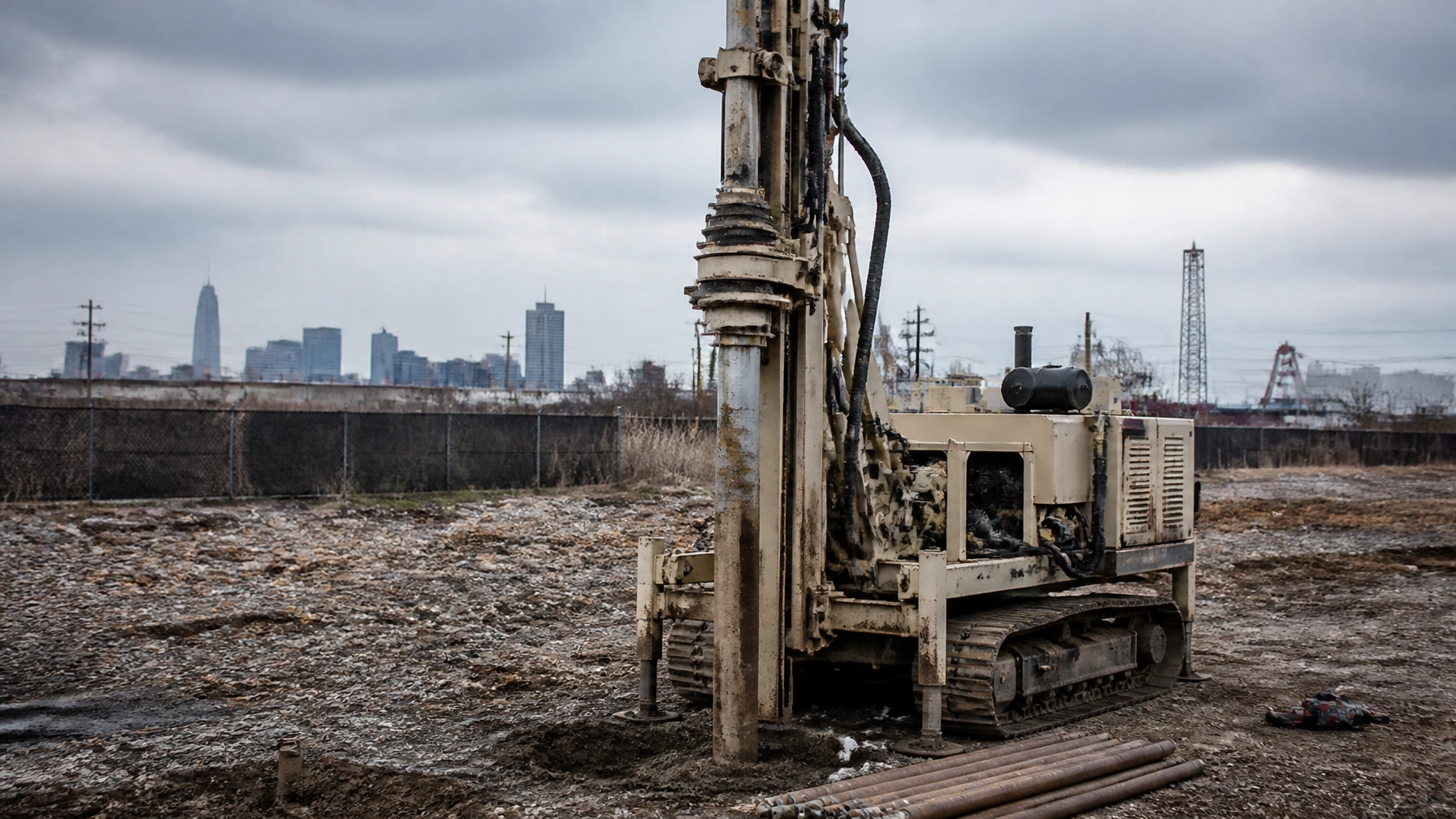
- The Delay: You have to re-mobilize a drill rig, re-sample the soil and groundwater, and wait weeks for lab results.
- The Cost: You’re paying for two mobilizations, two sets of lab fees, and carrying costs on a property that should have been cleared already.
Every week of delay incurs carrying costs and tests the patience of your lenders. At Envicon, we focus on regulatory compliance and permitting from the first day to ensure these "surprises" never happen.
Why These Compounds? (PFAS and Dioxins)
You might be wondering why the NJDEP is suddenly so focused on these five chemicals for every unknown AOC.
PFAS (PFNA, PFOA, PFOS, GenX): Often called "forever chemicals," these are incredibly stable in the environment and move easily through groundwater. Because they were used in everything from non-stick coatings to waterproof fabrics and firefighting foams, they are ubiquitous in urban and industrial areas like Northern New Jersey. NJDEP has established some of the strictest remediation standards in the country for these compounds.
2,3,7,8-TCDD (Dioxin): This is a byproduct of combustion and certain chemical manufacturing processes. It is highly toxic even at extremely low concentrations. In the densely developed corridors of NJ, historical incineration or unregulated dumping means Dioxins are a frequent "unknown" threat that the state is no longer willing to ignore.

The LSRP’s Obligation
It’s important to remember that your LSRP has a fiduciary duty to the state's environment, not just to your project. Under the new guidance, an LSRP must ensure that the remediation is protective based on all information.
If there is an unknown AOC, the LSRP is now regulatory-bound to include these compounds in the QA/QC plan. Hiring a firm that "misses" this isn't just a mistake; it's a liability. You need a team that sits at the table with NJDEP and understands the nuances of the LSRP program.
"Collaboration is not a buzzword: it's how we work. We don't just deliver services; we help transform underused and contaminated properties into thriving assets by staying ahead of the regulatory curve." : Jason Pancoast, CEO of Envicon Group.
The Envicon Edge: Moving Faster and Working Smarter
When you hire a large national firm, you often get a cookie-cutter approach designed for any market, applied to your NJ project. They might use a template from a project in Ohio that doesn't account for the specific intricacies of N.J.A.C. 7:26E.
At Envicon, we do things differently:
- Regional Fluency: We’ve spent 20 years working daily with the NJDEP and local officials. We know the reviewers by name, and we know exactly how they interpret these new rules.
- Direct Leadership: You won't talk to a partner at the pitch and then never see them again. You get hands-on coordination from the first call through project close.
- Proactive Tech: We use real-time project reporting dashboards that give you full visibility into your site's status. No waiting for a monthly PDF to find out your sampling plan was rejected.
- Precision and Speed: Our goal is to remove the obstacles between you and a buildable site. We produce documentation that holds up under scrutiny the first time.

Summary and Takeaways
The NJDEP's update to the Technical Requirements is a clear signal: the era of "standard" TCL/TAL sampling for unknown AOCs is over.
- Update Your Plans: Any new Site Investigation (SI) or Remedial Investigation (RI) must now account for PFNA, PFOA, PFOS, GenX, and 2,3,7,8-TCDD.
- Check Your LSRP: Ensure your LSRP is fully aware of the N.J.A.C. 7:26E-2.1 amendments and has updated your QA/QC plans accordingly.
- Avoid Re-mobilization: It is far cheaper to sample for these compounds during your initial mobilization than to go back and fix it later.
- Focus on Outcomes: Don't just settle for a report. You need a "cleared path" to redevelopment.
Don't let a missing analyte stall your next project. We specialize in turning complex, environmentally challenged sites into clean, buildable assets. Whether you're dealing with brownfield redevelopment or a high-stakes acquisition, we take full responsibility for the outcomes.
Ready to clear the path?
Explore our tools or reach out to our team to ensure your project stays on track.
- Cost estimator tool: Calculate your project's environmental costs
- Risk screener tool: Identify potential site liabilities early
- Learn more: Visit the Envicon Group homepage
Leave a Reply