Category: Industry Insight

  • NJDEP Proposes One-Year Extension of REAL Rules Legacy Period : What It Means for Your Project

    NJDEP Proposes One-Year Extension of REAL Rules Legacy Period : What It Means for Your Project

    For developers and property owners in New Jersey, the clock just got a little more time. On June 1, 2026, the New Jersey Department of Environmental Protection (NJDEP) filed a formal rulemaking proposal to extend the "legacy period" for the Resilient Environments and Landscapes (REAL) rules.

    Instead of the original deadline of July 20, 2026, the NJDEP is proposing to push that window out to July 20, 2027.

    This isn’t just a clerical change. It’s a vital breathing room for the New Jersey development community. If your project qualifies, you could still have your permit applications evaluated under the environmental land use regulations that were in effect prior to January 20, 2026. This allows you to bypass some of the most stringent new elevation and coastal inundation requirements: at least for now.

    At Envicon Group, we don’t just sell reports; we sell cleared paths. Understanding the nuances of this extension is the difference between a buildable site and a project stalled by regulatory red tape.

    What Are the REAL Rules?

    The REAL rules represent a fundamental shift in how New Jersey handles coastal and flood hazard development. Triggered by the increasing frequency of extreme weather and rising sea levels, these rules amended several key areas, including the Coastal Zone Management, Freshwater Wetlands, Stormwater Management, and Flood Hazard Area Control Act rules.

    There are two major technical hurdles that the REAL rules introduced:

    • The 4-Foot Elevation Mandate: The rules generally require new habitable buildings to be elevated at least 4 feet above the FEMA Base Flood Elevation (BFE). This is known as the Climate Adjusted Flood Elevation (CAFE).
    • Inundation Risk Zones (IRZ): These are areas mapped to show where daily tidal flooding is expected in the future due to sea-level rise. Development in these zones is significantly restricted, with an emphasis on making ground floors "floodable" rather than habitable.

    According to the official NJDEP filing, the proposed extension gives the industry more time to align with these rigorous standards.

    "Integrity is not just ethical behavior: it is about delivering the truth and never cutting corners. In the context of REAL, that means being honest about the technical challenges of your site before you commit capital." : Jason Pancoast, CEO, Envicon Group.

    The One-Year Extension: Why It Matters

    The legacy period is the "grandfathering" window. If you submit a qualifying, administratively and technically complete permit application by the deadline, your project is reviewed under the old rules.

    By proposing to extend this from July 20, 2026, to July 20, 2027, the NJDEP is acknowledging the complexity of the transition. For a developer in Jersey City, Hoboken, or the Jersey Shore, this extra year can save millions in construction costs related to foundation design, pile driving, and lost floor-area ratio (FAR) due to increased elevation.
    Active remediation and brownfield site in New Jersey

    Key Dates to Track:

    • June 1, 2026: Rulemaking proposal published.
    • July 7, 2026: Virtual public hearing (at 6:00 p.m.).
    • July 31, 2026: End of the 60-day public comment period.
    • July 20, 2027: The proposed new deadline for legacy applications.

    How to Qualify for the Legacy Window

    It isn't enough to just "apply." To secure your spot under the pre-REAL standards, your application must be:

    1. Eligible: This applies to Individual Permits, General Permits, Verifications, and Letters of Interpretation (LOI).
    2. Complete: The application must be deemed both administratively and technically complete. This means all forms, site plans, and engineering reports are submitted correctly.
    3. Paid: All associated NJDEP fees must be paid in full before the cutoff.

    If your application is rejected for being incomplete after the deadline passes, you will likely be forced to redesign under the REAL standards. This is where most projects fail when using large, "black box" consulting firms. They submit a report to check a box, but they don't have the regional fluency to ensure it passes the reviewer’s desk on the first try.

    The Cost of Inaction: Why You Can’t Wait

    Every week of delay incurs carrying costs. If you miss the July 20, 2027 window, the impact on your project's pro forma is immediate:

    • Increased Construction Costs: Elevating a building an additional 4 feet requires significant structural changes and more expensive materials.
    • Lender Hesitation: Banks are becoming increasingly wary of projects in coastal inundation zones. A "legacy" permit provides certainty that a REAL-compliant design might not.
    • Market Timing: A redesign can push a project start back by 6 to 12 months, missing a key market cycle.
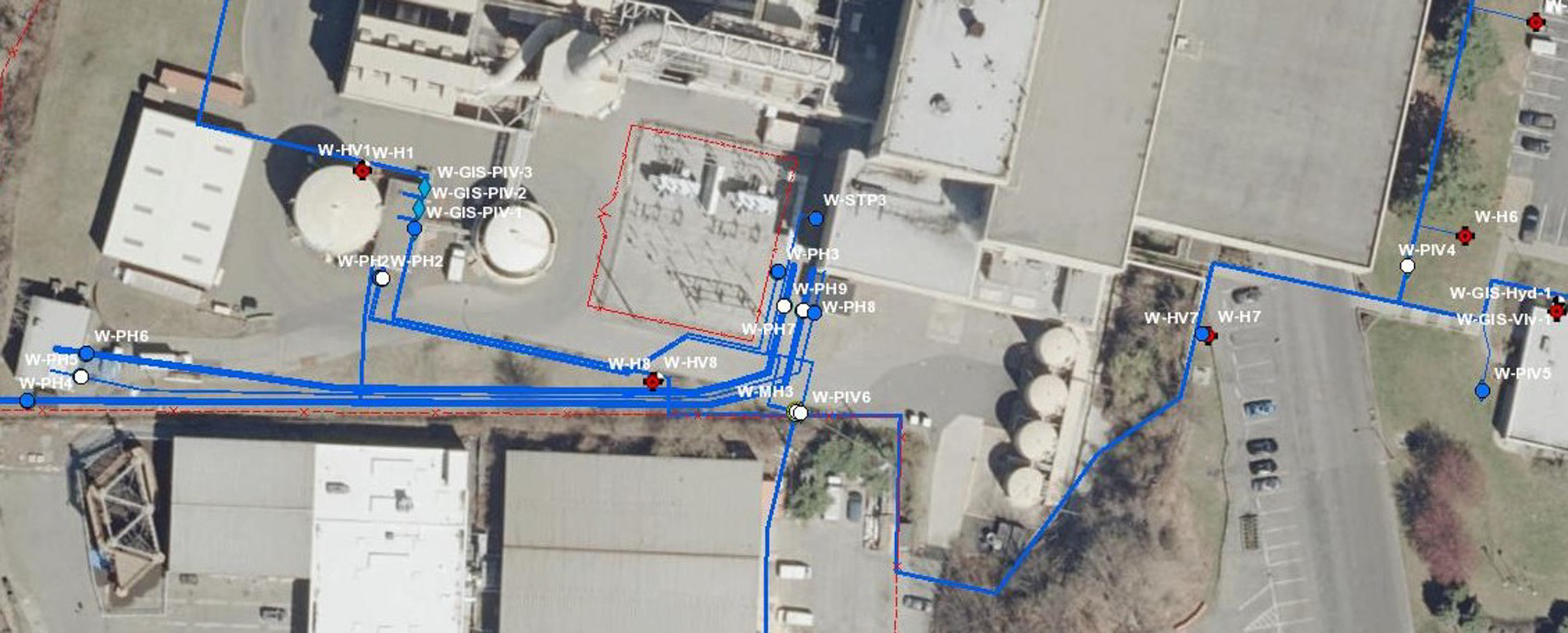
    Aerial utility infrastructure mapping for site development

    Envicon’s Approach: Why We Are Different

    When you hire a large national firm, you often talk to a partner during the pitch and never see them again. Your project gets handed to a junior staffer who is using a cookie-cutter playbook designed for any market, not specifically for the intricacies of the NJDEP reviewers.

    At Envicon Group, we bring 20 years of direct agency relationships. We don't just know the rules; we know the people who review them. We work directly with architects, attorneys, and local officials to ensure alignment. We use proprietary project management technology that gives our clients a real-time dashboard of their project's status. You’ll know exactly where your application stands in the queue.

    “Collaboration is not a buzzword: it's how we work. We don't just deliver services; we help transform underused and contaminated properties into thriving assets.”

    What Should Developers Do Now?

    Even with an extra year, the clock is ticking. The process of taking a site from due diligence to a complete permit application takes time: especially when soil and groundwater management or remedial design is involved.

    1. Audit Your Pipeline: Look at every site you have under contract or in planning. Determine which ones fall within the new CAFE or IRZ maps.
    2. Run a Risk Screen: Use tools like our Risk Screener to identify if your project is at risk of being sidelined by the REAL rules.
    3. Mobilize Early: Don't wait for the 2027 deadline to start your field investigations. Secure your Letter of Interpretation (LOI) or Flood Hazard Area (FHA) verification now.

    Proactive engineering professional at NJ waterfront site

    Summary: A Cleared Path Forward

    The NJDEP’s proposal to extend the REAL rules legacy period to July 20, 2027, is a significant win for the New Jersey real estate and construction industry. It provides a window to lock in existing standards and avoid the costly requirements of the new Climate Adjusted Flood Elevations.

    However, "grandfathering" is not a right: it is a race. To qualify, your application must be bulletproof.

    Takeaways:

    • Extension Date: Proposed for July 20, 2027.
    • The Stakes: Bypassing a 4-foot elevation increase and coastal inundation restrictions.
    • The Requirement: A technically and administratively complete application submitted and paid before the deadline.
    • The Solution: Partnering with a firm that prioritizes precision and direct regulatory coordination over bloated reports.

    We specialize in turning environmentally challenged sites into buildable assets. Whether you are dealing with a complex brownfield redevelopment or need a Stormwater Pollution Prevention Plan (SWPPP), we are here to ensure your project keeps moving.

    Completed modern residential development on a former brownfield


    Ready to Secure Your Project’s Future?

    Don't let your project get caught in the 2027 rush. Secure your legacy status today with a team that knows the NJDEP inside and out.

    Envicon Group Logo

  • Climate Impact Assessments in NY: Navigating the 2026 EAF Updates

    Climate Impact Assessments in NY: Navigating the 2026 EAF Updates

    If you’re a developer or project sponsor in New York, the regulatory landscape just shifted beneath your feet. As of June 12, 2026, the New York State Department of Environmental Conservation (NYSDEC) officially updated the model Environmental Assessment Forms (EAFs) used for SEQRA (State Environmental Quality Review Act) reviews.

    This isn’t just a minor administrative tweak. These updates represent the full integration of the Climate Leadership and Community Protection Act (CLCPA) into the daily due diligence process. If you’re still using the May 2026 versions of the Short or Full EAF, your submittal is already obsolete.

    At Envicon Group, we’ve been tracking these changes since they were first drafted. The new forms demand a level of technical specificity regarding climate resilience and air impact analysis that many "big-box" consulting firms aren’t prepared to handle without a significant: and costly: learning curve.

    The New Baseline: Why the EAF Changed

    The 2026 amendments focus on three pillars: Climate Resilience, Air Emissions, and Environmental Justice (EJ).

    New York’s mandate is clear: every state agency decision, including the issuance of permits or SEQR findings, must now be consistent with statewide Greenhouse Gas (GHG) emission limits. Specifically, Section 7(2) of the CLCPA requires agencies to consider if their actions will interfere with the state’s climate goals.

    The June 12 updates to the EAF provide the mechanism for agencies to gather the data they need to make those determinations. You are no longer just reporting if a project is in a flood zone; you are now required to demonstrate how your project will hold up in 2050’s climate and how its emissions profile affects the local community.

    Decoding the Climate Resilience Questions

    The updated EAFs: particularly the Full EAF used for Type I actions: now include detailed prompts regarding climate-related risks.

    "We don’t just deliver services: we help transform underused and contaminated properties into thriving assets."

    To do that under the new rules, your site investigation must look beyond the current property lines. The new questions ask:

    • Vulnerability to Extreme Weather: How will your project withstand increased frequency and intensity of flooding, storm surges, and extreme heat?
    • Design Resilience: What specific design features (e.g., elevated mechanicals, enhanced stormwater management, or permeable surfaces) are being incorporated to mitigate these risks?
    • GHG Emissions Footprint: For projects above certain thresholds, a quantitative assessment of Greenhouse Gas emissions is now a functional requirement for Part 1 of the EAF.

    If your consultant is just checking "No" on these boxes without a site-specific Civil and Site Engineering strategy, you’re inviting a "Positive Declaration" and a trip into the multi-year purgatory of an Environmental Impact Statement (EIS).

    Close-up of a modern air quality monitoring station on an urban development site, highlighting technical sensors and instrumentation.

    Air Impact Analysis: Beyond the Checkbox

    Air quality has always been part of SEQRA, but the 2026 updates turn up the heat on regulatory compliance and permitting.

    Under the new forms, project sponsors must explicitly identify all air emission sources. This includes not just the obvious ones, like boilers or industrial stacks, but also "co-pollutants" that often accompany GHG emissions.

    For projects requiring air permits, the NYSDEC is moving from informal dialogue to active enforcement of CLCPA conformity. This means your air impact analysis needs to be ready for the "Disadvantaged Communities" test.

    Disadvantaged Communities and Environmental Justice

    Section 7(3) of the CLCPA requires that agency decisions do not disproportionately burden disadvantaged communities. The June 12 EAF updates include new questions designed to flag EJ concerns immediately:

    1. Proximity Mapping: Is the project located within or adjacent to a DEC-identified Disadvantaged Community?
    2. Disproportionate Impact: Will the air emissions or traffic patterns from the project create a new burden or exacerbate an existing one in that community?

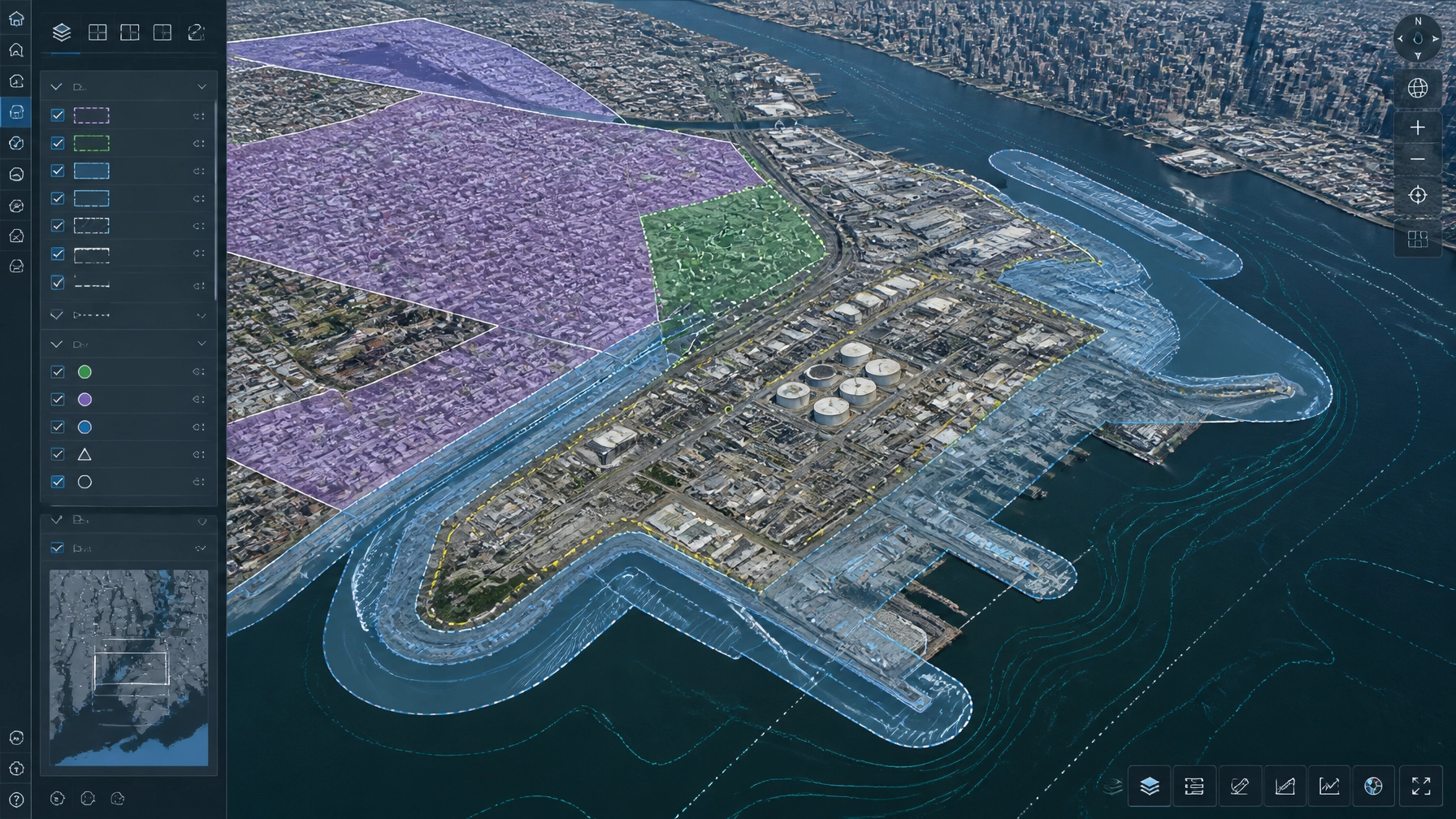
    Envicon uses proprietary GIS mapping and data dashboards to answer these questions with precision. We don't guess; we map your project against the latest state data to ensure your Brownfield Redevelopment Support is grounded in defensible facts.

    The Envicon Advantage: Speed, Precision, and Trust

    When you hire a large national firm to handle your EAF, you’re often paying for a "black box" process. You talk to a senior partner during the pitch, but your critical climate and air impact assessments are likely being drafted by a junior associate in a satellite office who has never set foot on your NYC or NJ site.

    At Envicon, we operate differently.

    • Regional Fluency: We’ve spent 20 years building relationships with the NYSDEC, NYC OER, and NJ DEP. We know the reviewers by name, and we know exactly what they are looking for in the new 2026 EAF climate sections.
    • Actionable Outcomes, Not Just Reports: Most consultants hand you a report and leave you to figure out what it means. We provide a cleared path. If the new EAF flags a climate risk, our Civil Engineering team is already designing the fix before the report is even finalized.
    • Transparent Technology: Our clients get real-time visibility into their project status. You’ll see the air monitoring data and the resilience mapping as we generate it, not weeks later in a bloated PDF.

    "Collaboration is not a buzzword: it's how we work."

    Practical Step-by-Step for Your Next Project

    If you are initiating a project in NY after the June 12, 2026 update, here is your roadmap:

    1. Verify the Form Version: Ensure your team is using the revised EAFs (Short or Full) updated specifically for the June 2026 amendments.
    2. Conduct an Early EJ Screen: Before you even file, map your project against the NYSDEC Disadvantaged Communities map. If you’re in a "red zone," your air impact analysis needs to be bulletproof.
    3. Quantify GHG Early: Don't wait for the agency to ask for it. Calculating your project’s greenhouse gas footprint early allows you to build in mitigation measures (like solar-ready roofs or high-efficiency HVAC) that prove CLCPA consistency.
    4. Update Your SWPPP: Climate resilience and stormwater are now linked in the EAF. Ensure your Stormwater Pollution Prevention Plan (SWPPP) accounts for the new 2026 intensity-duration-frequency (IDF) curves.

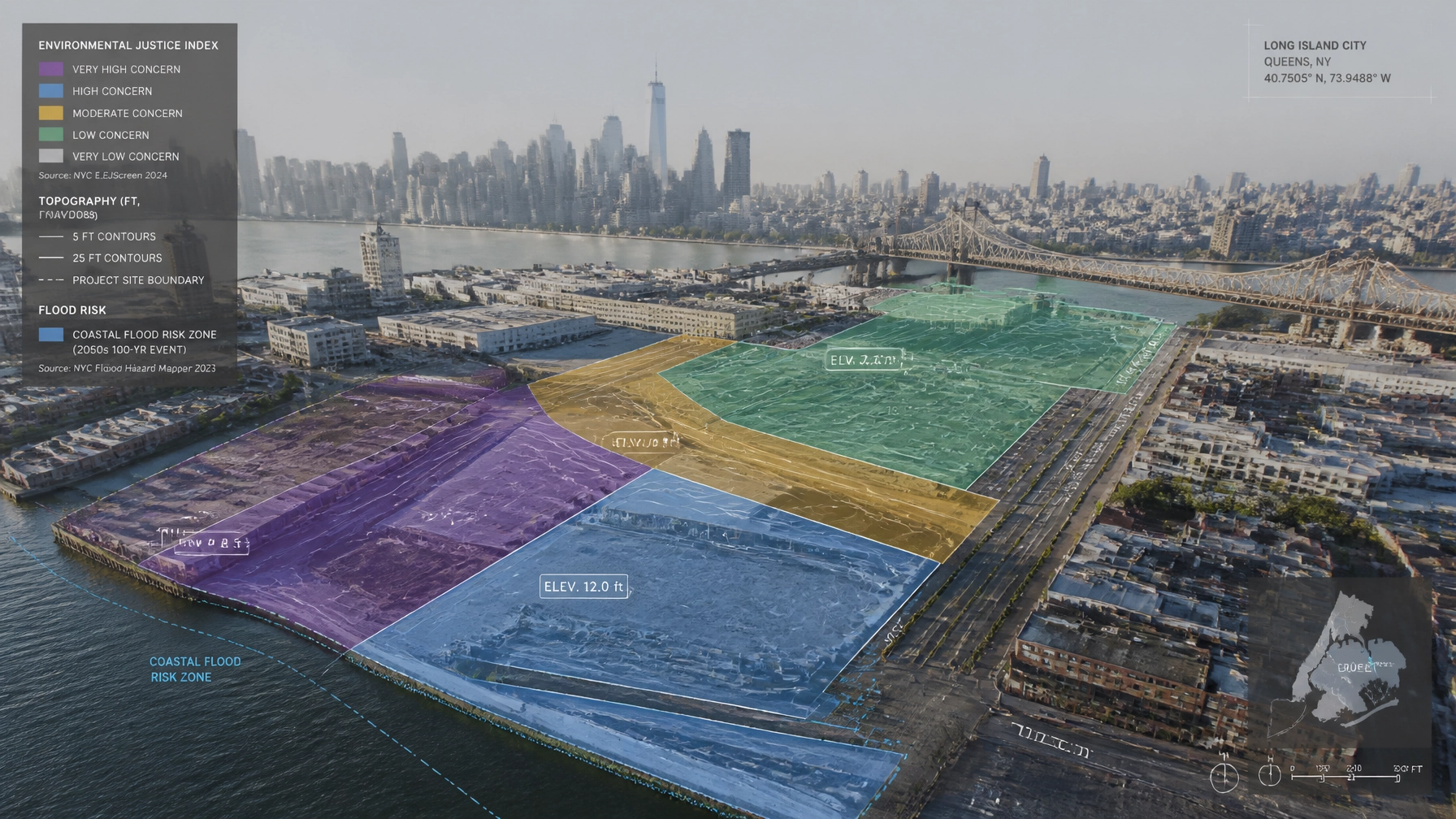
    Digital site assessment dashboard showing 3D climate resilience modeling and flood zone data for a Manhattan development.

    Summary: Don't Let Regulatory Change Stall Your Site

    The June 12, 2026, EAF updates are a signal that the NYSDEC is no longer treating climate and air impacts as "extra" considerations: they are now the core of the review.

    Every week your project sits in a reviewer's queue because of an incomplete climate assessment is a week of carrying costs and lost market timing. We specialize in turning these complex, environmentally challenged sites into buildable assets by navigating these exact hurdles with precision.

    Your project shouldn't be a test case for a junior consultant's first climate assessment.

    If you want a team that combines 20 years of field experience with the technology needed to master the 2026 EAF updates, contact Envicon Group today. We don't just sell reports; we sell cleared paths.

    Take the Next Step

    If your project is facing new climate review questions, don't wait until a regulator or lender flags the gap. Get clarity early and keep your site moving.

    Envicon Strategic Solutions logo - MAIN

  • Managing Disadvantaged Community Impacts: A Guide to the 2024 EJ Siting Law in NY

    Managing Disadvantaged Community Impacts: A Guide to the 2024 EJ Siting Law in NY

    The regulatory landscape for New York developers just shifted. If you’re operating in the five boroughs or across the state, the "check-the-box" approach to Environmental Justice (EJ) is officially dead.

    With the full implementation of the 2024 EJ Siting Law (S8830/A2103), environmental justice is no longer a peripheral consideration or a paragraph in a report, it is a gatekeeper for your project’s survival. The New York State Department of Environmental Conservation (NYSDEC) has updated its Environmental Assessment Forms (EAFs) to include aggressive proximity probes that can trigger mandatory burden reports and, in some cases, lead to outright permit denial.

    At Envicon, we don’t just deliver reports; we clear paths. This guide breaks down what you need to know about the new "Disadvantaged Community" (DAC) definitions and how to navigate the EAF proximity questions without stalling your schedule.

    The 2024 Regulatory Shift: From Disclosure to Denial

    For years, EJ was largely about public participation, ensuring the community was "informed." The 2024 law, which amends the Environmental Conservation Law (ECL) § 70-0118, changes the game.

    Now, for any project that is not classified as "minor," the NYSDEC is required to evaluate whether a proposed action will cause or increase a disproportionate pollution burden on a Disadvantaged Community.

    "No permit may be approved or renewed if it would cause or contribute, directly or indirectly, more than a de minimis amount of pollution to a disproportionate or inequitable burden on a DAC."

    This isn't just about air emissions or hazardous waste. It covers noise, odor, wastewater, and even traffic-related pollution. If your project is in or near a DAC, the burden of proof has shifted to you, the applicant.

    Defining the "Disadvantaged Community" (DAC)

    The state doesn't leave the definition of a DAC up for debate. Under the Climate Leadership and Community Protection Act (CLCPA), the Climate Justice Working Group has established specific criteria based on 45 environmental, health, and socioeconomic indicators.

    These include:

    • Environmental Burdens: Proximity to contaminated sites, wastewater treatment plants, and high-traffic corridors.
    • Public Health: Rates of asthma, heart disease, and low birth weight.
    • Socioeconomics: Household income levels, unemployment rates, and educational attainment.

    The result is a highly specific DAC Map that covers significant portions of NYC and industrial corridors in New Jersey-adjacent regions. If your site falls within these shaded zones, or even near them, your SEQR process just got more complex.

    Close-up of environmental soil sampling equipment and field logbook on an urban redevelopment site

    The EAF Proximity Probe: The Half-Mile Rule

    The NYSDEC has integrated this law directly into the State Environmental Quality Review (SEQR) process. The updated Environmental Assessment Forms now include a "proximity probe" that every developer needs to answer accurately:

    1. Is this project located within, or within a half-mile of, a disadvantaged community?
    2. If "No," could impacts from the project affect a disadvantaged community?

    A "Yes" to either of these triggers a requirement to identify every potential pollution impact: from soil management during construction to long-term operational emissions. Unlike a national firm that might rely on automated software to flag these, Envicon’s team uses a field-first approach. We know the regulators at the NYSDEC and NYC OER by name, and we understand how they interpret "de minimis" impacts in specific neighborhoods.

    Why Your Current Consultant Might Be a Liability

    Large national firms often apply a cookie-cutter playbook to NYC and NJ projects. They deliver bloated reports designed to protect the consultant, not to move your project forward. In the context of the EJ Siting Law, this defensive writing can be fatal.

    If your consultant is simply "checking the box" on the EAF without a deep understanding of the Existing Burden Report requirements, you risk:

    • Permit Denial: If the DEC determines the pollution increase is more than de minimis, they have the legal authority to deny your permit.
    • Schedule Creep: Re-sampling and re-modeling to address EJ concerns after a submittal has been rejected can add months to your timeline.
    • Lender Friction: Banks are increasingly sensitive to EJ risks. A flagged report can halt financing until a clear path to compliance is demonstrated.

    At Envicon, we provide strategic compliance and permitting that anticipates these hurdles. We don’t wait for the regulator to flag an issue; we identify the burden risks during due diligence and design mitigation strategies into the project from day one.

    Technical diagram of a subsurface remediation system including monitoring wells and soil strata

    Managing the Impact: A Practical Action Plan

    If your project triggers the DAC proximity probe, you need a technical partner who can speak the language of both the developer and the regulator. Here is how we manage EJ impacts:

    1. GIS-Led Site Characterization

    We use advanced GIS mapping to overlay your project footprint with the latest CLCPA DAC boundaries and existing pollution sources. This allows us to see what the regulator sees before the EAF is even filed.

    2. Tailored Mitigation Strategies

    If a project shows potential for disproportionate impact, we design targeted remedial strategies or civil engineering solutions: like advanced stormwater management or electrified construction equipment: to keep pollution increases below the de minimis threshold.

    3. Direct Agency Coordination

    Alignment is how projects get done. We work directly with architects, attorneys, and agency reviewers to ensure the EJ narrative in your EIS or EAF is technically sound and regulator-ready.

    4. Real-Time Transparency

    Through our digital project management infrastructure, you have full visibility into the status of your EJ assessments and regulatory submittals. You’re never in the dark about where your project stands.

    Professional urban redevelopment site in New Jersey showing environmental protection barriers and precision management

    Summary & Key Takeaways

    The 2024 EJ Siting Law is a major shift for development in New York. Success now requires more than technical engineering; it requires an "insider" understanding of how environmental justice criteria are applied in the field.

    • The Half-Mile Rule: Any project within 0.5 miles of a DAC triggers heightened scrutiny.
    • De Minimis is the Standard: Permits can be denied if the project adds any non-negligible pollution to an already burdened community.
    • Field-First Knowledge Wins: You need a firm that knows the NYC/NJ regulatory landscape daily, not a regional satellite office.

    Every week of delay is a week of carrying costs. Don't let your project sit in a queue while a junior staffer at a big-box firm figures out the new EAF questions.

    Envicon Group specializes in turning complex, environmentally challenged sites into clean, buildable assets. We bring 20 years of direct agency relationships and a technology-first approach to ensure your project stays on schedule and under budget.

    Ready to clear the path for your next project? Contact Envicon Group today for a direct consultation with our licensed professionals.

    Digital project management dashboard showing real-time environmental data and permit status

    Call to Action


    Envicon Strategic Solutions logo - MAIN

  • ASTM E1527-21: Why Skipping PFAS in Your Phase I is a Massive Risk

    ASTM E1527-21: Why Skipping PFAS in Your Phase I is a Massive Risk

    If you’re developing in the New York or New Jersey metro area, your due diligence process just got a lot more complicated. For years, the industry treated Per- and Polyfluoroalkyl Substances (PFAS): the so-called "forever chemicals": as an "emerging contaminant" that lived in the margins of a report. You’d see them listed as a "non-scope item," meaning they weren't technically required for a standard Phase I Environmental Site Assessment (ESA) under the old ASTM rules.

    That era is over.

    With the shift to the ASTM E1527-21 standard and recent EPA rulings, treating PFAS as an optional add-on isn't just a technical oversight: it’s a business-killing liability. At Envicon, we’ve seen projects stalled at the finish line because a lender flagged a "clean" Phase I that ignored the PFAS signal. We don't write reports to satisfy a checklist; we write them to clear your path to a buildable site.

    The "Non-Scope" Trap

    Under the federal standard, a Phase I ESA is designed to satisfy "All Appropriate Inquiries" (AAI) to protect you from CERCLA liability. Historically, the scope of that search was limited to substances defined as "hazardous" under CERCLA.

    Until very recently, PFAS didn't make that list.

    In ASTM E1527-21, PFAS were explicitly categorized as "non-scope items." This created a dangerous loophole. Large, national consulting firms: the ones that sell reports by the thousand: often stick strictly to the "scope." If it isn't required by the ASTM template, they don't look for it. They deliver a report that says you’ve met the AAI requirement, while completely ignoring a contaminant that could cost millions to remediate.

    For a developer, this is the "Non-Scope Trap." You get a report that protects your legal defense under CERCLA, but does absolutely nothing to protect your balance sheet from the reality of contaminated soil and groundwater.

    The April 2024 Pivot: PFOA and PFOS are Now In-Scope

    The landscape shifted significantly on April 19, 2024. The EPA officially designated two specific PFAS compounds: PFOA and PFOS: as hazardous substances under CERCLA.

    What does this mean for your Phase I?

    • Mandatory Inclusion: Because ASTM E1527-21 pulls its scope directly from the CERCLA list, PFOA and PFOS are no longer "optional." They must be evaluated as part of your Recognized Environmental Condition (REC) analysis.
    • AAI Compliance: If your consultant delivers a Phase I today that ignores these compounds, that report may not satisfy AAI. You are potentially losing your federal liability protections before you even break ground.
    • The Rest of the "Family": While PFOA and PFOS are now "in-scope," there are thousands of other PFAS compounds (like PFNA or GenX) that remain technically "non-scope." This is where the risk lives.

    If your consultant is only checking the two mandatory boxes and ignoring the rest of the PFAS family, they are handing you a half-finished puzzle.

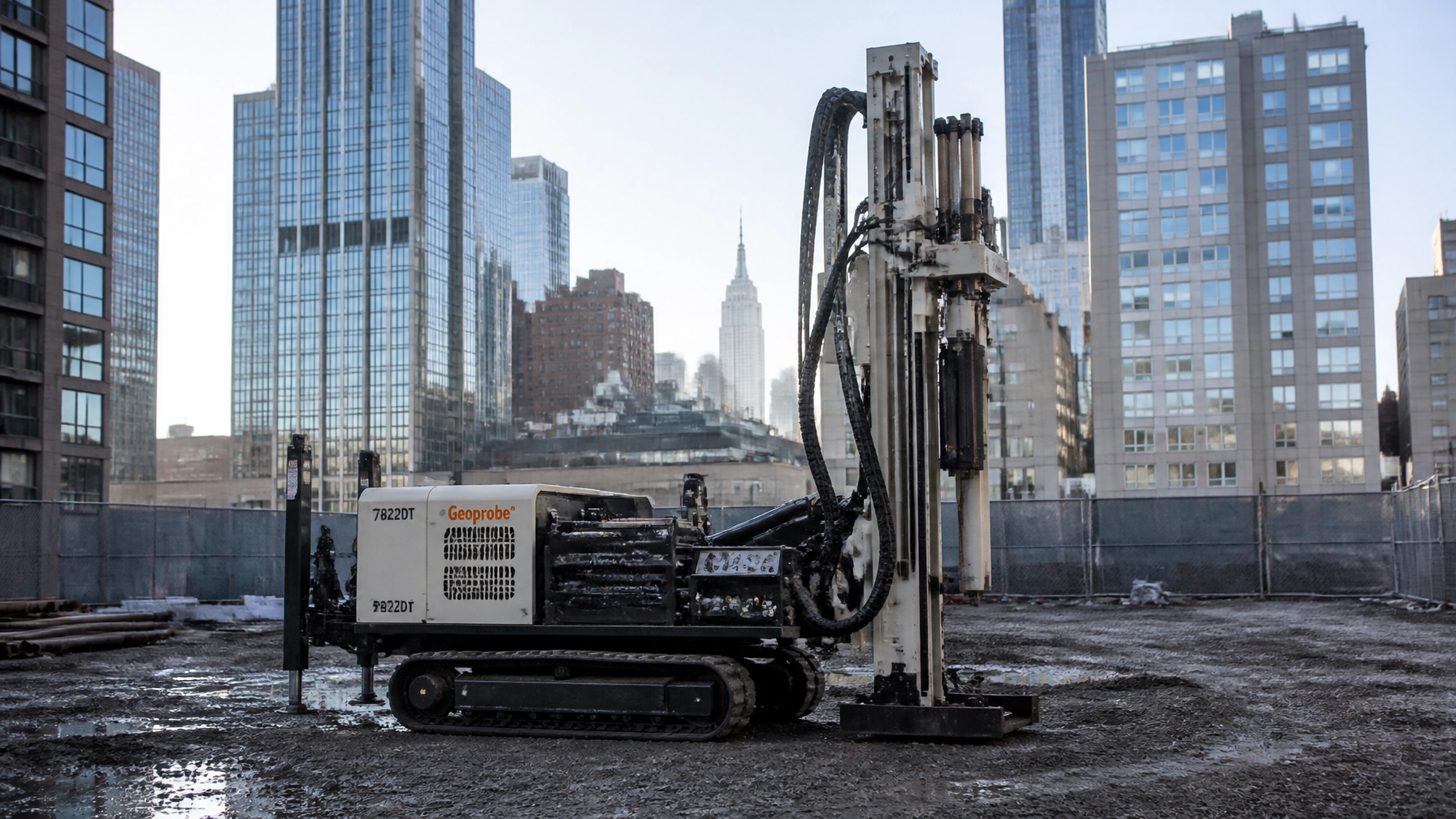
    Technical drilling rig for soil characterization

    Why "Technically Non-Scope" Still Matters in NJ and NY

    Regional fluency is where Envicon separates itself from the "Big-Box" firms. If you are working in New Jersey or New York, the federal CERCLA definition is only half the story.

    New Jersey: The LSRP Reality

    In New Jersey, the NJDEP LSRP program is significantly more aggressive than federal standards. The NJDEP has already established strict groundwater quality standards for PFOA, PFOS, and PFNA. If you have a site in Jersey City or Newark, "non-scope" is a meaningless term. If it’s in the soil or water, you are responsible for it.

    New York: The OER and DEC Pressure

    In New York City, the OER and NYSDEC have integrated PFAS sampling into nearly every remedial program. Whether you are in the Brownfield Cleanup Program (BCP) or dealing with an "E-Designation," you will be testing for PFAS.

    An ASTM report that excludes PFAS because they aren't "hazardous substances" under federal law yet is a report written for a market that doesn't exist in the Tri-State area.

    The Lender’s Perspective: Why They Care More Than the EPA

    Even if you are willing to take the regulatory risk, your lender likely isn't. Major financial institutions have updated their internal risk assessments faster than the ASTM standards.

    We are increasingly seeing lenders reject Phase I reports that don't include a robust PFAS evaluation. They recognize that PFAS remediation is expensive, complex, and politically sensitive. They don't want to hold a mortgage on a site that has a "forever chemical" plume migrating toward a municipal well.

    "Every week of delay incurs carrying costs and reduces lender patience. A rejected submittal because of an incomplete PFAS assessment isn't just a technical error: it's a financial failure." : Jason Pancoast, CEO, Envicon Group

    The Real-World Risk: What You're Actually Skipping

    When a consultant "skips" PFAS, they aren't just leaving out a few lines of text. They are failing to evaluate:

    1. Historical Industrial Use: Metal plating, textile manufacturing, and even commercial printing often utilized PFAS.
    2. Fire-Fighting Foams (AFFF): If your site is near a former gas station, airport, or industrial facility that had a fire, there is a high probability of PFAS presence.
    3. Adjacency Risks: PFAS are highly mobile in groundwater. A "clean" site can be contaminated by a neighbor a mile away.

    Industrial granular activated carbon water treatment system for PFAS remediation

    Envicon’s Resolution: We Don’t Sell Reports, We Sell Cleared Paths

    At Envicon, we don't treat PFAS as a "non-scope" afterthought. We treat it as a fundamental part of the Site Development Playbook.

    When you hire a large national firm, you get a junior staffer using a template that hasn't been updated since 2021. When you hire Envicon, you get hands-on leadership that understands the NJ/NY regulatory landscape.

    Our approach to PFAS in Phase I is simple:

    • Forensic History: We don't just look at EDR reports. We look at the actual manufacturing processes that happened on your site over the last 50 years.
    • Direct Agency Coordination: We know the reviewers at the NYC OER and NJDEP. We know what they are looking for before they ask for it.
    • Proactive Strategy: If we see a PFAS risk, we don't just flag a REC and walk away. We provide a clear path forward: estimated sampling costs, potential remedial strategies, and a timeline for closure.

    Summary: The Takeaway for Developers

    Ignoring PFAS in your Phase I because it’s "technically non-scope" is like ignoring a foundation crack because it’s not in the architectural rendering. It’s there, it’s a problem, and it will cost more to fix later.

    • PFOA and PFOS are now mandatory in Phase I ESAs.
    • Lenders and State Regulators (NJDEP/NYSDEC) expect a full evaluation of all PFAS compounds, not just the mandatory ones.
    • Big-Box firms often hide behind ASTM templates to avoid the technical work of a real assessment.
    • Envicon provides certainty. We leverage 20 years of local experience and real-time project dashboards to ensure your due diligence holds up under scrutiny.

    Don't let an "emerging contaminant" stall your project. Let's get the work done right the first time.

    Are you sitting on a potential PFAS liability?
    Contact Envicon Group today to review your existing Phase I or to scope your next acquisition with precision.


    Envicon Strategic Solutions logo - MAIN

  • The Technical Truth: Why Big Firms Fear Specificity

    The Technical Truth: Why Big Firms Fear Specificity

    If you’ve spent any time in the New York or New Jersey development world, you know the "Big Firm" pitch. They show up with a glossy deck, a partner you’ll never see again, and a promise of "unmatched resources." But three months into your project, that "unmatched resource" feels like a black box. You’re getting bloated, 500-page reports that are 90% boilerplate and 10% defensive posturing.

    At Envicon Group, we call this the "Specificity Gap." Large national firms fear specificity because specificity requires accountability. It requires an engineer to stand on your site at 7:00 AM, look a regulator in the eye, and say, "This is the path forward."

    When you hire a technical environmental consulting firm in NYC, you don't need a report that protects the consultant; you need a cleared path that protects your project.

    The "Defensive Writing" Trap

    The biggest problem with the "Big Box" approach to environmental consulting is defensive writing. When a junior staffer at a 10,000-employee firm writes your remedial investigation report (RIR), their primary goal isn't to get your site built: it's to ensure their firm can’t be sued.

    This results in "fishing expedition" sampling plans and vague recommendations that leave you, the developer, in a state of perpetual "further investigation." Every week your project sits in someone’s queue is a week of carrying costs, lender fatigue, and missed market timing.

    We don’t sell reports. We sell cleared paths. Whether it’s navigating a complex NYC OER VCP enrollment or managing NJDEP historic fill issues, our technical depth allows us to be precise where others are vague.

    3D technical visualization of soil strata and groundwater plumes for site characterization

    NYC OER VCP Enrollment: Beyond the Paperwork

    Enrolling in the NYC Office of Environmental Remediation (OER) Voluntary Cleanup Program (VCP) is often presented as a simple administrative hurdle. But any developer who has been through it knows the devil is in the technical details.

    An NYC OER VCP enrollment consultant needs to do more than just fill out a form. They need to anticipate the agency’s technical reviewer. If your remedial investigation work plan for NYC OER VCP is generic, you’re looking at months of back-and-forth comments.

    Envicon’s advantage is regional fluency. We sit at the table with the OER, NYSDEC, and NYC Parks daily. We know the reviewers by name, and we know exactly what data they need to see to sign off on a Remedial Action Work Plan (RAWP). This isn't just about "speed": it's about technical precision that eliminates the "re-mobilization, re-sampling, re-billing" cycle that plagues large-firm projects.

    High-Resolution Site Characterization (HRSC) vs. The "Dig and Haul"

    Many consultants default to the most expensive solution: "dig and haul." It’s easy for them, but it’s a budget killer for you.

    As a soil and groundwater remediation consultant in NYC, we utilize high-resolution site characterization (HRSC). By using advanced field tools like Membrane Interface Probes (MIP) or targeted 3D plume modeling, we can surgically identify the source of contamination. Instead of excavating an entire block, we pinpoint the 20% that actually needs to move.

    This level of technical environmental consulting in NYC is the difference between a $100,000 remediation bill and a $1,000,000 one.

    Close-up of technical environmental sampling equipment on a professional site plan

    The NJ Landscape: ISRA and the LSRP

    Across the river, the stakes are just as high. If you’re dealing with NJDEP site remediation program requirements, you need an environmental engineer for NJ ISRA compliance who understands that the Site Remediation Reform Act (SRRA) was designed to put the power back in the hands of the Licensed Site Remediation Professional (LSRP): and by extension, the client.

    Large firms often treat the LSRP as an internal auditor rather than a project lead. At Envicon, your LSRP environmental consultant in New Jersey is the person answering your call. We don’t hide behind "corporate technical committees." We use our 20 years of agency relationships to make informed, technical decisions that move your project toward a Response Action Outcome (RAO) without the typical administrative lag.

    Tech-Enabled Transparency: The Envicon Dashboard

    The "Monthly PDF" is dead. In a high-stakes development environment, waiting 30 days to see your field data is unacceptable.

    We’ve built a proprietary project management infrastructure that gives our clients real-time visibility. Our project dashboards provide:

    • Live field activity tracking: Know exactly where the drill rig is and what they’re finding.
    • Budget vs. Actuals: No more $500k "disposal surprises" at the end of the month.
    • Regulatory Milestone Status: See where your NYC OER VCP application or NJDEP permit sits in the process at any given moment.

    Transparency changes the dynamic. It forces us to be right, and it allows you to make decisions with confidence.

    Real-time project dashboard displayed on a tablet at a construction site

    Why "Boutique" is the New "Premium"

    The industry is shifting. Developers are tired of paying premium rates for junior-staff execution. They want the person who wrote the report to be the same person who knows their lender’s requirements and the regulator’s expectations.

    "Collaboration is not a buzzword: it's how we work." : Jason Pancoast, CEO of Envicon Group

    We focus on the technical truths that others gloss over. Whether it's managing PFAS investigation and remediation in New Jersey or designing a vapor intrusion mitigation system (VIMS) for a high-rise in Long Island City, we lead with technical depth, not corporate volume.

    Summary of the Envicon Advantage:

    • Direct Access: You talk to the PEs and LSRPs, not a call center.
    • Regional Fluency: 20 years of direct NYC/NJ agency relationships.
    • Precision Data: HRSC and 3D modeling to minimize excavation and disposal costs.
    • Real-Time Dashboards: Full transparency into your project’s health and schedule.

    The path to a buildable site isn't found in a boilerplate report. It's found in the technical specifics.

    Ready to clear the path for your next project? At Envicon Group, we don’t just deliver reports: we deliver outcomes. Contact us today to discuss your site’s specific challenges.

    Envicon Strategic Solutions logo - MAIN

  • NY’s New Environmental Justice Siting Law: How SEQRA Significance is Changing in 2026

    NY’s New Environmental Justice Siting Law: How SEQRA Significance is Changing in 2026

    For decades, the State Environmental Quality Review Act (SEQRA) was largely a "check-the-box" procedural hurdle for many developers in New York. You filled out your Environmental Assessment Form (EAF), addressed the obvious impacts like traffic and noise, and: if your consultant knew what they were doing: you walked away with a Negative Declaration.

    That era ended on June 12, 2026.

    With the official implementation of the New York Environmental Justice Siting Law (EJSL) amendments, the threshold for what constitutes a "significant adverse impact" has fundamentally shifted. If your project is in or near a Disadvantaged Community (DAC), the path to a Negative Declaration just became significantly narrower.

    The New Baseline: "Disproportionate Pollution Burden"

    The June 2026 amendments to 6 NYCRR Part 617 have operationalized a concept that was previously high-level policy: the Disproportionate Pollution Burden.

    Agencies are now legally mandated to evaluate whether a proposed action may cause or increase this burden on a DAC. This isn’t a suggestion; it’s a requirement for every determination of significance. If the lead agency finds that your project may add even a marginal amount of pollution to a community already carrying a heavy environmental load, the law now points directly toward a mandatory Environmental Impact Statement (EIS).

    In the past, you might have argued that your project’s individual emissions were negligible. Under the new rules, that argument fails. The review now looks at cumulative impacts. It’s no longer about what you are adding in isolation; it’s about what the community is already enduring.

    The Death of the Negative Declaration in DACs

    For any site located within or within a half-mile of a DAC (as defined by the NYS Climate Justice Working Group), the "Negative Declaration" is effectively on life support.

    The amended regulations explicitly state that a project may trigger an EIS if it increases disproportionate pollution burdens. Because many urban areas in New York City and Northern New Jersey are already classified as DACs due to historical industrial use and socioeconomic factors, almost any mid-to-large-scale redevelopment will now face intense scrutiny at the EAF stage.

    Modern air monitoring and sampling equipment set up on an urban construction site in New York

    The New Model EAF: Air and Climate Take Center Stage

    The Model EAFs (both Short and Full) have been overhauled to capture data that many consultants aren't used to providing at the early stages of a project.

    1. Granular Air Emissions Data

    The new forms align closely with NYSDEC air permitting requirements. You are now asked to disclose potential new or increased air emissions within a DAC before you’ve even finished your preliminary design. This includes not just permanent stack emissions, but construction-related dust and long-term traffic-related exhaust.

    2. Physical Climate Risk

    Following the Community Risk and Resiliency Act (CRRA), the EAF now includes explicit questions about future physical climate risks. You must document how your project will handle:

    • 100-year and 500-year flood events.
    • Projected sea-level rise over the life of the asset.
    • Ecological changes associated with a warming climate.

    If your consultant hands you an EAF that glosses over these points with "To be determined," your project will likely be stalled by a savvy regulator or an environmental attorney looking for a reason to challenge your permit.

    The Business Impact: Carrying Costs and Lender Patience

    In our world, time is the most expensive line item. Every week your project sits in a reviewer's queue because of an incomplete DAC analysis, your carry costs mount.

    Lenders are already flagging these new SEQRA requirements. They want to know: before they close on the construction loan: that your environmental clearance is "bulletproof." A rejected submittal or a late-stage move from a Negative Declaration to an EIS can blow a hole in your pro forma and destroy your market timing.

    Digital monitor displaying 3D geospatial analysis of flood risk and disadvantaged community boundaries on a New Jersey site

    Why the "Big Box" Firms Will Fail You Here

    Large national firms typically use a cookie-cutter playbook for SEQRA. They have junior staff in remote offices filling out these EAFs based on templates. They write "defensive" reports designed to protect the consultant from liability rather than move your project forward.

    But the 2026 amendments require regional fluency. You need an engineer who knows the NYSDEC or NYC OER reviewer by name: someone who knows how that specific reviewer interprets "disproportionate burden."

    At Envicon, we don't just deliver a report and wish you luck. We take ownership of the outcome. We’ve built proprietary technology: including our own real-time GIS mapping dashboards: that allows us to screen your site against DAC criteria and air quality data before you even sign a contract.

    We see the obstacles before they become delays.

    The Envicon Resolution

    We believe in doing the work right and standing behind our word. To navigate the June 2026 SEQRA amendments, you need a partner who:

    • Performs early-stage DAC screening using the Disadvantaged Community Assessment Tool (DACAT) during due diligence.
    • Integrates air and climate modeling directly into the Phase II Site Investigation rather than treating it as an afterthought.
    • Coordinates directly with regulators (NYSDEC, OER, NJ DEP) to align on the scope of the EJ analysis before the formal submittal.

    Aerial view of an active urban remediation site with precision excavation and soil staging areas

    Summary & Takeaway

    • The Law is Active: As of June 12, 2026, all new SEQRA reviews must address disproportionate pollution burdens in DACs.
    • Mandatory EIS: If your project may increase environmental stress in a DAC, expect a full Environmental Impact Statement.
    • EAF Overhaul: Air quality and physical climate risks (flooding, sea level rise) are now front-end requirements, not late-stage studies.
    • Strategic Risk: Relying on generic consultants for these high-stakes urban sites is a recipe for delay and litigation.

    "We don’t sell reports. We sell cleared paths." If you’re looking at a site in New York or New Jersey and the new EJ Siting Law has you concerned, let’s talk. We’ll look at the data together and find the most direct route to a buildable, compliant asset.

    Ready to Navigate the New SEQRA?

    1. Read more on the blog homepage: Latest Environmental Insights
    2. Call now for a project review: (917) 764-2171
    3. Get a preliminary budget: Cost Estimator Tool

    Envicon Group Logo

  • Complying with the 2025 NYC Energy Conservation Code: What Owners Need to Know in 2026

    Complying with the 2025 NYC Energy Conservation Code: What Owners Need to Know in 2026

    March 30, 2026, changed the compliance baseline for NYC development projects. The New York City Department of Buildings began enforcing the 2025 New York City Energy Conservation Code (2025 NYCECC) and the 2025 NYC ASHRAE 90.1 standard for applicable job filings on that date.

    For owners, the change is not limited to insulation values or equipment efficiency. The 2025 code places greater responsibility on the project team to prove that the building envelope, HVAC systems, documentation, and commissioning process perform as designed.

    The practical message is simple: energy compliance must be managed during design and construction: not assembled at the end of the project.

    Which NYC energy code applies to your project?

    The filing date and completeness of the energy submission determine which code applies.

    According to the NYC Department of Buildings Energy Conservation Code page:

    • Completed applications filed on or before March 29, 2026 may continue under the 2020 NYCECC.
    • Applications filed on or after March 30, 2026 must comply with the 2025 NYCECC or the applicable 2025 NYC ASHRAE 90.1 path.
    • Incomplete filings submitted before March 30, 2026, may be required to comply with the 2025 code.
    • A material compliance change after the enforcement date may also trigger review under the 2025 NYCECC.

    That distinction matters for acquisitions, phased filings, core-and-shell projects, tenant build-outs, and developments with long approval timelines. A filing strategy based on the old code can create redesign, resubmittal, procurement, and scheduling problems if the energy analysis is incomplete or the scope changes.

    The governing framework is established through Local Law 47 of 2026, the 2025 Energy Conservation Construction Code of New York State, and NYC-specific amendments.

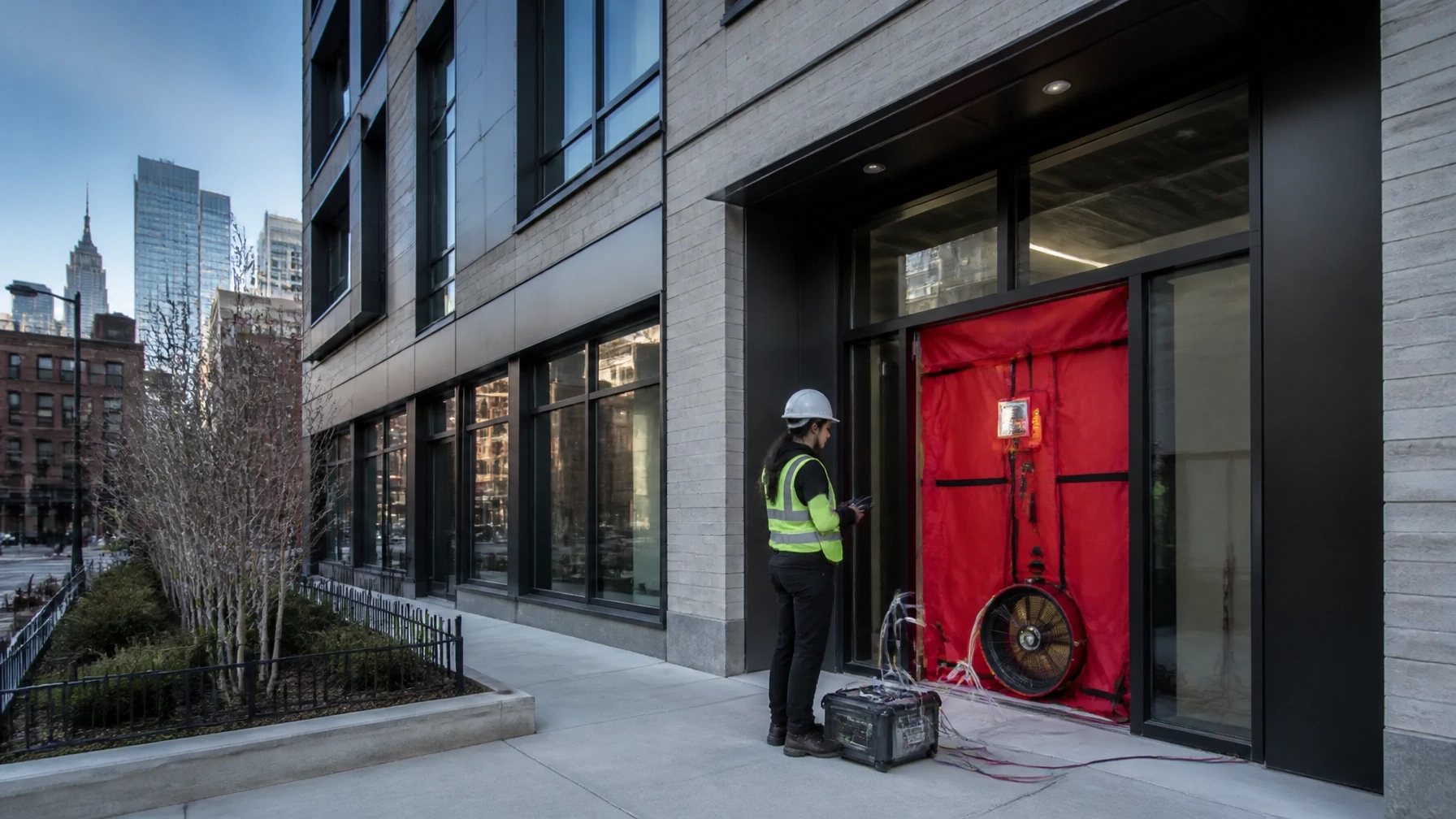
    Airtightness is now a tested performance requirement

    The 2025 NYCECC requires owners to treat the building envelope as a complete system. Walls, roofs, slabs, windows, doors, penetrations, parapets, vestibules, loading docks, and mechanical openings all contribute to the building’s air-leakage performance.

    For commercial buildings, Section C402.6.2 establishes a maximum measured air-leakage rate of:

    0.35 cubic feet per minute per square foot of building thermal envelope area at 75 Pa, or 0.3 inches water gauge.

    The test must cover the whole building thermal envelope, including above- and below-grade areas. Testing must be performed by an approved third party using an accepted method, including:

    • ASTM E779
    • ASTM E1827
    • ASTM E3158
    • Another approved equivalent method

    The test uses multiple pressure points, with results averaged from both pressurization and depressurization. The report must identify the tested envelope area, building volume, number of stories, and measured leakage rates.

    For buildings larger than 50,000 square feet, a guarded test under ASTM E3158 may be permitted. However, that does not mean the owner can test only a convenient portion of the project. Critical areas still need to be included, such as:

    • Stories with conditioned space directly beneath a roof
    • Building entrances
    • Loading docks
    • Floors over unconditioned space
    • Below-grade areas
    • Representative portions of at least 25% of remaining above-grade wall area

    The DOB Building Envelope How-To Guide summarizes the testing protocols, envelope documentation requirements, and air-barrier details.

    Design the air barrier before construction starts

    A failed airtightness test is rarely caused by one dramatic defect. It usually results from dozens of small gaps at transitions and penetrations.

    The 2025 NYCECC requires construction documents to identify:

    • The air-barrier material and location within each assembly
    • The continuous air-barrier plane
    • Wall-to-roof and wall-to-floor transitions
    • Parapets and copings
    • Foundation interfaces
    • Window and door frames
    • Mechanical, electrical, and structural penetrations
    • Changes between different air-barrier materials
    • Sealing methods, including caulking, taping, gasketing, or approved adhesives

    For commercial buildings and additions of 10,000 gross square feet or more, Section C408.4 also requires air-barrier commissioning and substantial-completion documentation before final inspection.

    That means the air barrier must remain accessible for inspection and repair. Covering it before inspection removes the opportunity to correct defects at the lowest cost.

    Owners should require the architect, envelope consultant, general contractor, and testing agency to coordinate the following before mobilization:

    1. Air-barrier responsibility matrix
    2. Mock-up or preconstruction review
    3. Inspection schedule
    4. Critical joint and penetration checklist
    5. Preliminary testing or smoke-tracing strategy
    6. Corrective-action process
    7. Final testing and reporting schedule

    This is where field-level oversight matters. A report prepared after the walls are closed does not help the project.

    Field engineer inspecting sealed HVAC ductwork during a leakage test

    Mandatory duct leakage testing: residential and commercial requirements

    Building-envelope testing and duct leakage testing are separate obligations. Owners should not treat one as a substitute for the other.

    Residential duct systems

    Under the residential provisions, duct systems must be tested for total air leakage where required by Section R403.3.7 and related provisions.

    Testing is performed at 0.1 inches water gauge, or 25 Pa, and includes leakage from both supply and return ductwork. Accepted test standards include:

    • ANSI/RESNET/ICC 380
    • ASTM E1554

    The maximum allowable leakage depends on factors such as:

    • Conditioned floor area served
    • Number of ducted returns
    • Whether the ducts are inside or outside conditioned space
    • Whether the test occurs at rough-in or post-construction

    A signed written test report must be available to the Authority Having Jurisdiction. Multifamily projects may use approved sampling procedures, but a failed sample can expand the required testing scope.

    The DOB Mechanical Systems How-To Guide identifies limited exceptions, including certain standalone ventilation ducts and very short duct runs located entirely within conditioned space.

    Commercial duct systems

    Commercial projects face a different structure. The 2025 NYCECC requires duct and air-handler sealing, proper insulation, and documentation of duct pressure classifications.

    Duct leakage testing becomes especially important for:

    • High-pressure duct systems
    • Ducts operating above 3 inches water gauge
    • Ductwork located outside the conditioned envelope
    • Alterations that relocate or expand significant portions of a duct system
    • Systems subject to specific progress-inspection requirements

    High-pressure commercial systems should be tested under the SMACNA HVAC Air Duct Leakage Test Manual requirements when applicable. The project specifications should state the test pressure, test sections, allowable leakage class, responsible testing party, and documentation requirements.

    Do not wait for the mechanical contractor to interpret this in the field. The requirement should appear in the drawings and specifications before bidding.

    COMcheck and REScheck: use the NYC-specific compliance path

    The 2025 NYCECC permits several energy-analysis approaches, but the software configuration must match the selected code path.

    REScheck for residential projects

    For residential projects using REScheck:

    • Use the 2025 New York City version.
    • Do not use the generic IECC version for an NYC filing.
    • Submit the full report.
    • Include building envelope, HVAC, and service water heating information.
    • Make sure the report matches the construction drawings and equipment schedules.

    A REScheck report that passes numerically but uses the wrong jurisdiction setting is not a reliable compliance document.

    COMcheck for commercial projects

    For commercial projects using COMcheck:

    • Select the 2025 NYCECC version when following the Energy Conservation Code.
    • Use the 2025 NYC ASHRAE 90.1 version when following that standard.
    • Confirm that the report matches the selected compliance path.
    • Coordinate envelope, lighting, HVAC, and service water heating inputs with the architectural and engineering drawings.
    • Include trade-offs only where the selected code path allows them.

    The 2025 code also makes coordination of envelope data more important. For example, commercial projects must track wall and fenestration areas carefully. Under the prescriptive ECC path, vertical fenestration is generally limited to 30% of gross above-grade wall area, with an increase to 40% when the required daylighting and daylight-responsive controls are provided.

    Window schedules should identify the whole-assembly U-factor, SHGC, visible transmittance where applicable, air-leakage rating, manufacturer, and model. The values in the schedule must match the values used in COMcheck.

    The same rule applies to HVAC equipment. Capacity, fuel type, efficiency, controls, and model information shown on the mechanical drawings must align with the energy analysis. The DOB supporting documentation guide specifically emphasizes consistency between construction drawings, equipment schedules, and compliance reports.

    Energy compliance coordination with envelope drawings, HVAC plans, and performance data

    Owner’s 2026 compliance checklist

    Before your project reaches permit submission or construction, confirm the following:

    • The applicable code is documented based on filing status and project scope.
    • The selected energy path is identified on the drawings.
    • NYC-specific COMcheck or REScheck software is being used.
    • Envelope assemblies, areas, U-factors, R-values, SHGC values, and thermal bridges are coordinated.
    • Air-barrier locations and transitions are detailed.
    • Third-party envelope testing is included in the project schedule and budget.
    • Duct leakage testing requirements are identified for residential and applicable commercial systems.
    • Mechanical equipment schedules match the energy-analysis inputs.
    • Air-barrier and mechanical commissioning responsibilities are assigned.
    • Testing reports, corrective actions, commissioning documents, and the envelope certificate are included in the closeout plan.

    Why owners use a field-first compliance team

    Energy-code compliance is not only a modeling exercise. It is a project-delivery issue.

    A large consultant may deliver a compliant-looking report and leave the architect, contractor, or owner to reconcile field conditions. That approach creates gaps between design intent, procurement, installation, testing, and sign-off.

    At Envicon Group, we coordinate the work across the project team. Our environmental, civil, engineering, and construction-oversight professionals work directly with owners, architects, contractors, attorneys, and regulators. We use real-time reporting and digital project controls so you can see what is complete, what is at risk, and what requires a decision.

    “We don’t sell reports. We sell cleared paths.”

    That means identifying the compliance risk early, assigning responsibility, verifying work in the field, and resolving problems before they become inspection failures or schedule delays.

    The takeaway

    The 2025 NYCECC is already in effect for applicable NYC filings. In 2026, owners should expect more testing, more documentation, and less tolerance for disconnects between drawings and construction.

    The most reliable strategy is to:

    1. Select the correct code and compliance path.
    2. Build airtightness and duct testing into the specifications.
    3. Coordinate COMcheck or REScheck with the actual design.
    4. Inspect critical work before it is concealed.
    5. Treat commissioning and closeout as part of project delivery: not paperwork at the end.

    A compliant building is not created by a software report alone. It is designed, installed, tested, documented, and verified.

    Start your 2025 NYCECC compliance review

    Modern NYC multifamily building representing completed energy-code coordination and commissioning

    Envicon Group logo

  • The NYC OER Soil Management Plan: Your Shield Against Disposal Violations

    The NYC OER Soil Management Plan: Your Shield Against Disposal Violations

    In New York City, dirt is never just dirt. If you’re developing a site with an E-Designation or a Restrictive Declaration, every yard of soil you move is a potential regulatory minefield. The "dirt police": a loose coordination between the NYC Office of Environmental Remediation (OER), the NYSDEC, and the DOB: are not looking for "good faith efforts." They are looking for documented compliance.

    If you treat your NYC OER Soil Management Plan (SMP) as a report to be filed and forgotten, you are inviting stop-work orders, $50,000+ fines, and catastrophic delays to your Certificate of Occupancy. At Envicon, we don’t sell you a PDF to sit on a shelf. We provide the operational roadmap that keeps your project moving and your site compliant.

    What is a Soil Management Plan (SMP)?

    An SMP is not a suggestion; it is a legally binding operational rulebook. When OER grants a Notice of Satisfaction or a Remedial Closure Report (RCR), it often comes with the requirement to manage residual contamination under an SMP.

    This document dictates exactly how soil must be screened, stockpiled, tested, and transported. It defines the "Engineering Controls": like vapor barriers or composite cover systems: that must remain intact for the life of the building. Failing to follow the SMP isn't just a technicality; it’s a breach of the recorded covenant on your property.

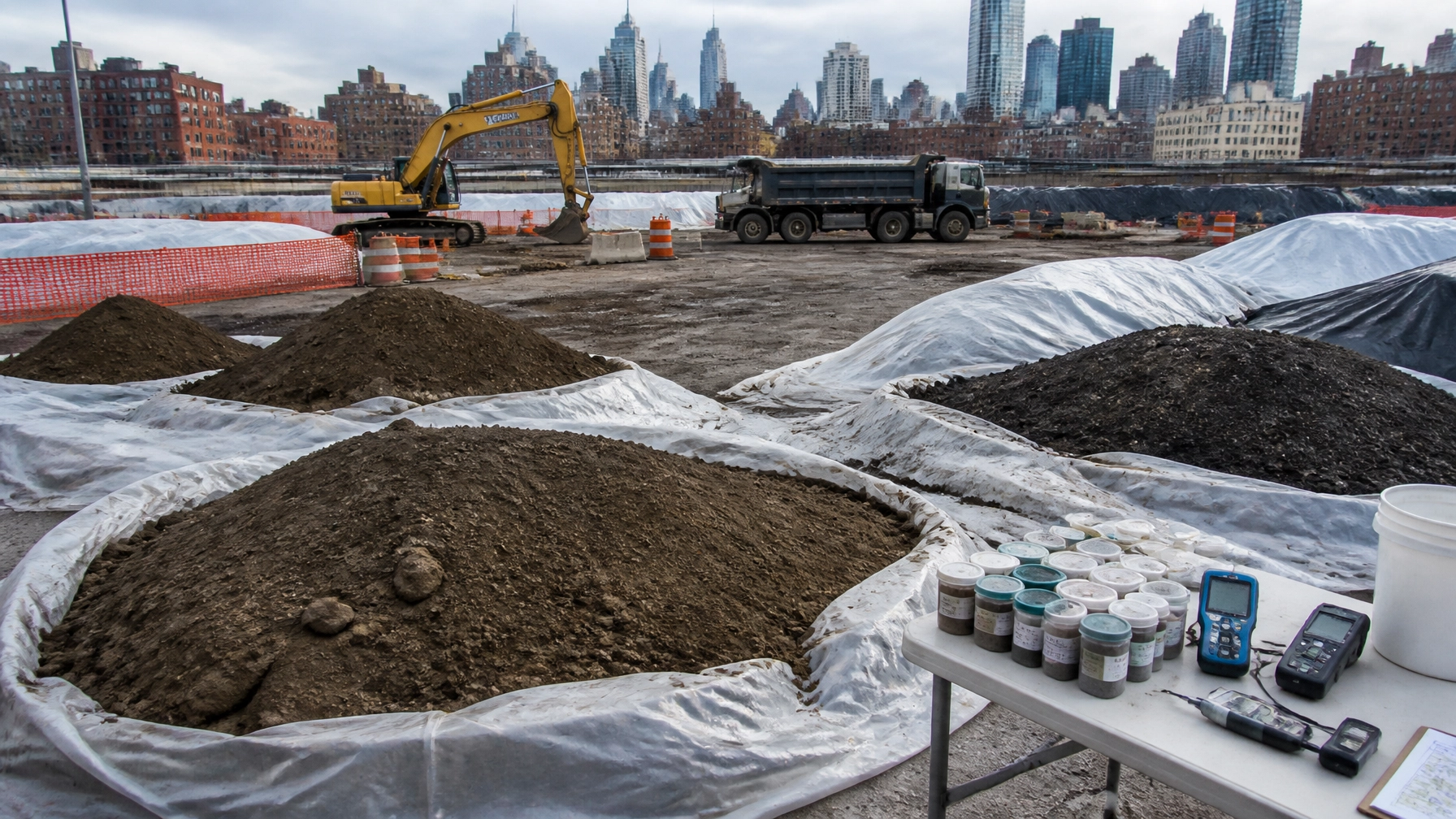
    Technical soil management compliance scene with truck manifests, disposal documentation, sample jars, and stockpile controls at an urban remediation site

    The NYC OER Soil Management Plan Compliance Checklist

    To stay ahead of the "dirt police," your site team needs a tactical checklist that translates the 50-page SMP into daily field actions. If your current consultant isn't giving you this level of specificity, you’re paying for a report that won’t protect you in the field.

    1. Pre-Excavation Prerequisites

    • Approval Status: Has the OER approved the Remedial Action Plan (RAP) and the specific SMP? You cannot break ground without a Notice to Proceed.
    • Waste Characterization: Have you performed "in-situ" sampling? Big-box firms often wait until soil is stockpiled, which doubles your handling costs. We sample while the dirt is still in the ground to get facility approvals before the first shovel hits.
    • Facility Acceptance: Do you have written approval letters from the receiving landfill or recycling center?

    2. On-Site Handling & Field Screening

    • Field Screening: A qualified environmental professional (QEP) must be on-site to screen soil with a Photoionization Detector (PID) and visual/olfactory checks.
    • Stockpile Management: Are stockpiles on poly-sheeting (20-mil minimum)? Are they covered at the end of the day?
    • Segregation: Never mix "clean" soil with "impacted" soil. One bucket of contaminated fill dumped into a clean pile can turn a $15/ton disposal into a $90/ton nightmare.

    3. Dust, Odor, and Vapor Control

    • Air Monitoring: Is your Community Air Monitoring Program (CAMP) active? Real-time particulate monitoring isn't just for OER; it’s your primary defense against neighbor complaints that trigger DOB inspections.
    • Suppression: Do you have a dedicated water source for dust suppression? In NYC, "we'll get a hose later" is a fast track to a violation.

    4. Transportation and Disposal Documentation

    • Licensed Haulers: Are your trucks carrying Part 364 permits?
    • Manifests: Every single load must have a non-hazardous or hazardous waste manifest.
    • Weight Tickets: You need a 1-to-1 match between your manifests and the facility weight tickets. Missing one ticket can stall an OER closure for months.

    Active remediation at an urban redevelopment site showing soil handling and environmental containment measures

    Avoiding the "Dirt Police" and Costly Violations

    The most common reason for an NYC project to stall at the 11th hour is "missing documentation." When you apply for your Certificate of Occupancy, OER reviews the Remedial Closure Report. If you can’t prove where 200 tons of soil went, or if your end-point samples weren’t taken at the correct frequency, OER will not sign off.

    The Envicon Difference: Large national firms treat this as a "clerical task" handled by junior staff. At Envicon, we treat documentation as a high-stakes engineering deliverable. We use real-time project reporting dashboards that track every manifest, every sample result, and every truck in real-time. You don’t have to wait for a monthly PDF to know if you're in compliance; you can see it on your phone at 7:00 AM.

    Dirt is Money: The Clean Soil Bank Opportunity

    Not all soil leaving an NYC site is "waste." The NYC Clean Soil Bank is a massive, underutilized resource that can save developers hundreds of thousands in disposal fees. If your soil meets the "Clean Fill" criteria (typically TAGM 4046 or unrestricted SCOs), it can be transferred to other NYC capital projects or public works.

    However, the window to qualify for the Clean Soil Bank is narrow. It requires early coordination with OER and rigorous testing protocols. Most "big-box" consultants won't bother with the paperwork because it’s easier for them to just tell you to ship it to a landfill in Pennsylvania. We look for the path that protects your budget, not the path of least resistance for the consultant.

    Excavator performing soil investigations and site preparation at a remediation site

    Why Experience Matters in the 5-Boroughs

    NYC OER reviewers are specialists. They know the history of every block in Long Island City, the Bronx, and Brooklyn. If you submit a cookie-cutter SMP designed for a site in Ohio, they will flag it immediately.

    Envicon brings 20 years of direct agency relationships. We don’t sit in a queue; we sit at the table. We know what the reviewers expect because we work with them daily. When a field challenge arises: like hitting an abandoned UST that wasn't on the maps: we don't wait three days to "consult with the partner." We solve it on the spot, coordinate with OER, and keep the machines moving.

    Summary of Key Takeaways:

    • The SMP is Law: It is a legally binding document that stays with the property.
    • In-Situ Sampling is Essential: Characterizing soil before excavation saves time and money.
    • Documentation is the Product: Without manifests and weight tickets, you don't have a buildable site.
    • Technology Beats Paper: Real-time tracking prevents 11th-hour delays for your Certificate of Occupancy.

    Take Control of Your Site

    Stop paying for bloated reports that leave you vulnerable to field violations. You need a partner who understands that a "cleared path" is more valuable than a "defensive report."

    Whether you’re dealing with an active E-Designation or preparing for a Phase II Site Investigation, Envicon Group is built to move at the speed of New York development.

    Contact Envicon Group today to review your Soil Management Plan and ensure your project stays on schedule and under budget.

    Envicon Strategic Solutions logo - MAIN

  • The Data Advantage: Why Our Real-Time Dashboards Beat Your Consultant’s Monthly PDF

    Look, we’ve all been there. It’s the middle of the month, your lender is breathing down your neck for a status update on the remediation, and you’re staring at a PDF report that was sent three weeks ago. That report is a static snapshot of a site that doesn’t exist anymore. The soil has been moved, the groundwater has shifted, and your carrying costs are ticking up every hour you spend waiting for the "next update."

    In the high-stakes world of New York and New Jersey real estate development, relying on a monthly PDF is like trying to navigate the Holland Tunnel using a paper map from 1985. It’s slow, it’s outdated, and it’s defensive. Most national firms write those reports to protect themselves, not to move your project forward.

    At Envicon Group, we’ve ditched the "black box" consulting model. We believe that if you’re paying for the data, you should see the data, in real time. By leveraging advanced environmental project management technology, we’ve built a proprietary infrastructure that gives our clients real-time project reporting dashboards. This isn't just a shiny toy; it’s a fundamental shift in how remediation and civil engineering are executed.

    The "Monthly PDF" Trap: Why Your Consultant is Hiding Behind Paper

    When you hire a massive, national consulting firm, you’re usually paying for a partner to sell you the job and a junior staffer to actually do the work. The "Monthly Report" is their primary shield. It allows them to batch their errors, hide their delays, and present a curated version of reality that suits their internal billing cycle.

    Here’s what’s actually happening during that 30-day gap:

    • Data Lag: Field data collected on the 2nd of the month doesn't reach your inbox until the 30th. If a sample came back high, you’ve lost four weeks of reaction time.
    • Defensive Writing: Reports are often bloated with jargon designed to CYA (Cover Your Assets, well, their assets, actually).
    • The Communication Void: You don't know who is talking to the NJDEP or NYC OER reviewers, or what was actually said. You’re just told "it’s in progress."

    At Envicon, we don't sell reports. We sell cleared paths. That means giving you a direct line of sight into the field activity, the lab results, and the regulatory milestones as they happen.

    A 3D visualization of a subsurface groundwater plume model displayed on a sleek, industrial digital screen. The image shows technical data points, flow vectors, and contaminant concentration heat maps. The lighting is natural and professional, emphasizing precision engineering.

    Engineering with Live Data: How We Use Our Tech Stack

    Our real-time project reporting dashboards are more than just a list of tasks. They are integrated command centers for complex sites. Whether we are managing a Phase II Environmental Site Assessment or a multi-year remedial design, our tech stack changes the game.

    1. High-Frequency Monitoring & Telemetry

    For projects involving Vapor Intrusion (VI) or groundwater remediation, we don't just wait for quarterly lab results. We deploy field sensors equipped with real-time telemetry. If a sub-slab depressurization system (SSDS) loses pressure or a groundwater pump fails, our dashboard flags it instantly. We know before you do, and we’re likely already on-site fixing it before it becomes a regulatory violation or a safety hazard.

    2. Live Soil Management and Tracking

    On NYC sites under OER or DEC oversight, soil management is the biggest "surprise" cost. We use environmental project management technology to track every yard of soil from the bucket to the facility. Our clients can log in and see exactly how much "Historic Fill" has been exported versus "Clean Soil," providing an up-to-the-minute look at their disposal budget. This level of remediation project tracking and real-time reporting in New Jersey and New York prevents the $500k "disposal surprise" at the end of a project.

    3. Integrated GIS and Site Modeling

    We don't just hand you a 2D map. Our dashboards feature interactive GIS layers. You can toggle between soil boring locations, groundwater contours, and utility layouts. This spatial clarity is vital when coordinating with architects and structural engineers. It ensures that everyone is working off the same "single source of truth."

    Regional Fluency: Mapping NYC OER and NJDEP Milestones

    One of the biggest frustrations with "big-box" firms is that their project management software is built for generic offices, not for the specific hurdles of Hudson County or the Five Boroughs.

    Our systems are purpose-built for this market. We’ve integrated specific NYC environmental compliance project tracking modules that mirror the OER Voluntary Cleanup Program (VCP) milestones.

    • Notice to Proceed (NTP) Tracking: We track the lead-up to your NTP with granular detail, so you know exactly which reviewer has your Remedial Action Work Plan (RAWP) and what the outstanding comments are.
    • NJDEP LSRP Milestones: For our Jersey projects, our NJ environmental project management and reporting software tracks the mandatory timeframes for NJDEP LSRP submittals. You’ll never miss a biennial certification because your consultant "forgot" it was due.

    A high-tech environmental monitoring well cap with an integrated digital sensor. A glowing blue data stream radiates from the sensor, indicating a live connection to a cloud-based dashboard. The background is a crisp, professional construction site in New York.

    Avoiding the $500k "Surprise": The Business Impact of Speed

    Transparency isn't just a "feel-good" metric. It has a direct impact on your IRR. Every week of delay on a high-value development project incurs massive carrying costs.

    "Collaboration is not a buzzword: it's how we work. By opening up our data to the entire project team: developers, attorneys, and GCs: we remove the friction that usually stalls these projects." – Jason Pancoast, CEO.

    Think about a typical brownfield redevelopment environmental reporting dashboard in NY. If a localized spill is discovered during excavation, a traditional consultant might take a week to sample, two weeks for lab results, and another week to write the report. By that time, your excavator has demobilized and you're paying for idle equipment.

    With Envicon’s tech-enabled approach:

    1. Instant Capture: Our field engineer logs the discovery on a tablet.
    2. Rapid Lab Integration: We use labs with direct API links to our dashboard. Results pop up as soon as they are validated.
    3. Real-Time Review: Our PE reviews the data in the dashboard and updates the soil management plan within hours, not weeks.
    4. Action: The path is cleared before the next morning’s shift starts.

    Envicon vs. The "National" Firms: Why the Big Guys Can't Do This

    Large firms are built on billable hours and administrative layers. They have no incentive to show you their raw data because it would reveal the inefficiencies of their process. They want you to wait for the report because the report is the product.

    At Envicon, the outcome is the product. We are a family-owned, 20-year firm that is PE-led and field-first. We sit at the table with the regulators: OER, NYSDEC, NJ DEP: and we use our data to advocate for your project.

    Feature Large National Firm Envicon Group
    Data Visibility Monthly PDF (Static) Real-Time Dashboard (Live)
    Reporting Style Defensive & Bloated Clean, Action-Oriented & Technical
    Tech Stack Generic Office Software Custom-Built Env/Engineering Platform
    Communication Black Box Coordination Direct Access to Principals & Data
    Decision Speed Slow (Report-Based) Urgent (Data-Driven)

    Summary: Control Your Data, Control Your Project

    If your current consultant is treating your project like a secret, it’s time to ask why. In the modern regulatory environment of New York and New Jersey, you can’t afford to be in the dark.

    environmental consulting services with real-time dashboards in NJ and NY are no longer a luxury; they are a project requirement. By integrating environmental project management technology into every phase of our work, we ensure that your site is buildable, compliant, and moving forward.

    We don’t just deliver services; we help transform underused and contaminated properties into thriving assets. And we do it with the precision and speed that only a technology-first firm can provide.

    A sleek, professional tablet mounted on a modern tripod at a construction site overlooking the New Jersey skyline. The tablet screen displays a live, interactive GIS map with green 'on-track' status indicators and real-time sensor data overlays. Minimalist and authoritative.

    Ready to clear the path for your next project? At Envicon Group, we don’t just deliver reports: we deliver outcomes. Contact us today to discuss your site’s specific challenges.

    Envicon Strategic Solutions logo - MAIN

  • Living with the Past: NJDEP Historic Fill Material Remediation Requirements

    If you are developing in Jersey City, Newark, Paterson, or any of New Jersey’s legacy urban centers, you aren’t just building on soil: you are building on history. For over a century, New Jersey’s shoreline and wetlands were expanded using "historic fill": a heterogeneous mix of ash, cinders, brick, block, and dredging spoils.

    While this material once literally built the state, the New Jersey Department of Environmental Protection (NJDEP) views it as a "discharge." Under N.J.A.C. 7:26E (the "Tech Rules"), this means it must be remediated. However, for a developer, "remediation" doesn't necessarily mean "removal."

    Navigating NJDEP historic fill material remediation requirements is a balancing act between regulatory compliance and project pro-forma. If handled by a firm that treats your project like a cookie-cutter template, you’ll end up with a bloated sampling budget. If handled by a field-first firm like Envicon, you get a cleared path to a Response Action Outcome (RAO).

    What Qualifies as Historic Fill?

    The NJDEP defines historic fill as non-indigenous material, generally deposited before October 1976, used to raise the topographic elevation of a site. It typically contains large quantities of ash, coal, cinders, and construction debris.

    Crucially, historic fill is NOT process waste. If your "fill" contains chromate chemical production waste, ore processing slag, or hazardous industrial byproducts, the NJDEP reclassifies it as a separate Area of Concern (AOC). These do not get the same "presumptive remedy" benefits as historic fill and can trigger significantly more expensive excavation requirements. This is why the initial Preliminary Assessment and Site Investigation is the most critical phase of your project.

    The Strategy: To Sample or to Assume?

    When a Site Investigation (SI) confirms the presence of historic fill, developers face a strategic fork in the road under N.J.A.C. 7:26E-3.12.

    1. The "Assume Contamination" Path (The Pro Move)

    NJDEP rules allow you to bypass expensive analytical characterization of the fill itself. You can simply assume the material exceeds Residential Direct Contact Soil Remediation Standards (RDCSRS) and that groundwater is impacted.

    • Why do this? It saves thousands in lab fees and weeks of schedule. If you know the fill is staying on-site under a cap, why pay to prove it’s dirty? You move straight to delineating the extent of the fill rather than its chemistry.
    • The Catch: You must still investigate any specific AOCs (like former USTs or floor drains) within the fill footprint independently.

    2. The "Sample and Evaluate" Path

    If you believe your fill might actually meet residential standards: perhaps it’s mostly clean silty sand: you can sample it.

    • The Risk: If you sample and find even one exceedance of Polycyclic Aromatic Hydrocarbons (PAHs) or Lead (extremely common in NJ fill), you are back to square one, but with a lighter wallet.

    High-resolution inline technical image of a historical industrial site map overlaid with modern investigation grid points, boring locations, and remediation boundary annotations for an urban New Jersey brownfield parcel.

    The Presumptive Remedy: Engineering and Institutional Controls

    New Jersey law (specifically the Brownfield Act) provides a "rebuttable presumption" that you do not have to remove historic fill. Instead, the standard remediation is to leave it in place and "manage" it. This involves a three-pronged approach:

    1. Engineering Controls (The Cap)

    You must prevent humans from touching the contaminated fill. In an urban redevelopment, your project is often its own remedy.

    • Building Slabs: The footprint of your new building serves as a perfect cap.
    • Pavement: Asphalt or concrete parking lots and sidewalks are approved engineering controls.
    • Clean Fill/Landscaping: In "green" areas, NJDEP typically requires 12 to 24 inches of certified clean fill over an orange poly-marker "warning barrier" to prevent future utility workers from accidentally digging into the historic fill.

    2. Institutional Controls (The Deed Notice)

    Since you are leaving contamination on-site, the public must be notified. A Deed Notice is recorded with the County Clerk, describing the location of the fill and the requirements to maintain the cap. This stays with the property title forever (or until the fill is removed).

    3. Ground Water Classification Exception Area (CEA)

    Historic fill almost always impacts groundwater, usually with metals or PAHs. Instead of active pumping and treating, NJDEP allows for a CEA. This is a "paper" restriction that designates the groundwater under your site as non-potable for a specific duration. For historic fill, the CEA is typically set to the property boundary, making the process significantly simpler than a traditional chemical plume investigation.

    Why Your Choice of Consultant Matters

    At many national firms, historic fill is treated with a defensive, "check-the-box" mentality. They’ll send a junior staffer to the field, write a 400-page report that protects their liability more than your project, and then hand you a massive bill for "regulatory coordination."

    Envicon does it differently:

    • Direct LSRP Access: You don't talk to a project manager who talks to a Licensed Site Remediation Professional (LSRP). You talk to the person signing the forms. Our NJDEP LSRP Guide outlines how we cut through the bureaucracy.
    • Field-First Engineering: We look at your civil grading plans while designing the remediation. If we can use the existing site soils to balance the site under a cap, we save you six figures in disposal costs.
    • Regulatory Fluency: We know the reviewers at NJDEP by name. We don't guess what they want; we know their technical preferences, which prevents the dreaded "Notice of Intent to Deny" on your permit applications.

    A technical diagram-style visual of a remediation cap cross-section. It shows a modern building slab on top, followed by a layer of clean soil, an orange mesh warning barrier, and finally the historic fill material below. The image is clean, sharp, and uses professional engineering graphics.

    The Post-Remediation Reality: Permits and Monitoring

    Once the remedy is in place and your LSRP issues the RAO, the work isn't entirely over. You will need a Soil Remedial Action Permit (SRAP). This permit requires:

    1. Biennial Certifications: Every two years, a professional must inspect the cap (check for cracks in the pavement, holes in the lawn) and certify to the NJDEP that the remedy is still protective.
    2. Financial Assurance: For most private developers, the NJDEP requires a stand-by trust or letter of credit to ensure funds are available to maintain the cap in perpetuity.

    Managing these Compliance & Permit requirements is where most projects fail long-term. Envicon’s digital solutions provide real-time dashboards so you never miss a biennial filing or a permit renewal.

    Summary: Turning Legacy Land into Assets

    Historic fill doesn't have to be a project-killer. In fact, for many developers, it’s a predictable hurdle that can be managed with the right strategy.

    • Confirm early: Use a Preliminary Assessment to define if your fill is truly "historic" or if you have a more complex "waste" issue.
    • Assume and Delineate: Don't waste money sampling what you're going to cap anyway.
    • Integrate the Remedy: Make your building and parking lots do double-duty as your engineering controls.
    • Plan for the SRAP: Factor the long-term monitoring costs into your project pro-forma.

    "In NJ urban redevelopment, you aren't just managing soil; you're managing a regulatory timeline. If your consultant isn't thinking about the Remedial Action Permit during the first week of due diligence, they're already behind." : Envicon Engineering Team

    Your project is too high-stakes for a "big box" firm to treat as an afterthought. If you’re facing NJDEP historic fill material remediation requirements on your next build, let’s clear the path.

    Contact Envicon Group today to discuss your site strategy.


    Envicon Strategic Solutions logo - MAIN